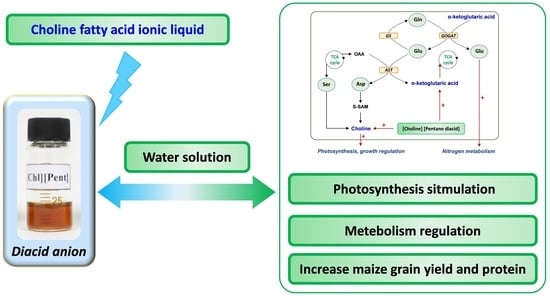
Open AccessArticle Choline Fatty Acid Ionic Liquids Enhance Growth, Nitrogen Metabolism, and Grain Guality in Maize ( Zea mays L.) 1 College of Agronomy, Northwest A & F University, Yangling 712100, China 2 College of Life Sciences, Northwest A & F University, Yangling 712100, China * Authors to whom correspondence should be addressed. † These authors equally contributed to this work. Molecules 2026, 31(12), 1998; https://doi.org/10.3390/molecules31121998 (registering DOI) Submission received: 30 April 2026 / Revised: 29 May 2026 / Accepted: 4 June 2026 / Published: 7 June 2026 Abstract Choline-based ionic liquids (ILs) have emerged as promising candidates for application in multifaceted avenues, including electrochemistry, biomaterials, and environmental remediation technologies. However, their regulatory effects on the growth of agricultural plants have rarely been discussed. In this study, 14 choline–fatty acid ILs ([Chl][FA] ILs) containing different FA anions were synthesized, and their effects on the maize growth were investigated. Hydroponic experiments revealed that low concentrations (20 mg/L) of dicarboxylic acid-based [Chl][FA] ILs (e.g., choline pentane diacid [Chl][Pent]) significantly promoted maize root and shoot biomass, whereas higher concentrations inhibited it. Specifically, [Chl][Pent] enhanced chlorophyll content without altering Fv/F 0, upregulated nitrate reductase (NR) and glutamine synthetase (GS) activities, and stimulated the expression of key nitrogen metabolism (NR and GS) and photosynthetic (Rubisco) genes. Pathway analyses of differentially expressed genes indicated that [Chl][Pent] was associated with the upregulation of nitrogen and glycerophospholipid metabolism. [Chl][Pent] increased the average grain yield by 6.88% over two years compared to CK. Field application of [Chl][Pent] increased grain yield and protein accumulation relative to both control and choline chloride treatments. Overall, these findings demonstrate the potential of dicarboxylic acid-based [Chl][FA] ionic liquids as eco-friendly biostimulants for enhancing crop growth, yield, and quality. Keywords: ionic liquids; nitrogen metabolism; transcriptomics; crop growth; pentane diacid Graphical Abstract 1. Introduction Choline-based ionic liquids ([Chl] ILs) constitute a class of designable functional compounds that have recently demonstrated considerable potential for application in diverse fields such as electrochemistry, biocatalysis, biomedicine, and environmental remediation technologies [ 1, 2, 3, 4]. However, their physiological impact on plants remains largely unexplored. In biological systems, choline derivatives are ubiquitous and play key roles in critical metabolic processes such as lipid metabolism [ 5]. Studies have confirmed that crop growth and development can be regulated in multiple ways via exogenous amendment of choline analogs. For instance, choline chloride, a common plant growth regulator, improves crop growth, enhances photosynthesis, and increases yield [ 6], while its derivative betaine functions as a key osmotic protectant under environmental stresses [ 7]. From a plant nutritional perspective, quaternary ammonium compounds, such as choline analogs, constitute an important class of organic nitrogen in the soil, serving as potential nitrogen sources for both plants and rhizosphere microorganisms [ 8]. We hypothesized that [Chl] ILs enhance maize growth by modulating nitrogen metabolism and photosynthetic activity. Choline–fatty acid ILs ([Chl][FA] ILs) are synthesized by pairing choline cations with various small-molecule FA anions. On a related note, FAs and their derivative anions have recently garnered growing interest in the design of ILs owing to their low production costs, favorable physicochemical properties, structural tunability, high biodegradability, and high environmental compatibility [ 9, 10, 11]. In biomedical applications, [Chl][FA] ILs are considerably advantageous for use as surfactants, demonstrating low toxicity and high efficiency [ 12]. When employed as drug delivery vehicles, they demonstrate both excellent biocompatibility and structural flexibility, facilitating the electrostatic adsorption of nano-drug particles, while FA hydrophobic chains form protective layers to not only prevent nanoparticle aggregation but also enhance membrane interactions for improved transmembrane diffusion [ 11, 13]. Some drug-active [Chl][FA] ILs can serve dual functions as carriers and therapeutic agents [ 14]. They also exhibit significant potential for application in functional food development, such as co-delivery of flavonoids or as novel naturally derived emulsifiers [ 15, 16]. Despite the well-researched and developed applications mentioned earlier, the growth regulation effects of [Chl][FA] ILs on agricultural crops remain largely unexplored—most existing studies focus primarily on agricultural biomass pretreatment [ 1, 17]. More specifically, in contrast to conventional pretreatment methods (e.g., acid/alkali treatment), [Chl][FA] ILs offer advantages such as reduced chemical pollution, lower energy consumption requirements during production, and higher extraction efficiency [ 18]. Other studies have examined the effects of these ILs on growth regulation or crop protection. For example, Choline ionic liquid based on 2,4-D exhibits better herbicidal efficacy than its commercial counterpart [ 19]. In tomato cultivation, the choline derivative choline benzothiadiazole (chol-BTH, synthesized from choline and the resistance inducer BTH) has demonstrated superior performance over BTH alone in inducing the expression of disease resistance genes (and thereby enhancing disease resistance) and activating antioxidant capacity [ 20]. This dual-action effect mirrors that observed in pharmaceutical applications; nevertheless, it remains underexplored in the context of agriculture. FAs are physiologically active substances abundantly present in nature that regulate critical plant metabolic processes, including energy metabolism and stress response [ 21, 22]. Specifically, certain short-chain dicarboxylic acids participate in the tricarboxylic acid (TCA) cycle, helping to maintain the metabolic balance of reactive oxygen species to promote crop growth and stress tolerance [ 23]. [Chl][FA] ILs exhibit unique cation–anion synergistic effects, offering novel opportunities for crop regulation. Specifically, in fatty acid-derived [Chl][FA] ILs, variations in anionic carbon chain length and carboxyl group number differentially modulate plant metabolic pathways; however, the underlying mechanisms remain unclear. To address this gap, we synthesized a series of 14 structurally tailored [Chl][FA] ILs and systematically evaluated their growth-regulatory effects in maize ( Zea mays L.). From this series of synthesized compounds, we selected choline pentane diacid as a representative IL for in-depth analysis of its impacts on seedling growth, physiological responses, gene expression patterns, and grain yield and quality parameters. Overall, this study provides mechanistic insights into the agricultural potential of [Chl][FA] ILs as novel biostimulants for the growth of maize crops. 2. Results 2.1. Effects of Different [Chl][FA] ILs on Maize Seedling Growth A total of 14 [Chl][FA] ILs were synthesized via a one-step neutralization method (as detailed in Table 1). Hydroponically grown maize seedlings were used to evaluate the effects of five representative [Chl][FA] ILs with relative medium alkyl chain lengths ([Chl][Pro], [Chl][But], [Chl][Suc], [Chl][Pent], and [Chl][Adi]) over a concentration gradient of 0–200 mg/L. The results demonstrated that at low concentrations (20 mg/L), three dicarboxylate-based [Chl][FA] ILs ([Chl][Suc], [Chl][Pent], and [Chl][Adi]) promoted seedling growth (measured in terms of root and shoot biomass). However, all five [Chl][FA] ILs exhibited inhibitory effects at higher concentrations (as detailed in Figure 1). 2.2. Effects of [Chl][Pent] on Photosynthesis and Nitrogen Metabolism 2.3. Transcriptomic DEGs Analyses and Metabolic Pathway Enrichment Comparative transcriptomic analyses were performed to characterize the differential gene expression patterns among the [Chl][Pent] vs. CK and [Chl][Pent] vs. [Chl]Cl treatment scenarios. A total of 345 and 168 DEGs were identified in the [Chl][Pent] vs. CK and [Chl][Pent] vs. [Chl]Cl comparisons, respectively ( Figure 5). The [Chl][Pent] vs. CK scenario comparison is detailed as follows. The 214 upregulated genes were primarily enriched during secondary metabolite biosynthesis, nitrogen metabolism, zeatin biosynthesis, and cutin biosynthesis. The 131 downregulated genes were primarily enriched during phenylpropanoid biosynthesis and secondary metabolite biosynthesis. The [Chl][Pent] vs. [Chl]Cl scenario comparison is detailed as follows. The 100 upregulated genes were primarily enriched during nitrogen metabolism, secondary metabolite biosynthesis, and the plant mitogen-activated protein kinase signaling pathway. The 68 downregulated genes were enriched during sphingolipid metabolism, linoleic acid metabolism, monoterpenoid biosynthesis, and diterpenoid biosynthesis. Furthermore, the observed upregulation of the zeatin biosynthesis and photosynthetic pigment synthesis pathways may contribute to growth enhancement and increased photosynthetic pigment content (as illustrated in Figure 6). 2.4. Grain Yield and Quality The two-year field trials demonstrated that the foliar application of both [Chl][Pent] and [Chl]Cl enhanced maize yield, with [Chl][Pent] treatment yielding superior effects compared to those achieved with [Chl]Cl treatment. The grain quality analyses revealed that [Chl][Pent] increased grain yield in 2024, with effects on grain yield and protein content showing variation across experimental conditions. However, [Chl]Cl had no significant effect on protein content (as detailed in Table 2). 3. Discussion Choline, an essential endogenous metabolite in plants, plays critical physiological roles in fatty acid metabolism, membrane stabilization, and stress resistance enhancement [ 6]. The amphiphilic nature of [Chl][FA] ILs significantly contributes to their plant growth-promoting effects, suggesting that the observed growth benefits may derive from synergistic actions of both choline and fatty acids [ 24]. Specifically, their high water solubility stimulates growth when they are applied via irrigation or foliar spraying. Additionally, FA moieties are strongly compatible with biological membranes, thereby enabling higher tissue permeability [ 13]. From a biosafety perspective, studies have demonstrated that choline-based ILs typically display low toxicity and high biodegradability, indicating favorable ecological safety. Moreover, choline compounds in soil are also one of the common organic nitrogen sources [ 18, 26]. In contrast, some common ILs (e.g., imidazolium- and pyridinium-based ILs) have been widely reported to pose significant biotoxicity [ 27]. The physiological measurements suggest that [Chl][Pent] enhanced photosynthesis and nitrogen metabolism in maize. The increased leaf photosynthetic pigment content was in agreement with the known functions of other choline analogs (e.g., choline chloride, glycine betaine) in stimulating thylakoid development [ 28, 29]. Stability in the Fv/F 0 ratio (a key indicator of PSII reaction center efficiency) indicates that [Chl][Pent] minimally influenced photochemical efficiency. The result suggests that [Chl][Pent] treatment may promote light-harvesting ability by increasing pigment content and Rubisco activity, rather than regulating PSII efficiency (Fv/F 0 value). This characteristic clearly distinguishes [Chl][Pent] from toxic agents, such as heavy metals, which typically impair the photosynthetic apparatus. [Chl][Pent] treatment upregulated key nitrogen metabolism enzymes (NR and GS), potentially through α-ketoglutarate-mediated regulation. As α-ketoglutarate participates in both the TCA cycle and amino acid assimilation pathways, the pentane diacid accumulation induced by [Chl][Pent] may enhance nitrogen metabolism by elevating α-ketoglutarate levels [ 21, 23, 30]. Transcriptomic analyses revealed the coordinated upregulation of glycerophospholipid metabolism pathways ( Figure 6), which is consistent with the established role of choline as a lipid metabolism intermediate [ 6, 23]. Overall, these findings are consistent with a potential involvement of nitrogen metabolic pathways in the growth-promoting effects of [Chl][Pent]. Field experiments showed that [Chl]Cl and [Chl][Pent] may increase grain yield to some extent, which is consistent with the documented role of choline compounds in promoting photosynthesis and nitrogen metabolism [ 28, 31]. The treatment concentration used in this study is relatively lower and is similar to that of conventional plant growth regulators such as [Chl]Cl, uniconazole and chlormequat chloride [ 32]. However, from the result of this study, unlike in [Chl]Cl, the presence of the glutarate anion in [Chl][Pent] adds distinct advantages for yield and grain quality improvement. Specifically, the [Chl][Pent] treatment significantly increased the protein content relative to both the control (CK) and [Chl]Cl treatments. This may be correlated with the upregulation of NR-mediated nitrogen assimilation and subsequent protein accumulation, as previously reported [ 30]. These suggest a potentially dual functional mechanism of [Chl][Pent], as part of which both the choline cation and glutarate anion contribute synergistically to plant growth regulation. For crops such as maize, increased grain protein content typically enhances both nutritional value and marketability. From this perspective, [Chl][Pent] holds distinct advantages over traditional plant growth regulators like [Chl]Cl. In this study, the synthesis procedure for [Chl][Pent] was relatively simple, and its low-concentration application requires minimal dosage, resulting in lower operational costs. These attributes benefit the potential application of [Chl][Pent] as a plant biostimulant in agricultural ecosystems. 4. Materials and Methods 4.1. Synthesis and Characterization of [Chl][FA] ILs 4.2. Hydroponic Maize Growth Experiments Maize cultivar Zhengdan 958 ( Zea mays L., purchased from Doneed Seeds Ltd., Beijing, China), a widely employed cultivar in China, was selected for this study. The seeds thereof were surface-sterilized with 75% ethanol and germinated on moist filter paper. Uniformly germinated seeds were transferred to hydroponic boxes (with dimensions of 20 × 13 × 10 cm; eight plants per box) containing 0.5 strength Hoagland nutrient solution (pH 6.0), which was replenished every 48 h. For preliminary concentration screening, five representative [Chl][FA] ILs were tested at concentrations of 0, 5, 10, 20, 40, 60, 80, 100, and 200 mg/L in the nutrient solution to evaluate their dose-dependent effects on seedling growth. The plants were cultivated for 14 days under controlled conditions (16/8 h light/dark cycles; 28 °C temperature; 8000 lx irradiance). After 14 days, six maize seedlings from each treatment group were taken for root and stem biomass data determination. Following the preliminary screening, choline pentane diacid ([Chl][Pent]), a representative IL with a dicarboxylate anion, was selected for further investigation. Two controls were included: (1) no additive (CK) and (2) Choline chloride ([Chl]Cl). Fresh leaf samples were collected to evaluate photosynthesis, nitrogen metabolism, and gene expression profiles (the number of biological replicates was all ≥4). The following analytical methods were employed. Photosynthetic pigments (chlorophylls and carotenoids) were extracted from fresh leaves using 80% acetone and quantified by a three-wavelength spectrophotometric method according to Lichtenthaler (1987) [ 31]. The chlorophyll fluorescence Fv/F 0 was measured using an FC 800-C/1010 imaging system (PSI, Drásov, Czech Republic). Nitrate reductase (NR) and glutamine synthetase (GS) activities were determined using commercial assay kits (Comin Biotechnology, Suzhou, China) following the manufacturer’s protocol. For transcriptomic profiling, total RNA was extracted from the leaves of the CK-, [Chl]Cl-, and [Chl][Pent]-treated plants (at a concentration of 20 mg/L) using the TRIzol reagent. The RNA quality was verified using a NanoDrop 2000 spectrophotometer [ 34]. Moreover, cDNA libraries were constructed and sequenced using the NovaSeq X Plus platform (Majorbio, Shanghai, China), and gene expression levels were quantified as transcripts per million (TPM). Differentially expressed genes (DEGs) were analyzed using edgeR, and significantly enriched metabolic pathways were identified using KOBAS ( http://bioinfo.org/kobas/. accessed on 10 April 2025). 4.3. Field Yield and Quality Analyses A two-year field trial (2023–2024) was conducted during the summer maize growing season (June–October) at the experimental farm of Northwest A&F University, Yangling, Shaanxi, China (34°16′ N, 108°04′ E). Maize was planted at 60,000 plants/ha in a randomized complete block design ( n = 3, plot size 3 × 7 m 2). Foliar applications were performed between 09:00–11:00 h under wind speed of 6.5 km/h and temperature of 19–27 °C, with 2023 and 2024 showing comparable weather patterns during application windows (total precipitation of 1164.6 mm in 2023 and 1069.7 mm in 2024; mean temperature of 9–20 °C in 2023 and 10–22 °C in 2024; source of data: https://www.tianqi24.com/yangling (accessed on 29 May 2026). Exogenous choline treatments with CK (water only), [Chl]Cl (100 mg/L), and [Chl][Pent] (100 mg/L) were applied at the early grain-filling stage (10 d after flowering) via foliar spraying. A spraying volume of 450 L/ha was adopted for each treatment. When the crops matured, whole cobs were harvested and air-dried at 25 °C to constant weight, followed by grain yield analysis. Grain quality parameters (i.e., protein, starch, and oil contents) were analyzed using near-infrared spectroscopy (DA7250 platform, Perten, Hägersten, Sweden) [ 35]. 4.4. Statistical Analyses Data are presented as means ± standard deviation (SD) from at least three independent biological replicates. Significant differences among treatments were assessed using one-way ANOVA, followed by Duncan’s multiple range test ( p < 0.05). 5. Conclusions This study synthesized and investigated the effects of 14 structurally distinct choline fatty acid ionic liquids on hydroponic maize seedling growth. The results showed that low concentration of [Chl][Pent] may promote the growth of maize. Treatment with [Chl][Pent] increased leaf photosynthetic pigment content and nitrogen metabolism enzyme activities. Gene expression profiling revealed that [Chl][Pent] up-regulated genes in growth-associated pathways, such as nitrogen metabolism and zeatin biosynthesis. The field validation results confirmed that foliar application of [Chl][Pent] may improve grain yield and protein content of maize to some extent. These findings show that [Chl][Pent] has translational value as a foliar treatment to enhance maize growth and grain quality under conventional agronomic practices. Supplementary Materials Author Contributions Conceptualization, Y.L. and X.C.; investigation, Q.G., W.C. and M.N.; data curation, S.Y., Y.M. and Q.C.; software, Y.H. and P.Z.; writing—original draft preparation, Y.L. and X.C.; project administration, Y.L. and X.C. All authors have read and agreed to the published version of the manuscript. Funding This study was supported by the National Natural Science Foundation of China (grant no. 32272047) and the National Key Research and Development Program (2021YFD1600602-05). Data Availability Statement The raw data supporting the conclusions of this article will be made available by the authors on request. Acknowledgments All participants in this study thank Doneed Seeds for providing maize seeds. Conflicts of Interest The authors declare no conflicts of interest. References Miao, S.; Atkin, R.; Warr, G. Design and applications of biocompatible choline amino acid ionic liquids. Green Chem. 2022, 24, 7281–7304. [] [ CrossRef] Tanner, E.E.L. Ionic liquids charge ahead. Nat. Chem. 2022, 14, 842. [] [ CrossRef] Gontrani, L. Choline-amino acid ionic liquids: Past and recent achievements about the structure and properties of these really “green” chemicals. Biophys. Rev. 2018, 10, 873–880. [] [ CrossRef] [ PubMed] Li, X.D.; Ma, N.N.; Zhang, L.J.; Ling, G.X.; Zhang, P. Applications of choline-based ionic liquids in drug delivery. Int. J. Pharm. 2022, 612, 121366. [] [ CrossRef] [ PubMed] Mobin, M.; Aslam, R.; Salim, R.; Kaya, S. An investigation on the synthesis, characterization and anti-corrosion properties of choline based ionic liquids as novel and environmentally friendly inhibitors for mild steel corrosion in 5% HCl. J. Colloid. Interface Sci. 2022, 620, 293–312. [] [ CrossRef] [ PubMed] Cui, L.; Wang, J.; Tang, Z.; Zhang, Z.; Yang, S.; Guo, F.; Li, X.; Meng, J.; Zhang, J.; Kuzyakov, Y.; et al. General and specialized metabolites in peanut roots regulate arbuscular mycorrhizal symbiosis. J. Integr. Agric. 2024, 23, 2618–2632. [] [ CrossRef] Bai, X.; Zeng, X.; Huang, S.Q.; Liang, J.S.; Dong, L.Y.; Wei, Y.N.; Li, Y.; Qu, J.J.; Wang, Z.H. Marginal impact of cropping BADH transgenic maize BZ-136 on chemical property, enzyme activity, and bacterial community diversity of rhizosphere soil. Plant Soil. 2019, 436, 527–541. [] [ CrossRef] Warren, C.R. Isotope pool dilution reveals rapid turnover of small quaternary ammonium compounds. Soil Biol. Biochem. 2019, 131, 90–99. [] [ CrossRef] Ali, M.K.; Moshikur, R.M.; Wakabayashi, R.; Tahara, Y.; Moniruzzaman, M.; Kamiya, N.; Goto, M. Synthesis and characterization of choline-fatty-acid-based ionic liquids: A new biocompatible surfactant. J. Colloid. Interface Sci. 2019, 551, 72–80. [] [ CrossRef] El Seoud, O.A.; Keppeler, N.; Malek, N.I.; Galgano, P.D. Ionic liquid-based surfactants: Recent advances in their syntheses, solution properties, and applications. Polymers 2021, 13, 1100. [] [ CrossRef] El Mohamad, M.; Han, Q.; Clulow, A.J.; Cao, C.; Safdar, A.; Stenzel, M.; Drummond, C.J.; Zhai, J.; Greaves, T.L. Regulating the structural polymorphism and protein corona composition of phytantriol-based lipid nanoparticles using choline ionic liquids. J. Colloid. Interface Sci. 2024, 657, 841–852. [] [ CrossRef] [ PubMed] Dutta, A.; Burrell, B.; Prajapati, E.; Cottle, S.; Maurer, H.Y.; Urban, M.J.; Pennock, S.R.; Muhamed, A.M.; Harris, J.; Flores, Y.; et al. Lipid bilayer permeabilities and antibiotic effects of tetramethylguanidinium and choline fatty acid ionic liquids. Biochim. Biophys. Acta-Biomembr. 2025, 1867, 184393. [] [ CrossRef] [ PubMed] Vashisth, P.; Smith, C.L.; Amarasekara, D.L.; Dasanyake, G.S.; Singh, G.; Chism, C.M.; Hamadani, C.M.; Shaikh, T.; Grovich, N.; Gamboa, B.; et al. Choline carboxylic acid ionic liquid-stabilized anisotropic gold nanoparticles for photothermal therapy. Acs Appl. Nano Mater. 2024, 7, 26332–26343. [] [ CrossRef] Xiao, T.; Li, B.; Lai, R.; Liu, Z.; Xiong, S.; Li, X.; Zeng, Y.; Jiao, S.; Tang, Y.; Lu, Y.; et al. Active pharmaceutical ingredient-ionic liquids assisted follicular co-delivery of ferulic acid and finasteride for enhancing targeted anti-alopecia. Int. J. Pharm. 2023, 648, 123624. [] [ CrossRef] Shimul, I.M.; Moshikur, R.M.; Nabila, F.H.; Moniruzzaman, M.; Goto, M. Formulation and characterization of choline oleate-based micelles for co-delivery of luteolin, naringenin, and quercetin. Food Chem. 2023, 429, 136911. [] [ CrossRef] Hijo, A.; Silva, E.K.; Cristianini, M.; Meirelles, A.J.A. High-intensity ultrasound assisted-emulsification using ionic liquids as novel naturally-derived emulsifiers for food industry applications. Innov. Food Sci. Emerg. Technol. 2023, 84, 103301. [] [ CrossRef] Montes, S.; Azcune, I.; Elorza, E.; Rekondo, A.; Grande, H.; Labidi, J. Fractionation of banana rachis using ionic liquids: Sustainability and selectivity of choline lactate. Ind. Crops Prod. 2022, 183, 114956. [] [ CrossRef] Wang, Y.T.; Chai, Y.; Zheng, X.P.; Du, Y.P.; Zhang, Y.C.; Zheng, Y.Z. Pretreatment of tea stem by biocompatible ionic liquids for enhanced enzymatic hydrolysis of cellulose and formation of UV-blocking chitosan film. Food Chem. 2025, 474, 143172. [] [ CrossRef] Marcinkowska, K.; Praczyk, T.; Gawlak, M.; Niemczak, M.; Pernak, J. Efficacy of herbicidal ionic liquids and choline salt based on 2,4-D. Crop Prot. 2017, 98, 85–93. [] [ CrossRef] Frackowiak, P.; Gawlik-Dziki, U.; Sanchez-Bel, P.; Obrepalska-Steplowska, A. The effect of benzo(1,2,3) -thiadiazole-7-carbothioic acid s-methyl ester (BTH) and its cholinium ionic liquid derivative on the resistance induction and antioxidant properties of tomato ( Solanum lycopersicum L.). J. Agric. Food Chem. 2023, 71, 12958–12974. [] [ CrossRef] Yele, Y.; Dhillon, M.K.; Tanwar, A.K.; Kumar, S. Amino and fatty acids contributing to antibiosis against Chilo partellus (Swinhoe) in maize. Arthropod-Plant Interact. 2021, 15, 721–736. [] [ CrossRef] Yang, D.-S.; Zhang, J.; Li, M.-x.; Shi, L.-x. Metabolomics analysis reveals the salt-tolerant mechanism in Glycine soja. J. Plant Growth Regul. 2017, 36, 460–471. [] [ CrossRef] Liu, Y.; Yao, Y.; Yang, Y.; Shi, G.; Ding, F.; Liu, G.; Zhang, S.; Xie, J.; Yu, Z.; Li, S. Small molecular organic acid potassium promotes rice ( Oryza sativa L.) photosynthesis by regulating CBC and TCA cycle. Plant Growth Regul. 2023, 101, 569–584. [] [ CrossRef] Hamani, A.K.M.; Li, S.; Chen, J.; Amin, A.S.; Wang, G.; Shen, X.; Zain, M.; Gao, Y. Linking exogenous foliar application of glycine betaine and stomatal characteristics with salinity stress tolerance in cotton ( Gossypium hirsutum L.) seedlings. BMC Plant Biol. 2021, 21, 146. [] [ CrossRef] Zhang, L.; Li, X.; Zuo, W.; Li, S.; Sun, G.; Wang, W.; Yu, Y.; Huang, H. Root exuded low-molecular-weight organic acids affected the phenanthrene degrader differently: A multi-omics study. J. Hazard. Mater. 2021, 414, 125367. [] [ CrossRef] Lisiecka, N.; Parus, A.; Verkhovetska, V.; Zembrzuska, J.; Simpson, M.; Framski, G.; Niemczak, M.; Baranowski, D.; Cajthaml, T.; Chrzanowski, L. Effect of cation hydrophobicity in dicamba-based ionic liquids on herbicide accumulation and bioavailability in soil. J. Environ. Chem. Eng. 2023, 11, 111008. [] [ CrossRef] Liu, H.; Zhang, S.; Zhang, X.; Chen, C. Growth inhibition and effect on photosystem by three imidazolium chloride ionic liquids in rice seedlings. J. Hazard. Mater. 2015, 286, 440–448. [] [ CrossRef] [ PubMed] Zhao, H.; Tan, J.; Qi, C. Photosynthesis of Rehmannia glutinosa subjected to drought stress is enhanced by choline chloride through alleviating lipid peroxidation and increasing proline accumulation. Plant Growth Regul. 2007, 51, 255–262. [] [ CrossRef] Fortunato, S.; Nigro, D.; Lasorella, C.; Marcotuli, I.; Gadaleta, A.; de Pinto, M.C. The role of glutamine synthetase (GS) and glutamate synthase (GOGAT) in the improvement of nitrogen use efficiency in cereals. Biomolecules 2023, 13, 12. [] [ CrossRef] Pierzynowski, S.; Pierzynowska, K. Alpha-ketoglutarate, a key molecule involved in nitrogen circulation in both animals and plants, in the context of human gut microbiota and protein metabolism. Adv. Med. Sci. 2022, 67, 142–147. [] [ CrossRef] Lichtenthaler, H.K. [34] Chlorophylls and carotenoids: Pigments of photosynthetic biomembranes. Methods Enzymol. 1987, 148, 350–382. [] Ahmad, I.; Kamran, M.; Ali, S.; Bilegjargal, B.; Cai, T.; Ahmad, S.; Meng, X.; Su, W.; Liu, T.; Han, Q. Uniconazole application strategies to improve lignin biosynthesis, lodging resistance and production of maize in semiarid regions. Field Crops Res. 2018, 222, 66–77. [] [ CrossRef] Panda, S.; Gardas, R.L.; Deenadayalu, N. Evaluating the solute-solvent interactions of glycine in aqueous solution of choline based ionic liquids through volumetric properties at T=(293.15 to 313.15K). J. Mol. Liq. 2019, 289, 111087. [] [ CrossRef] Wang, C.; Hou, X.; Qi, N.; Li, C.; Luo, Y.; Hu, D.; Li, Y.; Liao, W. An optimized method to obtain high-quality RNA from different tissues in Lilium davidii var. unicolor. Sci. Rep. 2022, 12, 2825. [] [ CrossRef] Peiris, K.H.S.; Bean, S.R.; Wu, X.; Sexton-Bowser, S.A.; Tesso, T. Performance of a handheld microNIR instrument for determining protein levels in sorghum grain samples. Foods 2023, 12, 3101. [] [ CrossRef] Liu, Q.P.; Hou, X.D.; Li, N.; Zong, M.H. Ionic liquids from renewable biomaterials: Synthesis, characterization and application in the pretreatment of biomass. Green Chem. 2012, 14, 304–307. [] [ CrossRef] Moriel, P.; Garcia-Suarez, E.J.; Martinez, M.; Garcia, A.B.; Montes-Moran, M.A.; Calvino-Casilda, V.; Banares, M.A. Synthesis, characterization, and catalytic activity of ionic liquids based on biosources. Tetrahedron Lett. 2010, 51, 4877–4881. [] [ CrossRef] Figure 1. Effects of five [Chl][FA] ILs on maize seedling growth at different concentrations. ( A, B) represent the biomass of the shoots and roots of maize seedlings (a–d represent significant differences across treatments). Figure 1. Effects of five [Chl][FA] ILs on maize seedling growth at different concentrations. ( A, B) represent the biomass of the shoots and roots of maize seedlings (a–d represent significant differences across treatments). Figure 2. Effects of 14 [Chl][FA] ILs (20 mg/L) on root and shoot dry weight (DW) of maize seedlings. ( A, B) represent the biomass of the shoots and roots of maize seedlings (“*” indicates treatments with values significantly higher than CK at p < 0.01). Figure 2. Effects of 14 [Chl][FA] ILs (20 mg/L) on root and shoot dry weight (DW) of maize seedlings. ( A, B) represent the biomass of the shoots and roots of maize seedlings (“*” indicates treatments with values significantly higher than CK at p < 0.01). Figure 3. Morphological effects of [Chl][Pent] ILs (20 mg/L) on maize seedling growth. Figure 3. Morphological effects of [Chl][Pent] ILs (20 mg/L) on maize seedling growth. Figure 4. Effects of [Chl][Pent] on leaf photosynthesis pigment contents ( A), photosynthetic Fv/F 0 value ( B), Rubisco gene expression levels ( E), NR and GS activities ( C, D) and gene expression levels ( G, H), and ZOG gene expression levels ( F) (NR: nitrate reductase; GS: glutamine synthetase; ZOG: cis-zeatin O-glucosyltransferase; TPM: transcripts per million reads) (a–c represent significant differences across treatments). Figure 4. Effects of [Chl][Pent] on leaf photosynthesis pigment contents ( A), photosynthetic Fv/F 0 value ( B), Rubisco gene expression levels ( E), NR and GS activities ( C, D) and gene expression levels ( G, H), and ZOG gene expression levels ( F) (NR: nitrate reductase; GS: glutamine synthetase; ZOG: cis-zeatin O-glucosyltransferase; TPM: transcripts per million reads) (a–c represent significant differences across treatments). Figure 5. Number of DEGs between [Chl][Pent] and CK, and between [Chl][Pent] and [Chl]Cl. Figure 5. Number of DEGs between [Chl][Pent] and CK, and between [Chl][Pent] and [Chl]Cl. Figure 6. Comparative metabolic pathway enrichment analyses of differentially expressed genes in [Chl][Pent] vs. CK ( A– C) and [Chl][Pent] vs. [Chl]Cl ( D– F) treatments. Panels display significantly enriched metabolic pathways for upregulated ( B, E) and downregulated ( C, F) genes in each comparison. Figure 6. Comparative metabolic pathway enrichment analyses of differentially expressed genes in [Chl][Pent] vs. CK ( A– C) and [Chl][Pent] vs. [Chl]Cl ( D– F) treatments. Panels display significantly enriched metabolic pathways for upregulated ( B, E) and downregulated ( C, F) genes in each comparison. Table 1. Synthesized 14 [Chl][FA] ILs and their structures. Table 1. Synthesized 14 [Chl][FA] ILs and their structures. Monoacid Anions Diacid Anions Alkyl Chain Ionic Liquid Name Abbreviation Alkyl Chain Ionic Liquid Name Abbreviation C2 Choline acetic acid [Chl][Ace] C2 Choline oxalic acid [Chl][Oxa] C3 Choline propionic acid [Chl][Pro] C3 Choline propane diacid [Chl][Prop] C4 Choline butyric acid [Chl][But] C4 Choline succinic acid [Chl][Suc] C5 Choline pentanoic acid [Chl][Pen] C5 Choline pentane diacid [Chl][Pent] C6 Choline hexanoic acid [Chl][Hex] C6 Choline adipic acid [Chl][Adi] C7 Choline heptoic acid [Chl][Hep] C7 Choline heptane diacid [Chl][Hept] C8 Choline octanoic acid [Chl][Oct] C8 Choline suberic acid [Chl][Sub] Table 2. Effects of [Chl][Pent] on maize yield and quality. Table 2. Effects of [Chl][Pent] on maize yield and quality. Year Treatment Grain Yield (g/Plant) Starch (%) Protein (%) Oleaginousness (%) 2023 CK 123.1 ± 3.2 b 75.00 ± 0.94 a 9.62 ± 0.22 ab 5.02 ± 0.46 a [Chl]Cl 128.6 ± 2.8 a 75.85 ± 0.34 a 9.49 ± 0.14 b 5.12 ± 0.16 a [Chl][Pent] 131.4 ± 2.3 a 74.83 ± 0.90 a 9.87 ± 0.23 a 4.98 ± 0.50 a 2024 CK 133.8 ± 3.3 c 76.29 ± 0.90 a 8.66 ± 0.26 b 4.52 ± 0.43 a [Chl]Cl 138.4 ± 2.1 b 76.45 ± 0.60 a 8.64 ± 0.27 b 4.61 ± 0.24 a [Chl][Pent] 143.2 ± 2.4 a 75.58 ± 0.58 a 9.03 ± 0.19 a 4.87 ± 0.13 a Note: Different letters indicate significant differences within the same year ( p < 0.05). Disclaimer/Publisher’s Note: The statements, opinions and data contained in all publications are solely those of the individual author(s) and contributor(s) and not of MDPI and/or the editor(s). MDPI and/or the editor(s) disclaim responsibility for any injury to people or property resulting from any ideas, methods, instructions or products referred to in the content. © 2026 by the authors. Licensee MDPI, Basel, Switzerland. This article is an open access article distributed under the terms and conditions of the Creative Commons Attribution (CC BY) license. Share and Cite MDPI and ACS Style Guo, Q.; Chen, W.; Niu, M.; Yang, S.; Huang, Y.; Zhang, P.; Ma, Y.; Cai, Q.; Li, Y.; Chen, X. Choline Fatty Acid Ionic Liquids Enhance Growth, Nitrogen Metabolism, and Grain Guality in Maize ( Zea mays L.). Molecules 2026, 31, 1998. https://doi.org/10.3390/molecules31121998 AMA Style Guo Q, Chen W, Niu M, Yang S, Huang Y, Zhang P, Ma Y, Cai Q, Li Y, Chen X. Choline Fatty Acid Ionic Liquids Enhance Growth, Nitrogen Metabolism, and Grain Guality in Maize ( Zea mays L.). Molecules. 2026; 31(12):1998. https://doi.org/10.3390/molecules31121998 Chicago/Turabian Style Guo, Qiuchen, Wenquan Chen, Mengfei Niu, Shixu Yang, Yanan Huang, Pei Zhang, Yulong Ma, Qingru Cai, Yajun Li, and Xiaohong Chen. 2026. "Choline Fatty Acid Ionic Liquids Enhance Growth, Nitrogen Metabolism, and Grain Guality in Maize ( Zea mays L.)" Molecules 31, no. 12: 1998. https://doi.org/10.3390/molecules31121998 APA Style Guo, Q., Chen, W., Niu, M., Yang, S., Huang, Y., Zhang, P., Ma, Y., Cai, Q., Li, Y., & Chen, X. (2026). Choline Fatty Acid Ionic Liquids Enhance Growth, Nitrogen Metabolism, and Grain Guality in Maize ( Zea mays L.). Molecules, 31(12), 1998. https://doi.org/10.3390/molecules31121998 Article Metrics Article metric data becomes available approximately 24 hours after publication online.
Choline Fatty Acid Ionic Liquids Enhance Growth, Nitrogen Metabolism, and Grain Guality in Maize (Zea mays L.)