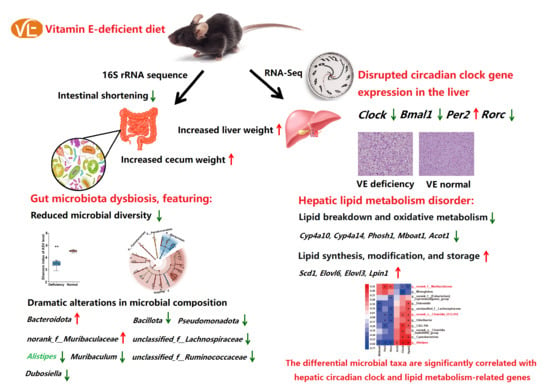
1. Introduction Circadian rhythm is the internal timing system that is present in all organisms and is driven by a transcription translation feedback loop which consists of the brain-and-muscle arnt-like protein 1 ( Bmal1) gene and the circadian locomotor output cycle kaput ( clock) gene [ 1]. Disruption of circadian clock function is closely associated with various diseases, including metabolic and gastrointestinal disorders [ 2], which are frequently accompanied by gut microbiota dysbiosis [ 3, 4, 5, 6]. A bidirectional interaction exists between the host circadian clock and the gut microbiota. Circadian rhythm disturbances can significantly alter the diurnal oscillations of the gut microbiota [ 7]. Conversely, germ-free or antibiotic-treated mice exhibit disruptions in both peripheral and intestinal circadian rhythms, along with a loss of rhythmicity in metabolic outputs [ 8, 9]. Supplementation with microbial metabolites, such as short-chain fatty acids (SCFAs), can in turn modulate the expression of core clock genes [ 10, 11]. To help close the knowledge gap, this study aimed to investigate the effects of short-term α-TE deficiency and high-dose α-TE supplementation on hepatic metabolism and gut microbiota in healthy adult mice, with a focus on the gut microbiota–liver axis. This study is expected to add new understanding regarding how α-TE may influence metabolic health, as well as offering possible theoretical grounding into nutritional approaches to synchronically affect biological clocks and gut microecology in the pursuit of maintaining metabolic homeostasis. 2.1. Design of Animal Experiments Thirty-two 5-week-old male C57BL/6J mice were bought from Beijing Vital River Laboratory Animal Technology Co., Ltd (Beijing, China). All of the mice were placed in a room controlled at 24 ± 1 °C with a light and dark cycle of 12 h and were freely provided with food and water. After a 7-day adaptation period with a standard α-TE-normal purified diet, mice were placed in three groups based on their fasting body weight: a α-TE-deficient diet group (Deficiency, n = 8), a α-TE-normal diet group (Normal, n = 12), and a α-TE-supplementation diet group (Supplement, four times the normal α-TE level, n = 12). Mice with abnormal body weights were excluded to ensure no significant difference in the initial average body weight among groups (one-way ANOVA with LSD post hoc test, p 1 and padjust 2.0, p 2.0) analysis, displaying taxonomic hierarchy from phylum to genus. Data are presented as mean ± SD. Statistical significance was determined by one-way ANOVA followed by post-hoc tests (Dunn’s t test). * indicates a significant difference between the Normal and Deficiency groups; # indicates a significant difference between the Supplement and Normal groups. **, p 2.0) analysis, displaying taxonomic hierarchy from phylum to genus. Data are presented as mean ± SD. Statistical significance was determined by one-way ANOVA followed by post-hoc tests (Dunn’s t test). * indicates a significant difference between the Normal and Deficiency groups; # indicates a significant difference between the Supplement and Normal groups. **, p < 0.01; ##, p < 0.01. Figure 6. Cecal microbial taxa in mice significantly influenced by α-TE-deficient and supplemented diets (phylum and genus levels). ( A, B) Differentially abundant taxa at the phylum level; ( C– E) differentially abundant taxa at the genus level. Data are expressed as mean ± SD. Statistical significance was determined using the Kruskal–Wallis H test followed by Dunn’s post hoc test. * p < 0.05, ** p < 0.01, *** p < 0.001 for the Deficiency group vs. the Normal group; # p < 0.05, ## p < 0.01, ### p < 0.001 for the Supplement group vs. the Normal group. Figure 6. Cecal microbial taxa in mice significantly influenced by α-TE-deficient and supplemented diets (phylum and genus levels). ( A, B) Differentially abundant taxa at the phylum level; ( C– E) differentially abundant taxa at the genus level. Data are expressed as mean ± SD. Statistical significance was determined using the Kruskal–Wallis H test followed by Dunn’s post hoc test. * p < 0.05, ** p < 0.01, *** p < 0.001 for the Deficiency group vs. the Normal group; # p < 0.05, ## p < 0.01, ### p < 0.001 for the Supplement group vs. the Normal group. Figure 7. Heatmaps depicting correlations between specific gut bacterial genera and key hepatic circadian clock and lipid metabolism genes. ( A) Gut bacteria versus core hepatic circadian clock genes. ( B) Gut bacteria versus core genes involved in lipid synthesis, modification, and storage. ( C) Gut bacteria vs. core genes for lipid catabolism and oxidation. Correlation was done using Spearman’s rank correlation ( n = 6 per group). Color intensity corresponds to the r value. The p values have been adjusted with the Bonferroni–Hochberg method. * indicates significance ( p < 0.05). Figure 7. Heatmaps depicting correlations between specific gut bacterial genera and key hepatic circadian clock and lipid metabolism genes. ( A) Gut bacteria versus core hepatic circadian clock genes. ( B) Gut bacteria versus core genes involved in lipid synthesis, modification, and storage. ( C) Gut bacteria vs. core genes for lipid catabolism and oxidation. Correlation was done using Spearman’s rank correlation ( n = 6 per group). Color intensity corresponds to the r value. The p values have been adjusted with the Bonferroni–Hochberg method. * indicates significance ( p < 0.05).
Dietary α-Tocopherol Deficiency Disrupts Hepatic Circadian Clock and Lipid Metabolism in Association with Gut Microbiota Dysbiosis