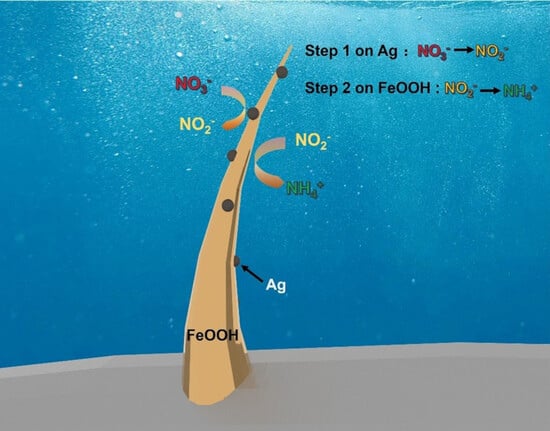
Abstract In nitrate electrochemical reduction reaction (NO 3RR), competing side reactions like hydrogen evolution often lead to poor selectivity and subpar kinetics, limiting practical use. Herein, using iron oxyhydroxide nanoarrays grown on a titanium mesh as the substrate, silver nanoparticles were introduced onto the tips of the iron oxyhydroxide nanowires via electrochemical deposition, thereby forming an Ag/FeOOH heterojunction electrocatalyst. At −0.85 V, Ag/FeOOH demonstrates excellent performance, with 97.56% ammonium selectivity, 92.45% nitrate conversion rate, and an ammonium yield of 3.21 mg h −1 cm −2. Furthermore, the Zn-NO 3− battery exhibited a power density of 1.28 mW cm −2. Ag/FeOOH’s structure enhances interfacial nitrate adsorption and reduces NO 3RR energy barriers, accelerating reaction kinetics. It promotes NO 3−-to-NO 2− conversion via dual-site synergy, boosting NH 4+ yield and advancing electrocatalyst design. 1. Introduction Ammonia (NH 3), as a vital chemical, finds extensive and indispensable applications across various industries, including agriculture, fertilizers, textiles, refrigeration, pharmaceuticals, and explosives [ 1, 2, 3]. However, current industrial-scale ammonia production primarily relies on the energy-intensive Haber–Bosch process [ 4, 5]. Concurrently, the issue of nitrate pollution in water bodies is becoming increasingly severe [ 6, 7]. Given the high solubility of nitrate ions (NO 3−) and the moderate dissociation energy (204 kJ mol −1) of the N=O bond in their molecular structure, the production of ammonia through the electrochemical nitrate reduction reaction (NO 3RR) has emerged as a highly promising alternative pathway. This approach not only effectively mitigates nitrate pollution but also simultaneously generates valuable ammonia [ 8, 9]. Despite its immense application potential, NO 3RR still faces a fundamental challenge in practical applications. Specifically, competitive side reactions such as the hydrogen evolution reaction (HER) and the formation of nitrite ions (NO 2−) occur during the NO 3RR process. The presence of these side reactions often leads to suboptimal selectivity and kinetic performance of NO 3RR [ 10]. Therefore, developing effective strategies to precisely regulate the local electronic environment at the active sites of catalysts, thereby synergistically enhancing catalytic activity, holds crucial significance for achieving high-performance NO 3RR. The interaction between a metal and its support plays a pivotal role in regulating catalytic performance by modulating the electronic structure, geometric environment, and adsorption properties of active sites, thereby guiding the reaction pathway [ 11, 12]. Introducing new catalytically active sites can create synergistic effects. For instance, anchoring metal atoms onto the surface of oxides or carbon materials enables atomic-level efficient utilization and introduces novel catalytically active sites [ 13, 14, 15]. These operations not only construct synergistic effects through strategies such as spatial separation and electronic modulation to enhance catalytic performance but also improve the corrosion resistance and cycle life of catalytic electrodes under harsh reaction conditions (e.g., high acidity and high potential) by regulating the surface structure, composition, and electronic properties of the catalysts. For example, Zhang et al. [ 16] incorporated Ta into RuO 2, significantly suppressing Ru dissolution while enhancing the activity of the oxygen evolution reaction (OER). The introduction of Ta stabilized the surface structure of RuO 2, reduced the corrosion rate, and rendered its stability in industrial water electrolysis close to that of IrO 2, with an overpotential reduction of 330 mV and a lifespan exceeding 2800 h. Gao et al. [ 17] constructed a rare-earth oxide (e.g., La 2O 3) coating on the surface of a Pt/γ-Mo 2N catalyst, effectively isolating the active sites from the corrosive environment and enabling the catalyst to achieve a lifespan exceeding 1000 h and a turnover number (TON) exceeding 15 million in methanol–water reforming for hydrogen production. In this work, a facile electrochemical reduction method was employed to successfully introduce Ag nanoparticles onto the surface of FeOOH. Experimental results demonstrate that this composite material exhibits outstanding performance in both the electrocatalytic NO 3− reduction system and the Zn-NO 3− battery system. FeOOH with introduced Ag nanoparticles offers significant advantages: Firstly, the introduced Ag catalytically active sites can accelerate the conversion rate of NO 3− to NO 2− while synergistically cooperating with the conversion process of NO 2− to NH 4+ on FeOOH, thereby comprehensively enhancing the efficiency of the electrocatalytic NO 3RR (nitrate reduction reaction) of the catalytic material. Secondly, based on mixed electrolytes with different feed ratios of NO 3− and NO 2−, by leveraging the differences in the conversion efficiencies of NO 3− and NO 2− at the dual active sites of Ag and FeOOH, the electrocatalytic NO 3RR process can be coordinated and optimized, ultimately achieving a superior ammonium yield. In conclusion, the Ag-FeOOH designed through the method of introducing active sites provides a novel approach for the design of electrocatalytic NO 3− reduction catalysts. Moreover, the carefully designed metal interface modification and passivation treatment can induce an asymmetric charge distribution, facilitating electron transfer from Ag to FeOOH, accelerating the electron transfer process, and increasing ammonia production. This study focuses on the interface modification of metal particles and establishes the mutual synergy between metals and supports as a key principle for designing catalytic electric fields, significantly advancing the field of sustainable electrocatalysis for the nitrogen cycle. 2.1. Characterization of Catalysts To gain insights into the electronic structure of the materials, we conducted X-ray photoelectron spectroscopy (XPS) tests on Ag, FeOOH, and Ag-FeOOH, as illustrated in Figure 2a–c. For Ag-FeOOH, the diffraction peak at a binding energy of 731.1 eV in the Fe 2p spectrum corresponds to Fe 2p 3/ 2, whereas for FeOOH, the binding energy corresponding to Fe 2p 3/ 2 is 731.6 eV. Additionally, in the Ag 3d spectrum of Ag-FeOOH, the binding energy of the Ag 3d 5/ 2 diffraction peak is 368.5 eV, while for pure Ag, it is 368.1 eV. By comparing the Fe 2p 3/ 2 binding energies of Ag-FeOOH and FeOOH, we observed a negative shift in the binding energy of Fe 2p 3/ 2 after the introduction of Ag sites. Similarly, by comparing the Ag 3d 5/ 2 binding energies of Ag-FeOOH and pure Ag, we found a positive shift in the binding energy of Ag 3d 5/ 2 for Ag introduced onto the FeOOH surface. This indicates that the Ag introduced via electrochemical reduction on the FeOOH surface alters its original electronic structure. Specifically, electrons flow from FeOOH to Ag. The strong interaction between Fe and Ag modifies the electronic structure of the metal centers, thereby influencing the electrocatalytic activity of Ag-FeOOH. Furthermore, as shown in Figure 2e, the contact angles of Ti, Ag, FeOOH, and Ag-FeOOH are not identical. Ti and Ag are non-hydrophilic, whereas FeOOH is a hydrophilic material. Notably, the material obtained by introducing Ag onto the FeOOH surface via electrochemical reduction remains hydrophilic [ 19]. In studies on electrocatalytic nitrate reduction to ammonium, it has been found that the hydrophilicity of materials facilitates electrolyte transport and enhances the electrocatalytic rate. As depicted in Figure 2d, we performed X-ray diffraction (XRD) tests and analysis on the synthesized Ag-FeOOH. The results revealed diffraction peaks corresponding to both FeOOH and Ag, confirming the successful synthesis of our material. 2.2. NO 3RR Performance To evaluate the impact of introducing Ag nanoparticles via electrochemical reduction on the electrocatalytic activity of FeOOH, we utilized a single-chamber electrolytic cell to assess the nitrogen reduction reaction (NO 3RR) activity of the catalysts. Initially, the double-layer capacitance (Cdl) and electrochemically active surface area (ECSA) of Ag, FeOOH, and Ag-FeOOH were evaluated through cyclic voltammetry curves obtained at different scan rates. As illustrated in Figure 3, the Cdl of Ag-FeOOH is 16.80 mF cm −2, which is higher than that of Ag (13.60 mF cm −2) and FeOOH (8.96 mF cm −2). Consequently, the ECSA of Ag-FeOOH is greater than that of both Ag and FeOOH, initially indicating that Ag-FeOOH possesses superior NO 3RR performance. Subsequently, to preliminarily investigate the current response of the catalysts to the nitrate reduction reaction (NO 3RR), linear sweep voltammetry (LSV) curves were measured for Ag, FeOOH, and Ag-FeOOH in solutions with and without the NO 3−-N electrolyte, as well as for Ag-FeOOH in a NO 3−-N-free electrolyte. As shown in Figure 4a, in the electrolyte solution containing NO 3−-N, Ag-FeOOH exhibited a stronger current response compared to both Ag and FeOOH, indicating that the Ag-FeOOH catalyst has a more pronounced response to NO 3RR. Specifically, LSV tests were conducted for Ag, FeOOH, and Ag-FeOOH in an NO 3−-free electrolyte (0 ppm). The results show that under NO 3−-free conditions, the current responses of all three catalysts are significantly lower than those in NO 3−-containing electrolytes. Moreover, the current increment of Ag-FeOOH upon introducing NO 3− is markedly larger than that of Ag and FeOOH, indicating that the enhanced current is primarily attributable to NO 3RR rather than HER. Additionally, the contribution from NO 2− to the total current was found to be negligible, further ruling out significant interference from intermediate product reduction. Furthermore, it is evident from the LSV curves that the current begins to deviate at −0.7 V vs. RHE, and this deviation becomes more pronounced with increasingly negative potential. This suggests that the catalyst starts to respond to the electrocatalytic reduction of NO 3− at this potential. Therefore, we selected the voltage range of −0.7 V to −0.9 V vs. RHE as the window for subsequent performance tests. As depicted in Figure 4b,c, from −0.7 V vs. RHE to −0.9 V vs. RHE, the removal rate of NO 3− and the ammonium yield gradually increased, reaching a peak at −0.85 V vs. RHE. At this potential, the NO 3− removal rate, ammonium selectivity, Faradaic efficiency, and ammonium yield were 92.45%, 97.56%, 89.58%, and 3.21 mg h −1 cm −2, respectively. Subsequently, the changes in the concentrations of NO 3−-N, NO 2−-N, and NH 4+-N over time were evaluated, with the curves presented in Figure 4d. When the voltage was held constant at −0.85 V vs. RHE, NO 3−-N rapidly decreased while NH 4+-N rapidly increased, demonstrating the rapid conversion of nitrate to ammonium [ 20]. Meanwhile, the concentration of the NO 2−-N intermediate product initially rose and then declined during the reaction, with its concentration being almost negligible, indicating the excellent ammonium selectivity of the material. We conducted performance tests over 10 cycles on the same catalyst, as shown in Figure 4e. The results demonstrated that after multiple cycles of testing, the conversion rate of nitrate, ammonium selectivity, and ammonium yield did not exhibit significant degradation, confirming the excellent stability of the catalyst. To investigate the performance of the catalytic material Ag-FeOOH under varying initial concentrations of NO 3−-N, we conducted electrolysis experiments at gradient potentials with initial concentrations of 50 ppm, 70 ppm, and 100 ppm, respectively. As illustrated in Figure 5, at an initial NO 3−-N concentration of 50 ppm, the removal rate and selectivity of NO 3− by the Ag-FeOOH catalyst increased with rising potential, while the Faradaic efficiency exhibited a volcanic distribution, reaching its optimal overall performance at −0.84 V vs. RHE, with values of 87.61%, 92.56%, and 52.33% for removal rate, selectivity, and Faradaic efficiency, respectively. At an initial concentration of 70 ppm NO 3−-N, the removal rate and selectivity of NO 3− also increased with the potential, but after reaching the optimal potential of −0.75 V vs. RHE, the Faradaic efficiency declined, showing a volcanic distribution and achieving its best overall performance at −0.85 V vs. RHE, with values of 80.11%, 95.32%, and 65.13%, respectively. At an initial concentration of 100 ppm NO 3−-N, the removal rate and selectivity of NO 3− continued to increase with the potential, and after reaching the optimal potential of −0.85 V vs. RHE, the Faradaic efficiency also displayed a volcanic distribution, attaining its peak performance at the same potential, with values of 92.45%, 97.56%, and 89.58% (data adopted from Figure 5), respectively. The results indicate that the catalytic material Ag-FeOOH demonstrates excellent removal rates of NO 3− across various initial concentrations. Moreover, it exhibits superior selectivity and Faradaic efficiency at higher initial concentrations of NO 3−-N, suggesting that the reaction kinetics in the electrocatalytic NO 3RR process can be enhanced by appropriately increasing the initial concentration of the reactant. In summary, the catalytic material Ag-FeOOH showcases outstanding catalytic performance across a wide range of initial concentrations. The source of ammonium was verified through blank control experiments and 15N isotope labeling experiments, while the ammonium yield was quantitatively analyzed using ultraviolet spectrophotometry and 1H nuclear magnetic resonance ( 1H NMR) spectroscopy [ 21]. As shown in Figure 6, the 1H NMR spectra from our isotope labeling experiments revealed that similar ammonium yields were obtained regardless of whether Na 14NO 3 or Na 15NO 3 was used as the nitrogen source. Furthermore, after conducting electrolysis experiments with Na 14NO 3 and Na 15NO 3, the electrolytes were subjected to 1H NMR testing. For more precise tracing, 1H NMR technology with 15N labeling was employed for analysis. In the 1H NMR spectra of standard electrolytes containing 14NH 4Cl and 15NH 4Cl, the 14NH 4+ ion exhibited a triplet peak at δ = 7.14, 7.05, and 6.96 ppm, whereas the 15NH 4+ ion displayed only a doublet peak at δ = 6.98 and 7.10 ppm. This further confirmed that the ammonium ions were produced through the electrocatalytic reduction of nitrate. The study further quantified the NH 4+ concentration using an external standard method ( Figure 5d) and compared the results with those obtained by colorimetry, thereby validating the accuracy of the data [ 22]. 2.3. Mechanism Analysis To investigate the role and mechanism of Ag nanoparticles introduced via electrochemical reduction on the FeOOH surface in the electrocatalytic NO 3RR process, we designed mixed-feed experiments involving NO 3− and NO 2−. We observed the linear sweep voltammetry (LSV) curves of Ag, FeOOH, and Ag-FeOOH under different mixed-feed ratios of NO 3− and NO 2− [ 23]. As illustrated in Figure 7a–c, the current responses of Ag varied under different ratios. Interestingly, as the NO 3− content increased, the current response of the electrode gradually enhanced. Similarly, FeOOH exhibited different current responses under varying ratios, with its current response gradually increasing as the NO 2− content rose. In contrast, Ag-FeOOH displayed irregular current responses under different feed ratios, with the mixed-feed ratio of 70:30 (NO 3− to NO 2−) demonstrating the best current response. The optimal NO 3−:NO 2− ratio of 70:30 likely arises from a balance between the two parallel reaction pathways. Although the two sites operate independently in terms of catalytic mechanism, the overall current response is still governed by the substrate availability at each site, which is concentration-dependent. Consequently, we proposed the hypothesis of dual catalytically active sites. Subsequently, electrolysis experiments were conducted on Ag, FeOOH, and Ag-FeOOH in electrolytes with varying feed ratios at −0.85 V vs. RHE. As depicted in Figure 8a, the conversion rates of NO 3− for the three different catalytic materials increased with the rising percentage of NO 3−, which aligns with kinetic theory. The results also revealed that FeOOH exhibited significantly lower NO 3− conversion capabilities compared to Ag and Ag-FeOOH, suggesting that NO 3− undergoes rapid conversion at Ag sites. Meanwhile, the concentrations of ammonium produced in the electrolyte after electrolysis experiments with electrode materials Ag, FeOOH, and Ag-FeOOH under different feed ratios are shown in Figure 8b. For FeOOH, the ammonium concentration decreased as the percentage of NO 3− in the electrolyte increased. Conversely, for Ag, the ammonium concentration increased with the rising percentage of NO 3−, but a decline occurred when the NO 3− percentage reached 100, compared to 70. This can be attributed to the rapid conversion of NO 3− to NO 2− on Ag, leading to the accumulation of a large amount of NO 2− that occupied the active sites, thereby causing a slight decrease in ammonium yield. In contrast, Ag-FeOOH did not exhibit a linear relationship in performance across different electrolyte ratios, reaching its peak at a NO 3− to NO 2− ratio of 30:70. This indicates that during the electrocatalytic NO 3RR process on the Ag-FeOOH catalyst, different NO 3− to NO 2− ratios result in varying utilization efficiencies of catalytic sites, with a 30:70 ratio being optimal. Simultaneously, as shown in Figure 8c, the NO 3− removal rates and NO 2− selectivities of Ag, FeOOH, and Ag-FeOOH in electrolytes without NO 2− were examined. The results revealed that Ag and Ag-FeOOH exhibited higher NO 3− removal rates compared to FeOOH, with Ag demonstrating the highest NO 2− selectivity. Furthermore, electrolysis experiments were conducted on Ag and FeOOH in a 100 ppm NO 3− electrolyte, and the changes in different substances over time are illustrated in Figure 8d,e. For Ag, during the electrocatalytic NO 3RR process, NO 3− underwent rapid conversion, and NO 2− continuously increased and accumulated within the first 80 min. In contrast, the conversion efficiency of NO 3− for FeOOH was significantly lower than that of Ag. This implies that the conversion rate of NO 3− to NO 2− at Ag sites is extremely fast, and a substantial portion of NO 2− fails to convert to NH 4+ due to its slower conversion rate compared to that of NO 3− to NO 2−, resulting in the accumulation of a considerable amount of NO 2−. It also indicates that NO 3− is more prone to conversion to NO 2− at Ag sites. Finally, as shown in Figure 8d, Ag, FeOOH, and Ag-FeOOH were employed as electrocatalysts for the nitrite reduction to ammonium reaction. The results demonstrated that FeOOH exhibited significantly higher NO 2− removal capabilities compared to Ag, with Ag-FeOOH displaying the highest NO 2− removal ability. This suggests that NO 2− is more readily converted to ammonium at FeOOH sites. In summary, the Ag catalytic sites on Ag-FeOOH are primarily responsible for the conversion of NO 3− to NO 2−, while the FeOOH sites are responsible for the conversion of NO 2− to NH 3. Under the synergistic catalytic action of these dual sites, NO 3− is rapidly converted to NH 3, achieving highly efficient electrocatalytic NO 3RR. 2.4. Zn-NO 3− Battery Application of Ag-FeOOH Motivated by the excellent NO 3RR performance of Ag-FeOOH, a Zn–NO 3− battery was assembled using Ag-FeOOH as the cathode and a polished zinc plate as the anode. The following presents the preliminary exploratory results. As illustrated in Figure 9a,b, the battery tested on an electrochemical workstation exhibited a constant open-circuit voltage (1.722 V vs. Zn/Zn 2+), which was largely consistent with the open-circuit voltage measured using a multimeter. We evaluated the discharge and power density curves of the battery, as shown in Figure 9c. From the discharge curve, it can be observed that as the cathode potential decreased, the output current density exhibited an opposite trend. The power density curve displayed a volcanic shape, with a peak power density of 1.28 mW cm −2. Additionally, we conducted discharge tests at various current densities, as depicted in Figure 9c. At a current density of 0.5 mA cm −2, the discharge voltage of the Zn-NO 3− battery tended to stabilize at 0.73 V. Similar stability was maintained at other current densities, indicating that the Zn-NO 3− battery possesses excellent discharge stability. To comprehensively assess the repeatability of the Zn-NO 3− battery, we performed charge–discharge cycle tests and presented the charge–discharge curves in Figure 9e. The results demonstrated that after multiple charge–discharge cycles, the battery’s output voltage remained within a specific range without significant deactivation, fully confirming the charge–discharge stability of the Zn-NO 3− battery [ 24]. 3.1. Material Preparation Using a titanium mesh as the substrate, the Ag-FeOOH material was prepared via a two-step process combining hydrothermal synthesis and electroplating. The detailed steps are as follows. (1) Hydrothermal Synthesis of FeOOH Catalyst Place the pre-treated titanium mesh into a 50 mL mixed solution containing 0.03 M FeCl 3·6H 2O and 0.03 M Na 2SO 4. Conduct a hydrothermal reaction at 60 °C under normal pressure for 12 h to obtain the FeOOH catalyst. Rinse the catalyst three times with deionized water and then dry it at 60 °C for subsequent use. (2) Electroplating of Ag onto FeOOH Utilize the as-prepared FeOOH catalyst as the working electrode in a three-electrode system for electroplating. The plating solution is a 50 mL mixed solution containing 3.55 g Na 2SO 4, 0.32 g Na 3C 6H 5O 7, and 0.024 g AgNO 3. Perform electroplating at a potential of −0.35 V vs. RHE using an I-t test for 30 s. By varying the concentration of AgNO 3, electrode materials with different Ag contents can be synthesized. After electroplating, rinse the electrode three times with deionized water and dry it at 60 °C for further use. 3.2. Product Detection All products were detected using a UV-Vis spectrophotometer [ 25]. Subsequently, the concentrations of the products in the electrolyte were calibrated using the corresponding standard curves. 3.3. Characterization X-ray diffraction (XRD) patterns were recorded on a Smart Lab X-ray diffractometer (Beijing Purxi General Instrument Co., Ltd., Beijing, China) operated at 40 KV and 40 mA with Cu K α radiation in the 2 θ range of 10–90°. Scanning electron microscope (SEM) images were obtained by a scanning electron microscope (S-4800, Hitachi High-Technologies Corporation, Tokyo, Japan), which was equipped with an energy-dispersive spectroscopy (EDS, Extreme) detector. Information on the microstructural features and lattice fringes was obtained via transmission electron microscope (TEM) and high-angle annular dark-field scanning TEM (JEM-F200, JEOL Ltd., Tokyo, Japan), while elemental distribution maps were acquired with the attached EDS detector. X-ray photoelectron spectroscopy (XPS) analysis was carried out using a scanning X-ray microprobe (ESCALAB 250Xi Thermo Fisher Scientific, Waltham, MA, USA). Ultraviolet–visible absorption spectra were recorded on a Tianmei UV2600 spectrophotometer (Techcomp Instrument Co., Ltd., Shanghai, China). 1H NMR was recorded on a JNM-ECZ600R NMR instrument (JEOL Ltd., Tokyo, Japan). 4. Conclusions In summary, to boost FeOOH’s catalytic activity, we employed electrochemical reduction to deposit Ag nanoparticles on its surface, creating dual catalytic sites. This setup enabled a synergistic catalytic environment for nitrate reduction to ammonium (NO 3RR), optimizing the sequential steps of NO 3− → NO 2− and NO 2− → NH 4+, thus enhancing Ag-FeOOH’s electrocatalytic efficiency. Tests using electrolytes with varied NO 3−/NO 2− ratios confirmed distinct roles: Ag sites mainly drove NO 3− to NO 2− conversion, while FeOOH sites facilitated NO 2− to NH 4+ transformation. Under dual-site synergy, Ag-FeOOH significantly optimized NO 3RR efficiency. The modified FeOOH showed exceptional performance across a wide NO 3− concentration range. In a 100 ppm NO 3−-N electrolyte, at −0.85 V vs. RHE, 97.56% ammonium selectivity, 92.45% nitrate conversion, and 3.21 mg h −1 cm −2 ammonium yield were achieved. The Zn-NO 3− battery with Ag-FeOOH cathode also exhibited excellent electrical performance and stability. This work, by introducing Ag nanoparticles to create dual active sites, effectively coordinated and optimized NO 3RR processes under synergistic catalysis, offering a new strategy for catalyst design and application in electrocatalytic NO 3RR.
Dual-Site Synergy of Ag/FeOOH Boosts Electrocatalytic Reduction of Nitrate