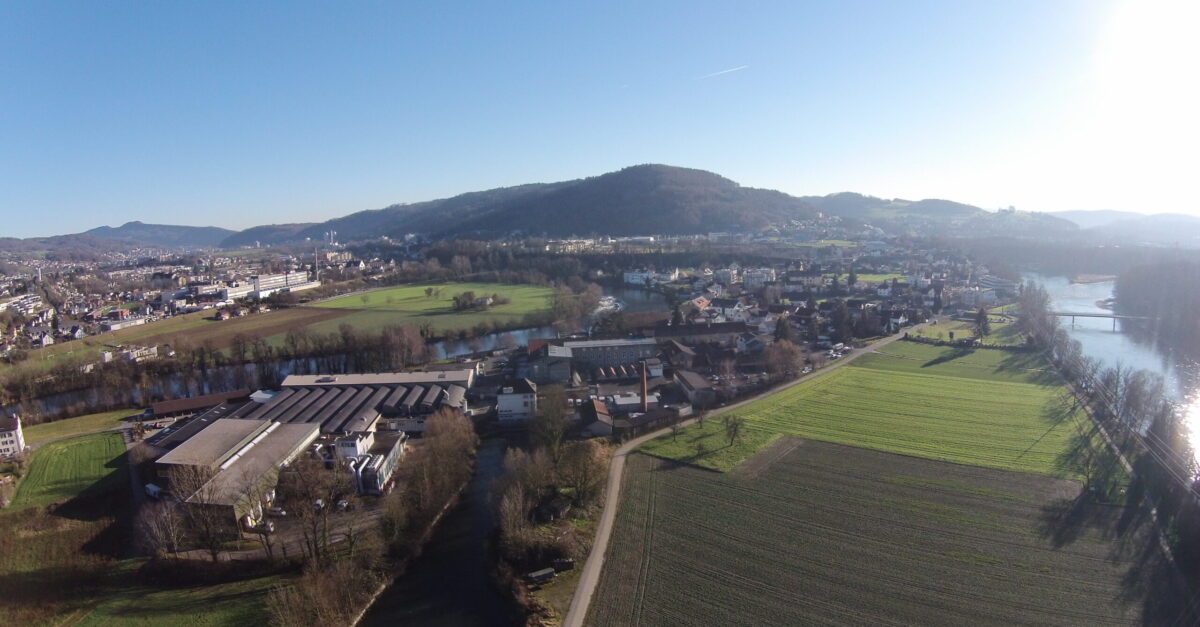
At the Limmatspitz in Gebenstorf, the former BAG industrial site is being transformed into a new residential and working address in the middle of the Aargau moated castle. Old factory buildings are giving way to a dense, urban quarter with a direct link to the floodplain landscape. The "Wasserschloss" development shows how a commercial island is becoming a building block between nature conservation, flood protection and high-density living. The BAG site is located in the Vogelsang district of Gebenstorf, between the village, the Limmat and the mouth of the Aare, Reuss and Limmat rivers. The BAG luminaire factory produced here for decades, and the halls shaped the industrial site on the edge of the Limmatspitz. When the company moved away at the beginning of the 2000s, a large reserve area in a prime location became available. Rezoning and Wasserschloss projectIn 2017, the “Limmatspitz” subzone was changed, the site was transferred from an industrial zone to a residential and commercial zone and made subject to a design plan. Since then, a new quarter has been developed under the name “Wasserschloss”, which combines living, working and services with the exposed landscape location. A study commissioned in 2024 decided on the urban planning framework, with Duplex Architekten and Gersbach Landschaftsarchitektur being awarded the contract. City block on the river, floodplain on the doorstepThe concept is based on compact buildings, clear courtyard structures and a dense edge to the Limmat. On the river side, buildings and open spaces are staggered, creating a buffer zone to the floodplain backdrop. Inside, semi-public courtyards and well-sunlit residential areas are created, while first floors offer space for services and commercial uses. Reclaiming the floodplain landscapeThe ecological upgrading of the adjacent Limmatspitz, a floodplain area of national importance, runs parallel to the densification of the site. Bank areas are being renaturalized, hard surfaces removed and the space reopened for dynamic river processes. The transformation from a commercial location to a residential area is thus deliberately linked to a “reconquest” by the floodplain landscape, with new paths and access points for local recreation. Flood protection, nature conservation and densityThe proximity to the surge tank places high demands on flood protection and construction methods. Building volumes and plinth zones are designed in such a way that they meet both the protection requirements and the views of the landscape. At the same time, the cantonal structure plan calls for efficient use of internal reserves, which leads to higher densities on the site. Building block of a new riverside townFor Gebenstorf, the development of the BAG site represents a structural leap from a traditional place to live and work to an address in the nationally recognized moated castle. The project is exemplary for a generation of site transformations that are intended to combine inner development, climate adaptation and nature conservation. How successful this will be will be shown by whether Wasserschloss ends up looking like a naturally grown quarter or a foreign body on the edge of one of the canton’s most valuable river landscapes.
