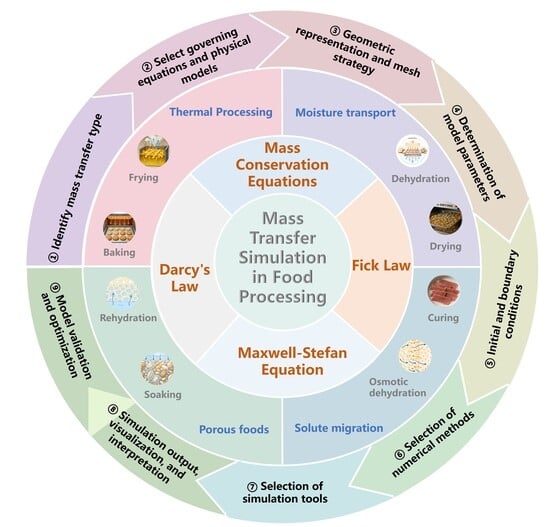
Open AccessReview Modeling and Simulation of Mass Transfer in Food Processing: Recent Advances in Governing Equations, Workflow, and Applications School of Food Science and Engineering, Jiangsu University, Zhenjiang 212013, China * Authors to whom correspondence should be addressed. Foods 2026, 15(12), 2084; https://doi.org/10.3390/foods15122084 (registering DOI) Submission received: 12 May 2026 / Revised: 1 June 2026 / Accepted: 4 June 2026 / Published: 8 June 2026 Mass transfer is central to food processing but remains difficult to quantify because food materials are heterogeneous, multiphase, porous, biologically structured, and dynamically changing. Under these conditions, experiments alone cannot fully capture the spatiotemporal complexity of transport behavior, making modeling and simulation essential for mechanism interpretation, process prediction, and engineering optimization. Existing reviews mainly address specific operations or numerical methods, with limited synthesis of governing equations, simulation workflows, application implementation, and practical applicability. This review examines food mass transfer by linking coupled momentum, heat, and mass transfer laws with governing equation selection, simulation workflow, and representative food processing applications. Governing formulations for Fickian diffusion, conservation-based transport, heat–mass coupling, multicomponent transfer, Darcy-type porous-medium flow, and related model extensions are summarized, together with their assumptions, geometric applicability, and dimensionless criteria. A unified simulation workflow is then organized, covering transport type identification, governing equation and physical model selection, geometric representation, parameter determination, initial and boundary condition specifications, numerical method and simulation tool selection, numerical implementation, validation, and transferability assessment. Representative applications are discussed for drying, heat–mass coupled processes, multicomponent transfer, transport in porous foods, and redistribution in multi-ingredient or multilayer foods. Overall, future progress requires more integrated, structure-aware, experimentally validated, transferable, and application-oriented simulation frameworks. Keywords: food processing; mass transfer; modeling and simulation; governing equations; simulation workflow Graphical Abstract 1. Introduction The increasing demand for high-quality, safe, and nutritious foods has promoted the continuous development of advanced food processing technologies. In drying [ 1], curing [ 2], rehydration [ 3], and thermal treatment [ 4, 5], product transformation is governed not only by mass transfer, such as moisture migration, solute diffusion, and gas transport, but also by momentum and heat transfer in the surrounding medium and within the food matrix. External airflow or oil flow controls convective exchange at the product surface, heat transfer determines temperature evolution and phase change, and mass transfer governs the redistribution or removal of water, solutes, and gases. These coupled transport phenomena directly affect product quality, texture development, storage stability, process efficiency, and energy utilization [ 6, 7]. However, food materials are typically heterogeneous, multiphase, porous, and structurally dynamic [ 1, 8, 9]. Their transport behavior is therefore often nonlinear, spatially nonuniform, and strongly coupled with changes in microstructure and physicochemical properties. For biological tissues, this heterogeneity also includes cell membranes and cell walls, whose integrity can strongly affect internal resistance to water and solute migration [ 10, 11]. Under such conditions, a quantitative description of mass transfer remains a central challenge in food engineering. This review first summarizes the governing equations commonly used to describe diffusion, heat–mass coupled transport, multicomponent transfer, and porous-medium transport in food materials. It then organizes a unified simulation workflow for mass transfer, including transport type identification, governing equation and physical model selection, geometric representation, parameter determination, initial and boundary condition specification, numerical method and simulation tool selection, numerical implementation, and validation. Selected representative applications are subsequently discussed to show how these workflow decisions are implemented in drying and dehydration, heat–mass coupled processes, multicomponent solute transfer, transport in porous foods, and moisture redistribution in multi-ingredient or multilayer foods. 2. Governing Equations and Physical Basis of Coupled Transport in Food Processing 2.1. Fundamental Transport Laws and Dimensionless Criteria 2.2. Fick’s Laws 2.2.1. Fick’s First Law Fick’s first law describes steady-state diffusion that is driven by a concentration gradient [ 32]. In food systems, it is mainly useful for interpreting diffusion flux under steady or quasi-steady conditions. It can be expressed by Equation (1): J = − D ∂ C ∂ x (1) where J is the diffusion flux (mol·m −2·s −1), D is the diffusion coefficient (m 2·s −1), ∂ C ∂ x is the concentration gradient (mol·m −4), and C is the concentration of the diffusing component (mol·m −3). 2.2.2. Fick’s Second Law Fick’s second law extends diffusion analysis to transient conditions by describing how concentration changes with time during diffusion [ 33]. It can be expressed by Equation (2): ∂ C ∂ t = D ∂ 2 C ∂ x 2 (2) where ∂ C ∂ t is the rate of change in concentration C with time t , D is the diffusion coefficient (m 2·s −1), and ∂ 2 C ∂ x 2 is the second derivative of concentration C with respect to the space coordinate x . For multidimensional transport with anisotropic or direction-dependent properties, the equation can be written as Equation (3): ∂ C ∂ t = ∂ ∂ x ( D x ∂ C ∂ x ) + ∂ ∂ y ( D y ∂ C ∂ y ) + ∂ ∂ z ( D z ∂ C ∂ z ) (3) where D x , D y , and D z represent the effective diffusivities in the three coordinate directions. Because most food processes are transient, Fick’s second law is commonly used to predict time-dependent concentration or moisture profiles in drying, soaking, curing, and dehydration [ 34, 35]. However, the simplified one-dimensional form of this equation should be used only when transport in one direction dominates [ 34]. This condition is usually satisfied for an infinite slab or plate, where one dimension is much smaller than the other two, or for an infinite cylinder, where radial transport dominates and axial gradients can be neglected [ 36]. For finite solids with comparable dimensions, such as cubes, thick slices, fries, bakery products, or irregular food pieces, resistance to heat and mass transfer may be comparable in more than one direction. In such cases, two- or three-dimensional formulations of Fick’s second law, or numerical methods such as FEM-, FVM-, or CFD-based approaches, are required to represent multidirectional transport more accurately. 2.3. Mass Conservation Equations Although Fick’s second law can be derived from mass conservation under diffusion-dominated conditions, more general mass conservation equations are required when convection, flow, or source terms must be considered. In food processing, such conservation-based formulations are useful when the transported component is governed not only by molecular diffusion but also by phase movement, interfacial exchange, phase transition, or local generation and consumption, as shown in recent coupled transport simulations of pasta drying, grain-pile drying, and microwave drying systems [ 37, 38, 39]. Compared with simple diffusion models, conservation-based formulations offer greater flexibility for representing realistic processing conditions. These formulations are particularly relevant when moisture loss, vapor migration, oil uptake, or local phase change affects product quality during thermal processing. A general form for a given component (A) can be written as Equations (4) and (5) [ 37, 40]: ∂ C A ∂ t + ∇ ⋅ ( C A v A + J A ) = R A (4) J A = − D A ∇ C A (5) where C A is the concentration of component A(mol·m −3), v A is the phase velocity of component A(m·s −1), J A is the diffusion flux of component A(mol·m −2·s −1), R A is the reaction/sink term of component A (mol·m −3·s −1) ( R A > 0 is generation and R A < 0 is consumption), and D A is the diffusion coefficient of component A (m 2·s −1). 2.4. Maxwell–Stefan Equations Food systems are often multicomponent in nature, and interactions among water, solutes, and other components can strongly affect transport behavior. In such cases, the Maxwell–Stefan equation can provide a more rigorous framework when species interactions are central because it accounts for frictional interactions among species in multicomponent systems [ 29, 41, 42]. This is particularly relevant to osmotic dehydration and compound marination, where water and multiple solutes migrate simultaneously and competitively [ 43, 44]. Therefore, the Maxwell–Stefan framework is valuable when coupled transport between components cannot be adequately simplified as effective binary diffusion. This framework is especially relevant to salt, sugar, and water redistribution, which affects flavor uniformity, texture, and product stability. A general Maxwell–Stefan formulation can be expressed as Equation (6): − ∇ x i = ∑ j ≠ i x j N i − x i N j c D i j (6) where x i is the mole fraction of the i-th component, N i is the molar flux of component i (mol·m −2·s −1), c is the total molar concentration (mol·m −3), and D i j is the Maxwell–Stefan diffusivity between components i and j (m 2·s −1). 2.5. Darcy’s Law Many food materials, such as bread, cakes, fruits, vegetables, and dried products, contain porous structures. In these systems, Darcy’s law provides the basic framework for describing pressure-driven fluid flow through porous media [ 8, 45]. It can be expressed by Equation (7): q = − K μ ∇ p (7) where q is the apparent flux (m·s −1), K is the permeability of porous media (m 2), μ is the dynamic viscosity (Pa·s), and ∇ p is the pressure gradient (Pa·m −1). 2.6. Key Transport Parameters Because these structural effects are usually embedded in fitted transport parameters, effective diffusivity should be interpreted as an apparent coefficient influenced by membrane permeability, tissue integrity, and processing history rather than as a universal material constant [ 51]. This does not mean that the assumption of constant effective diffusivity is always inappropriate. It may be acceptable when the process is conducted within a narrow temperature and moisture range, when shrinkage and microstructural changes are limited, when the food matrix can be approximated as homogeneous, and when the modeling objective is restricted to fitting overall drying, soaking, or moisture-uptake curves rather than predicting internal spatial gradients [ 52]. Constant Deff may also be reasonable for preliminary comparison among treatments or for materials whose cellular structure has already been largely disrupted, such as powders, ground foods, or mechanically homogenized matrices. In these cases, the fitted diffusivity should still be interpreted as an apparent parameter valid only within the calibrated material, geometry, and operating range. The equations discussed above differ not only in mathematical form but also in their assumptions, applicable transport conditions, and predictive limitations [ 21]. For this reason, the selection of a governing equation should not be based only on familiarity or simplicity, but on the dominant transport mechanism, material structure, availability of parameters, and validation objective. Table 3 summarizes the main governing equation frameworks used in food mass transfer simulation and compares their transport conditions, assumptions, representative applications, advantages, and limitations. As shown in Table 3, governing equation selection is a process-specific decision. Fick-based models are useful for diffusion-dominated systems and preliminary kinetic fitting, whereas conservation-based, coupled heat–mass, Maxwell–Stefan, Darcy, or porous-medium formulations are needed when flow, phase changes, multicomponent interactions, pressure gradients, or pore-scale structure become important. Therefore, the governing equation should be selected together with geometry, parameter representation, boundary conditions, numerical methods, and validation strategies. This provides the basis for the unified simulation workflow discussed in the next section. 3. A Unified Simulation Workflow for Mass Transfer in Food Processing Mass transfer in food processing is usually transient, spatially heterogeneous, and closely coupled with changes in food structure, composition, and physicochemical properties. As a result, numerical simulation is not only used to calculate moisture, solute, or gas transport, but also to organize experimental observations into a physically interpretable framework. For food science and technology applications, such a workflow is also important because simulated fields can be linked to quality-related responses such as moisture uniformity, solute distribution, texture formation, and processing efficiency. As illustrated in Figure 1, a unified simulation workflow for mass transfer begins with the identification of the dominant transport type, such as diffusion-dominated moisture transfer, multicomponent solute transfer, heat–mass coupled transport, or porous-medium transport. On this basis, appropriate governing equations and physical models are selected, followed by geometric representation and a mesh strategy, determination of the model parameters, and specification of the initial and boundary conditions. The model is then solved using suitable numerical methods and simulation tools, and the results are interpreted through kinetic curves, spatial distributions, quantitative indicators, and comparison with analytical or experimental data. Although these steps are presented in a logical sequence, they are not strictly linear. In practice, parameter determination, boundary condition setting, mesh refinement, and validation often require repeated adjustments. A unified simulation workflow is therefore necessary to improve the transparency, repeatability, and reliability of mass transfer simulation in food processing. Importantly, validation often leads to iterative refinement of geometric representation, parameter values, and boundary condition specification rather than a one-step confirmation of model performance. 3.1. Identification of Dominant Transport Type Dominant transport identification is more defensible when process characteristics are supported by dimensionless analysis or a time-scale comparison [ 63]. Such approaches help distinguish whether diffusion, convection, or structural resistance governs the process. Importantly, this step should not be treated as a one-time classification, but as a hypothesis that may need to be revised during model validation and refinement. 3.2. Selection of Governing Equations and Physical Models Despite the availability of these frameworks, model selection in food mass transfer studies is frequently driven by simplicity rather than physical consistency. In particular, the widespread use of Fickian models without verifying their underlying assumptions remains a major limitation [ 31, 62]. Such models implicitly assume homogeneous structure, constant parameters, and negligible coupling effects—conditions that are rarely satisfied in real food systems. Therefore, model selection should follow a hierarchical and decision-oriented logic. Simplified models may be appropriate for preliminary analysis or when transport mechanisms are clearly dominated by a single driving force [ 31]. However, when structural heterogeneity, multiphase interactions, or strong coupling effects become significant, more comprehensive formulations are required. Importantly, increasing model complexity should not be an end in itself. The selected model should balance physical realism, parameter availability, and computational feasibility, ensuring that added complexity translates into meaningful improvement in predictive capability. 3.3. Geometric Representation and Mesh Strategy Geometric representation governs the translation of food microstructure into a computational domain, directly influencing simulation fidelity and cost [ 75]. The choice is rarely a simple trade-off between abstraction and complexity; rather, it involves selecting a level of structural detail justified by the modeling objective. For foods with regular shapes, simplified geometries such as slabs, cylinders, spheres, or cuboids are often adopted as idealized domains ( Figure 2A) [ 76]. The choice of simplified geometry should be based on directional transport resistance rather than geometric convenience alone [ 21, 51]. One-dimensional diffusion models are appropriate only when one dimension controls the dominant transport path, as in thin slabs or sufficiently long cylinders. When the product dimensions are comparable, heat and mass transfer resistance may be significant along several directions, and the final moisture or temperature field is affected by multidirectional transport. Therefore, cuboids, thick slices, fries, filled products, and irregular foods generally require 2D or 3D numerical domains if spatial gradients are important [ 61, 67]. These idealized geometries are computationally efficient and sufficient for bulk transport simulations under the assumption of homogeneity. However, real food systems often exhibit irregular external morphology, heterogeneous internal composition, and anisotropic transport pathways [ 77]. Under such conditions, image-based reconstruction from techniques such as HSI [ 78], 3D scanning [ 79], or X-ray CT [ 80] can provide more realistic geometric descriptions and better preserve structural features relevant to mass transfer, including irregular boundaries, tissue heterogeneity, and directional transport paths ( Figure 2B). The gain in realism, however, is accompanied by greater demands in geometric preprocessing, parameter specification, and numerical computation. 3.4. Determination of Model Parameters In addition, parameter determination often relies on inverse modeling, where parameters are adjusted to fit experimental data [ 86]. Such problems are frequently ill-posed, meaning that multiple parameter sets may produce similar simulation results [ 75]. This raises concerns regarding parameter identifiability and the physical meaning of fitted values. More importantly, inverse-estimated parameters are often conditional rather than universal. A diffusivity, permeability, or transfer coefficient fitted from one material, maturity stage, geometry, pretreatment, or equipment design may not remain valid when the boundary conditions or product properties change [ 52, 87]. Therefore, parameter fitting should be distinguished from model validation. A model that reproduces the dataset used for parameter estimation cannot be assumed to have predictive capability unless it is tested against independent conditions, materials, or equipment configurations [ 51, 87]. To address these issues, parameter determination should be viewed as a process of selection, representation, and validation rather than simple data input. Where possible, parameters should be measured directly or supported by independent experiments [ 60]. Sensitivity analysis and uncertainty quantification should be incorporated to evaluate the robustness of model predictions [ 88]. Furthermore, representing parameters as functions of state variables, rather than constants, can improve the realism of simulations under dynamic conditions. 3.5. Initial and Boundary Conditions Initial and boundary conditions define the starting field, surface exchange, and driving forces imposed on the food domain. Initial conditions describe the starting distribution of variables such as moisture content or solute concentration, while boundary conditions represent exchange mechanisms at the interface [ 75, 89]. In practice, these conditions are often simplified due to limited experimental data [ 75]. For example, constant surface conditions or simplified flux boundaries are frequently assumed in drying models [ 75]. Such assumptions may not accurately reflect real processing environments, where boundary conditions can vary spatially and temporally. Therefore, boundary conditions should be selected based on physical mechanisms rather than numerical convenience [ 90]. Whenever possible, they should be informed by experimental measurements or justified by process analysis. Their influence on simulation results should be critically evaluated, as inappropriate boundary conditions may lead to significant errors even when the governing equations are correct [ 91]. 3.6. Selection of Numerical Methods 3.7. Selection of Simulation Tools 3.8. Simulation Output, Visualization, and Interpretation Simulation results can be presented in multiple forms, including kinetic or point-scale outputs ( Figure 3A), two-dimensional field distributions ( Figure 3B), and three-dimensional volume distributions ( Figure 3C). Kinetic or point-scale outputs are useful for tracking temporal changes in concentration or moisture content [ 105], whereas two-dimensional field maps reveal cross-sectional gradients and spatial heterogeneity [ 70]. Three-dimensional volume visualization provides a more intuitive representation of the overall transport field and is especially valuable for interpreting internal pathways, pore-channel effects, and boundary-layer behavior [ 109]. These different forms of output also determine what can be directly compared during validation, ranging from bulk kinetics to spatial field distributions. Unlike point-based measurements, simulation can resolve time-dependent concentration or moisture fields across the domain. In numerical simulation platforms such as ANSYS and COMSOL Multiphysics, transport processes can also be displayed dynamically through animations, streamlines, slices, and volume-rendering maps. For example, the simulated diffusion of NaCl in steak clearly revealed nonuniform migration caused by the coexistence of muscle, fat, and connective tissue [ 60]. Such visualization is not only helpful for mechanism interpretation but also valuable for identifying local resistance, assessing uniformity, and determining process duration. More importantly, simulation output should not be regarded merely as a presentation tool. Proper visualization can help locate regions with steep gradients for local mesh refinement, support parameter calibration by comparing field evolution with imaging data, identify preferential pathways or retention zones in porous structures, and guide the selection of sampling or monitoring points. Therefore, the interpretation of simulation output should be linked directly to model refinement and process improvement. 3.9. Model Validation and Refinement Validation should be selected according to the type of simulation output. For kinetic or point-scale predictions, simulated moisture content, solute concentration, mass loss, or water uptake can be compared with experimental curves or fitted transport parameters. For spatially resolved simulations, field-level validation is more important because the model is expected to reproduce not only average changes but also internal gradients and nonuniform distributions. In this context, imaging methods can provide independent evidence for comparing predicted and observed concentration or moisture fields. For example, hyperspectral imaging has been combined with finite element analysis to validate the spatial distribution of sucrose during beef marination, thereby linking experimental visualization with model prediction [ 15]. Image-assisted monitoring has also been coupled with mass transfer simulation to evaluate moisture diffusion during soybean rehydration [ 113]. These examples indicate that effective validation in food mass transfer research often requires the integration of compositional measurement, imaging evidence, and numerical predictions rather than reliance on a single endpoint metric. As summarized in Figure 4, model reliability can be assessed through kinetic comparison, spatial field validation, and imaging-supported evidence. When deviations or uncertainties are identified, the model should be refined by recalibrating key parameters, revising modeling assumptions, improving geometric representation, specifying initial and boundary conditions more accurately, and verifying complex multiphysics couplings step by step. Thus, validation is better treated as an iterative process that links reliability assessment with model refinement and re-simulation. It should also be noted that imaging-based validation using MRI, CT, or similar high-cost techniques is mainly valuable for research-scale model construction and field-level validation but is rarely used as a routine industrial tool because of equipment costs, measurement times, sample handling requirements, and limited compatibility with continuous production environments. This hierarchy shows that different validation levels support different claims. Curve fitting can be useful for estimating apparent parameters or comparing treatments, but it should not be presented as evidence of broad predictive capability [ 87]. Cross-condition, cross-material, and cross-equipment validation are more relevant when the goal is process optimization, scale-up, or industrial application [ 51]. Field-level validation is particularly important for models that claim to predict internal gradients or spatial heterogeneity. Therefore, the practical usefulness of a mass transfer model depends not only on the governing equation selected but also on the independence, diversity, and relevance of the validation evidence. 4. Applications of Mass Transfer Simulation in Representative Food Processing Operations The theoretical frameworks and simulation workflow discussed in the preceding sections provide the basis for applying mass transfer modeling to practical food processes. In practical food processing systems, mass transfer does not occur in a uniform manner, but varies with the dominant transport type, structural characteristics of the material, and degree of coupling with heat transfer, fluid flow, or multicomponent interactions. Accordingly, the practical value of mass transfer simulation lies in applying governing equations and a unified simulation workflow to specific food processes so that spatial distributions can be predicted, rate-limiting steps can be identified, and quality-oriented process improvement can be supported. Therefore, this section discusses representative applications of mass transfer simulation in food processing. This work demonstrates how the governing equations and workflow elements introduced earlier are implemented in typical application scenarios. To address the mathematical implementation of these applications more explicitly, this section also summarizes the representative partial differential equations, boundary conditions, and numerical methods used in each case study, while Table 7 further evaluates their practical applicability and limitations. 4.1. Simulation of Drying, Dehydration, and Moisture Redistribution Drying and dehydration are among the most established application domains of mass transfer simulation in food processing [ 18, 20]. In these processes, simulation is still most commonly built around Fick-based moisture transport, especially when the main objective is to estimate effective diffusivity and predict overall drying kinetics [ 23]. For intact biological tissues, drying simulations should also consider that blanching, pulsed electric field treatment, or mechanical disruption may modify membrane permeability and thus change the apparent effective diffusivity used in the model [ 57, 58]. However, recent studies show a clear shift from overall diffusion fitting toward spatially resolved and structural simulation. At one level, multiscale approaches have been introduced to infer diffusivity at a small unit level during drying, suggesting that diffusion modeling can be extended beyond empirical description [ 51]. At another level, coupled heat and mass transfer models have been increasingly used to resolve internal temperature and moisture distributions in products such as jujube slices and shrimp during hot-air or assisted drying [ 70, 117]. Moreover, when contraction of volume is significant, moving boundary formulations have been incorporated to better represent the evolving diffusion domain, as shown in the microwave-assisted drying of potato slices [ 65]. Therefore, these studies show a shift from simplified kinetic prediction to physically resolved models incorporating thermal fields, geometry evolution, and structural heterogeneity. This transition is summarized in Figure 5, which illustrates the evolution from simplified Fickian diffusion models toward heat–mass coupled transport simulations with refined boundary conditions, shrinkage-aware geometries, and variable transport parameters. 4.2. Simulation of Frying, Baking, and Other Heat–Mass Coupled Processes 4.3. Simulation of Curing, Osmotic Dehydration, and Solute Migration In single-component or separately fitted diffusion models, simulation is often used mainly to predict bulk water loss or solute uptake. By contrast, Maxwell–Stefan equations are more physically appropriate to situations in which competitive migration, coupled driving forces, and internal compositional redistribution are central to process behavior. This is especially relevant for curing and osmotic dehydration, where water loss, solute gain, and local concentration changes evolve simultaneously and may alter the effective transport environment during processing [ 29]. Although direct applications in food processing are still relatively sparse, when the research objective shifts from predicting overall mass change to analyzing the mechanistic coupling of multiple species during transfer, multicomponent transfer simulation becomes a more physically defensible choice. 4.4. Simulation of Rehydration, Soaking, and Transport in Porous Foods Recent studies further indicate that the value of simulation in this category lies in linking measurable structural descriptors with predictive transport models. For example, variable diffusivity has been introduced to better represent nonuniform moisture evolution during hydration [ 127]. In porous vegetables and other biological tissues, pore-scale and multiscale models can be combined with MRI or CT to explain how pore connectivity, membrane disruption, blanching pretreatment, and capillary transport alter rehydration behavior. In this context, pretreatment is not only a processing variable but also a structural modifier that changes permeability, tortuosity, swelling behavior, and the accessibility of liquid pathways [ 54]. Recent CT-based studies relating porosity to permeability show how structural descriptors can inform predictive transport models [ 3]. However, simulations supported by MRI or CT should be seen mainly as research tools for structural characterization and validation, not as routine industrial methods [ 38]. Overall, simulation of rehydration, soaking, and porous-medium transport is moving from bulk water uptake prediction toward spatially resolved and structure-dependent analysis. In this context, porosity, permeability, tortuosity, and swelling are not only material descriptors but also physically interpretable parameters that connect food microstructure with mass transfer behavior. 4.5. Simulation of Moisture Migration in Multi-Ingredient and Multilayer Foods From an implementation perspective, multi-ingredient and multilayer foods can be represented by layer- or component-specific diffusion or conservation equations [ 131, 132]. A representative formulation is ∂ M i / ∂ t = ∇ ⋅ ( D i ∇ M i ) , where Mi and Di denote the moisture content and effective diffusivity of the i-th component or layer. Initial conditions should define the moisture content or water activity of each component, while boundary conditions at the interface should consider the continuity of moisture flux and compatibility of water activity or sorption equilibrium [ 132, 133]. Analytical or FDM-based solutions may be sufficient for ideal one-dimensional layered systems, whereas FEM is more suitable for finite multilayer foods, filled products, heterogeneous component arrangements, or irregular interfaces. The main practical limitation is that layer-specific diffusivity, sorption isotherms, interfacial resistance, glass-transition-related changes, and storage-dependent structural changes are difficult to determine and validate [ 133]. Thus, these models are most valuable when the objective is to predict shelf-life-limiting moisture redistribution rather than only average moisture equilibration. To synthesize the representative applications discussed above and to address their mathematical implementation more explicitly, Table 7 compares the application categories in terms of representative partial differential equations or governing formulations, boundary conditions, numerical methods, practical limitations, and application relevance. Because several limitations listed in food mass transfer simulations are common phenomena rather than exceptional cases, the table further assesses the extent to which they affect practical application [ 51]. The impact of each limitation depends on the modeling objective: some simplifications may be acceptable for preliminary kinetic fitting, endpoint comparison, or qualitative interpretation, whereas they become problematic for spatial prediction, scale-up, shelf-life assessment, or process design [ 29, 61, 131]. Table 7. Mathematical implementation, practical impact, and appropriate use of representative mass transfer simulations in food processing. Table 7. Mathematical implementation, practical impact, and appropriate use of representative mass transfer simulations in food processing. Representative Processes Representative PDEs or Governing Formulations Typical Initial and Boundary Conditions Mathematical or Numerical Method Main Practical Limitation Practical Impact on Application Possible Mitigation or Appropriate Use References 5. Challenges and Future Perspectives Model transferability is also limited by the biological state of the food material. In intact tissues, effective diffusivity and permeability may partly reflect cell membrane resistance, tissue connectivity, and pretreatment-induced structural changes [ 59]. Blanching, pulsed electric field treatment, freezing, cutting, or mechanical disruption can alter membrane permeability and transport pathways, meaning that parameters fitted for untreated samples may not be transferable to pretreated or powdered materials [ 57]. Future studies should therefore report the tissue state and pretreatment history more explicitly and validate the transport parameters across biologically different material states. Validation remains another major bottleneck. Bulk measurements are still widely used, but they are often insufficient for assessing spatially resolved predictions in heterogeneous, multicomponent, or porous food systems. More robust validation requires closer integration of simulations with imaging and spatial characterization methods so that internal gradients, concentration fields, and structural changes can be evaluated more directly. Recent studies combining simulation with quantitative magnetic resonance imaging (MRI) and multi-output baking validation illustrate the value of this direction [ 14, 124]. A related issue is model transferability. Many food mass transfer models are inverse-calibrated using data obtained from specific material, geometry, equipment designs, and boundary conditions [ 52]. As a result, good agreement with the calibration data does not guarantee that the same model will remain valid for different varieties, maturity stages, pretreatments, sample dimensions, airflow or oil flow patterns, or equipment configurations [ 122]. Future studies should therefore distinguish parameter fitting from independent validation and should report the range of materials, boundary conditions, and equipment settings over which a model has been tested. Limited industrial adoption is another important challenge. Although advanced simulations can provide spatially resolved information on moisture, temperature, solute, oil, or gas transport, their direct use in routine production remains limited because accurate simulations require product-specific geometry, reliable material properties, well-defined boundary conditions, validation data, specialized software, computational resources, and expert operation [ 107]. Advanced simulations based on MRI, CT, or other expensive imaging data are valuable for mechanism interpretation, model construction, and validation, but they are rarely feasible as routine industrial tools [ 38]. At present, the more realistic industrial value of advanced modeling lies in offline equipment design, airflow or heat-transfer analysis, scale-up support, process troubleshooting, and pre-production optimization. 6. Conclusions Food mass transfer is better understood by connecting process descriptions with governing equations, workflow design, and representative applications. The literature indicates that no single transport framework is universally applicable. Appropriate model selection depends on the dominant transport type, the degree of coupling involved, and the structural complexity of the food matrix. At the same time, predictive reliability is determined not only by equation choice but also by geometric representation, parameter determination, boundary condition specification, numerical implementation, independent validation, and transferability assessment. Across drying, heat–mass coupled transport, multicomponent transfer, porous-medium transport, and moisture redistribution in composite foods, recent studies increasingly use spatially resolved, structure-aware, and mechanism-oriented simulations. The biological state of food tissues, including cell membrane integrity and pretreatment-induced structural changes, should be considered when interpreting fitted transport parameters and assessing model transferability. Future frameworks should better connect equation selection, parameter representation, boundary specification, numerical implementation, validation, industrial applicability assessment, and model simplification. Artificial intelligence may further contribute to application-oriented models by assisting parameter estimation, surrogate prediction, bias correction, and the integration of accessible process measurements with physically based transport models, provided that these models are physically interpretable and independently validated. Author Contributions S.C.: Conceptualization, Writing—original draft, and Writing—review and editing; Z.Q.: Writing—review and editing; T.W.: Investigation and Writing—review and editing; J.Z.: Writing—review and editing; R.Z.: Writing—review and editing; Y.Z.: Writing—review and editing; J.S.: Funding acquisition, Supervision, Project administration, and Writing—review and editing; All authors have read and agreed to the published version of the manuscript. Funding This work was supported by the Postgraduate Research and Practice Innovation Program of Jiangsu Province (KYCX24_4021), the National Key Research and Development Program of China (Grant No. 2022YFD2100603), the Natural Science Foundation of Jiangsu Province (BK20220058), and the Foundation of Jiangsu Specially Appointed Professor (202074). Institutional Review Board Statement Not applicable. Informed Consent Statement Not applicable. Data Availability Statement No new data were created or analyzed in this study. Data sharing is not applicable to this article. Acknowledgments During the preparation of this work, the authors used ChatGPT (GPT-5.5 Thinking, OpenAI) in order to improve the readability and language of the manuscript. The authors have reviewed and edited the output and take full responsibility for the content of this publication. Conflicts of Interest The authors declare no conflicts of interest. The funders had no role in the design of the study; in the collection, analyses, or interpretation of data; in the writing of the manuscript; or in the decision to publish the results. References Zhu, Y.; Wang, P.; Sun, D.; Qu, Z.; Yu, B. Multiphase porous media model with thermo-hydro and mechanical bidirectional coupling for food convective drying. Int. J. Heat Mass Transf. 2021, 175, 121356. [ Google Scholar] [ CrossRef] Zewdie, T.A.; Delele, M.A.; Fanta, S.W.; Alemayehu, M.; Alemayehu, G.; Adgo, E.; Nyssen, J.; Verboven, P.; Nicolai, B.M. Optimisation of onion bulb curing using a heat and mass transfer model. Biosyst. Eng. 2022, 214, 42–57. [ Google Scholar] [ CrossRef] Gao, H.; Zhu, Z.; Sun, D.-W. Determination of porosity and permeability correlation of leafy vegetable based on X-ray computed tomography and cell segmentation. J. Food Eng. 2025, 401, 112545. [ Google Scholar] [ CrossRef] Dai, B.; Kan, A.; Li, F.; Gao, J.; Yi, B.; Cao, D. A cross-regional thermo-hydro transport model for vacuum pre-cooling. J. Food Eng. 2022, 329, 111066. [ Google Scholar] [ CrossRef] Huang, Z.; Kan, A.; Lu, J.; Li, F.; Wang, T. Numerical simulation and experimental study of heat and mass transfer in cylinder-like vegetables during vacuum cooling. Innov. Food Sci. Emerg. Technol. 2021, 68, 102607. [ Google Scholar] [ CrossRef] Lee, S.H.; Choi, W.; Jun, S. Conventional and Emerging Combination Technologies for Food Processing. Food Eng. Rev. 2016, 8, 414–434. [ Google Scholar] [ CrossRef] Knorr, D.; Augustin, M.A. Food processing needs, advantages and misconceptions. Trends Food Sci. Technol. 2021, 108, 103–110. [ Google Scholar] [ CrossRef] Dadmohammadi, Y.; Datta, A.K. Food as porous media: A review of the dynamics of porous properties during processing. Food Rev. Int. 2022, 38, 953–985. [ Google Scholar] [ CrossRef] Datta, A.; Nicolaï, B.; Vitrac, O.; Verboven, P.; Erdogdu, F.; Marra, F.; Sarghini, F.; Koh, C. Computer-aided food engineering. Nat. Food 2022, 3, 894–904. [ Google Scholar] [ CrossRef] Li, J.; Shi, J.; Wang, T.; Huang, X.; Zou, X.; Li, Z.; Zhang, D.; Zhang, W.; Xu, Y. Effects of pulsed electric field pretreatment on mass transfer kinetics of pickled lotus root ( Nelumbo nucifera Gaertn.). LWT 2021, 151, 112205. [ Google Scholar] [ CrossRef] Ni, J.-B.; Zielinska, M.; Wang, J.; Fang, X.-M.; Prakash Sutar, P.; Li, S.-B.; Li, X.-X.; Wang, H.; Xiao, H.-W. Post-harvest ripening affects drying behavior, antioxidant capacity and flavor release of peach via alteration of cell wall polysaccharides content and nanostructures, water distribution and status. Food Res. Int. 2023, 170, 113037. [ Google Scholar] [ CrossRef] Fadiji, T.; Ashtiani, S.H.M.; Onwude, D.I.; Li, Z.; Opara, U.L. Finite Element Method for Freezing and Thawing Industrial Food Processes. Foods 2021, 10, 869. [ Google Scholar] [ CrossRef] Chigwaya, K.; Plessis, A.D.; Viljoen, D.W.; Crouch, I.J.; Crouch, E.M. Use of X-ray computed tomography and 3D image analysis to characterize internal browning in ‘Fuji’ apples after exposure to CO 2 stress. Sci. Hortic. 2021, 277, 109840. [ Google Scholar] [ CrossRef] Monod, R.; Clerjon, S.; Sicard, J.; Pagés, G.; Bonny, J.-M. Spatiotemporal quantification of sodium concentration in food using magnetic resonance imaging. Food Res. Int. 2025, 210, 116416. [ Google Scholar] [ CrossRef] Shi, Y.; Wang, Y.; Hu, X.; Li, Z.; Huang, X.; Liang, J.; Zhang, X.; Zhang, D.; Zou, X.; Shi, J. Quantitative characterization of the diffusion behavior of sucrose in marinated beef by HSI and FEA. Meat Sci. 2023, 195, 109002. [ Google Scholar] [ CrossRef] [ PubMed] Szpicer, A.; Bińkowska, W.; Stelmasiak, A.; Zalewska, M.; Wojtasik-Kalinowska, I.; Piwowarski, K.; Piepiórka-Stepuk, J.; Półtorak, A. Computational Fluid Dynamics Simulation of Thermal Processes in Food Technology and Their Applications in the Food Industry. Appl. Sci. 2025, 15, 424. [ Google Scholar] [ CrossRef] Akter, F.; Muhury, R.; Sultana, A.; Deb, U.K. A Comprehensive Review of Mathematical Modeling for Drying Processes of Fruits and Vegetables. Int. J. Food Sci. 2022, 2022, 6195257. [ Google Scholar] [ CrossRef] [ PubMed] Baidhe, E.; Clementson, C.L. A review of the application of modeling and simulation to drying systems for improved grain and seed quality. Comput. Electron. Agric. 2024, 222, 109094. [ Google Scholar] [ CrossRef] Dehghannya, J.; Ngadi, M. Recent advances in microstructure characterization of fried foods: Different frying techniques and process modeling. Trends Food Sci. Technol. 2021, 116, 786–801. [ Google Scholar] [ CrossRef] Wijerathne, A.D.H.T.; Joardder, M.U.H.; Welsh, Z.G.; Nayak, R.; Sablani, S.S.; Karim, A. Recent Advances in Food Drying Modeling: Empirical to Multiscale Physics-Informed Neural Networks. Compr. Rev. Food Sci. Food Saf. 2025, 24, e70194. [ Google Scholar] [ CrossRef] Li, J.; Deng, Y.; Xu, W.; Zhao, R.; Chen, T.; Wang, M.; Xu, E.; Zhou, J.; Wang, W.; Liu, D. Multiscale modeling of food thermal processing for insight, comprehension, and utilization of heat and mass transfer: A state-of-the-art review. Trends Food Sci. Technol. 2023, 131, 31–45. [ Google Scholar] [ CrossRef] González-Pérez, J.E.; Ramírez-Corona, N.; López-Malo, A. Mass Transfer During Osmotic Dehydration of Fruits and Vegetables: Process Factors and Non-Thermal Methods. Food Eng. Rev. 2021, 13, 344–374. [ Google Scholar] [ CrossRef] Welsh, Z.G.; Khan, M.I.H.; Karim, M.A. Multiscale modeling for food drying: A homogenized diffusion approach. J. Food Eng. 2021, 292, 110252. [ Google Scholar] [ CrossRef] Dash, K.K.; Sharma, M.; Tiwari, A. Heat and mass transfer modeling and quality changes during deep fat frying: A comprehensive review. J. Food Process Eng. 2022, 45, e13999. [ Google Scholar] [ CrossRef] Rana, A.; Dhiman, A.; Kumar, S.; Suhag, R.; Saini, R. Osmosonication for dehydration of fruits and vegetables: Mechanistic understanding, mathematical models and comprehensive applications in processing. Trends Food Sci. Technol. 2024, 152, 104688. [ Google Scholar] [ CrossRef] Szpicer, A.; Bińkowska, W.; Wojtasik-Kalinowska, I.; Salih, S.M.; Półtorak, A. Application of computational fluid dynamics simulations in food industry. Eur. Food Res. Technol. 2023, 249, 1411–1430. [ Google Scholar] [ CrossRef] Ghaitaranpour, A.; Koocheki, A.; Mohebbi, M. Simulation of bread baking with a conceptual agent-based model: An approach to study the effect of proofing time on baking behavior. J. Food Eng. 2024, 368, 111920. [ Google Scholar] [ CrossRef] Al-Najjar, S.Z.; Al-Sharify, Z.T.; Onyeaka, H.; Miri, T.; Obileke, K.; Anumudu, C.K. Advances in mass transfer and fluid flows in non-thermal food processing industry—A review. Food Prod. Process. Nutr. 2023, 5, 50. [ Google Scholar] [ CrossRef] Ramos-Morales, M.; Estévez-Sánchez, K.H.; Corona-Jiménez, E.; Sánchez-Cantú, M.; Cortés-Zavaleta, O.; Ochoa-Velasco, C.E.; Ruiz-López, I.I. Exploring multicomponent equilibrium and cross-diffusion in osmotic dehydration: A new perspective on mass transfer. J. Food Eng. 2026, 409, 112897. [ Google Scholar] [ CrossRef] Khan, M.I.H.; Batuwatta-Gamage, C.P.; Karim, M.A.; Gu, Y. Fundamental Understanding of Heat and Mass Transfer Processes for Physics-Informed Machine Learning-Based Drying Modelling. Energies 2022, 15, 9347. [ Google Scholar] [ CrossRef] Nguyen, T.T.; Rosselló, C.; Ratti, C. Simple mathematical modelling to represent air-drying kinetics of potato peel. J. Food Eng. 2023, 357, 111634. [ Google Scholar] [ CrossRef] Zhou, L.; Nyberg, K.; Rowat, A.C. Understanding diffusion theory and Fick’s law through food and cooking. Adv. Physiol. Educ. 2015, 39, 192–197. [ Google Scholar] [ CrossRef] [ PubMed] Vahidhosseini, S.M.; Barati, E.; Esfahani, J.A. Green’s function method (GFM) and mathematical solution for coupled equations of transport problem during convective drying. J. Food Eng. 2016, 187, 24–36. [ Google Scholar] [ CrossRef] Vega-Castro, O.; Osorio-Arias, J.; Duarte-Correa, Y.; Jaques, A.; Ramírez, C.; Núñez, H.; Simpson, R. Critical Analysis of the Use of Semiempirical Models on the Dehydration of Thin-Layer Foods Based on Two Study Cases. Arab. J. Sci. Eng. 2023, 48, 15851–15863. [ Google Scholar] [ CrossRef] Prudhvi, P.V.V.P.; Deepika, S.; Sutar, P.P. Modeling moisture and solids transfer kinetics during a novel microwave assisted water absorption-desorption process of dry red gram ( Cajanus cajan L.) splits. J. Food Eng. 2022, 318, 110891. [ Google Scholar] [ CrossRef] Da Silva, W.P.; De Lima, A.G.; Pereira, J.C.; Gomes, J.P.; Queiroz, A.J.; De Figueirêdo, R.M.; Paiva, Y.F.; Dos Santos, F.S.; De Melo, B.A.; Moura, H.V.; et al. A Diffusion Model to Describe Water Absorption by Red Rice during Soaking: Variable Mass Diffusivity, Variable Volume, Use of Boundary-Fitted Coordinates. Processes 2024, 12, 1696. [ Google Scholar] [ CrossRef] Adduci, G.; Petrosino, F.; Manoli, E.; Cardaropoli, E.; Coppola, G.; Curcio, S. Transport phenomena in pasta drying: A dough-air double domain advanced modeling. J. Food Eng. 2024, 376, 112052. [ Google Scholar] [ CrossRef] Ge, M.; Chen, G.; Liu, W.; Liu, C. Study of he
Modeling and Simulation of Mass Transfer in Food Processing: Recent Advances in Governing Equations, Workflow, and Applications