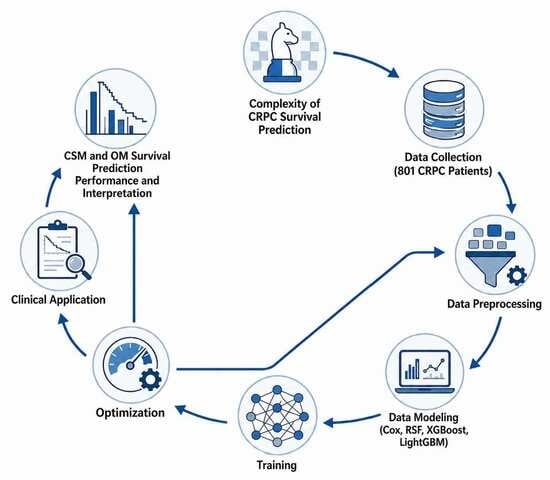
Open AccessArticle Multi-Model Machine Learning for Survival Predictions for Castration-Resistant Prostate Cancer 1 Department of Urology, CHA University Ilsan Medical Center, CHA University School of Medicine, Goyang 10414, Republic of Korea 2 Bithumb, Seoul 06234, Republic of Korea 3 Department of Urology, Gangnam Severance Hospital, Yonsei University College of Medicine, Seoul 06273, Republic of Korea 4 Department of Urology, Severance Hospital, Yonsei University College of Medicine, Seoul 03722, Republic of Korea * Authors to whom correspondence should be addressed. Cancers 2026, 18(12), 1866; https://doi.org/10.3390/cancers18121866 (registering DOI) Submission received: 26 April 2026 / Revised: 3 June 2026 / Accepted: 4 June 2026 / Published: 7 June 2026 Simple Summary Castration-resistant prostate cancer is an advanced stage of prostate cancer with highly variable outcomes, making accurate prognosis important for treatment planning. Many existing prediction algorithms rely on a limited number of variables and may not fully reflect real-world clinical complexity. We analyzed data from 801 patients and developed machine learning models to predict mortality risk and 2- and 3-year survival using clinical, laboratory, and pathological variables collected throughout the disease course. Key predictors included time to first-line treatment after the development of castration resistance, hemoglobin level, and alkaline phosphatase level. Overall, the machine learning models demonstrated better predictive performance than conventional methods. These results may help clinicians provide more individualized prognostic estimates and support treatment discussions with patients. Background: Accurate survival prediction is essential for optimizing treatment planning in patients with castration-resistant prostate cancer (CRPC). However, traditional statistical models often underperform because of limited variable inclusion and an inability to account for complex, multidimensional data interactions. Methods: We retrospectively collected 46 clinical, laboratory, and pathological variables from 801 patients with CRPC, covering the disease course from initial diagnosis to CRPC progression. Multiple machine learning (ML) models, including random survival forests (RSF), XGBoost, LightGBM, and logistic regression, were developed to predict cancer-specific mortality (CSM), overall mortality (OM), and 2- and 3-year survival status. The dataset was divided into training and test cohorts (80:20), and 10-fold cross-validation was performed. Performance was assessed using the C-index for regression models and the area under the curve (AUC), accuracy, precision, recall, and F1-score for classification models. Model interpretability was evaluated using SHapley Additive exPlanations (SHAP). Results: Over a median follow-up of 24 months, 70.6% of patients experienced CSM. Although XGBoost with its own imputation method achieved the highest C-index in the validation set, RSF demonstrated more stable performance and achieved the highest C-index in the held-out test set for both CSM (0.772) and OM (0.771). For classification tasks, RSF demonstrated superior performance in predicting 2-year survival, whereas XGBoost achieved the highest F1-score for 3-year survival prediction. SHAP analysis identified time to first-line CRPC treatment, hemoglobin level, and alkaline phosphatase level as key predictors of survival outcomes. Conclusions: RSF demonstrated robust test-set performance for time-to-event prediction, whereas XGBoost showed complementary value for 3-year survival classification. These models provide accurate and interpretable prognostic tools that may support personalized treatment strategies. External validation and integration of emerging therapies are warranted to enhance broader clinical applicability. Keywords: machine learning; prediction algorithms; prostatic neoplams; castration-resistant; survival Graphical Abstract 1. Introduction This study aimed to develop and compare multiple ML models to predict time to cancer-specific mortality (CSM), overall mortality (OM), and 2- and 3-year survival status after CRPC diagnosis using a comprehensive set of demographic and clinicopathological variables. We aimed to identify the most accurate and reliable ML model to guide clinical decision-making. 2. Materials and Methods 2.1. Data Collection Clinical, laboratory, and pathological data comprising 46 variables at the time of initial PCa diagnosis and at the time of progression to CRPC were retrospectively collected from 801 consecutive patients diagnosed with CRPC at two institutions from January 2005 to February 2022. CRPC was defined according to the Prostate Cancer Working Group 2 criteria. Patients were excluded if clinical data were incomplete, if treatment deviated from standard recommendations, or if the cause of death or survival status could not be identified. Data on CRPC treatments were collected, including the type of therapeutic agent (abiraterone acetate, enzalutamide, cabazitaxel, docetaxel, and olaparib) and the durations of first, second, and third lines of treatment until disease progression. The sequence of administered agents was determined by physician discretion and patient preference. Treatment regimens included intravenous docetaxel (75 mg/m 2) and cabazitaxel (20 mg/m 2) administered every three weeks in combination with oral prednisone (5–10 mg), enzalutamide (160 mg), abiraterone (1000 mg) combined with prednisolone (5–10 mg), and olaparib (300–600 mg). Each line of treatment was maintained until disease progression, the development of unacceptable toxicity, or patient refusal. Survival status and cause of death were determined using data from the National Cancer Registry Database or institutional medical records. Deaths were attributed to CRPC if there was documented progression of metastatic CRPC or if death resulted from treatment-related complications. 2.2. Study Endpoints The primary endpoint of this study was to develop ML models predicting time-to-CSM, time-to-OM, and 2-year and 3-year survival status following the diagnosis of CRPC. The secondary endpoint was to evaluate the discriminative performance of the developed models. 2.3. Statistical Analyses 2.3.1. Data Processing To prepare the dataset, several key variables were derived, including the time interval (months) between CRPC diagnosis and either death or last follow-up, %PSA changes from initial PCa diagnosis to ADT initiation, durations and %PSA changes between PCa diagnosis and ADT initiation, risk-group stratification based on LATITUDE (high-risk) and CHAARTED (high-volume) criteria, and neutrophil-to-lymphocyte ratio. For survival outcome classification, 2-year and 3-year survival status after CRPC diagnosis were encoded as binary variables. Cases with missing outcome data were excluded before model development. After feature derivation, the final dataset was randomly divided into training and held-out test sets using an 80:20 split prior to any preprocessing procedure to prevent data leakage. A detailed preprocessing and model development workflow is provided in Supplementary Figure S1. All preprocessing procedures, including imputation, categorical encoding, and scaling (when required), were fitted exclusively on the training set and subsequently applied to the validation/test data using transform-only procedures. Hyperparameter optimization and cross-validation were also conducted entirely within the training set. Missing data were addressed using imputation methods based on variable type. Continuous variables were imputed using IterativeImputer with a BayesianRidge estimator (scikit-learn version 1.8.0) (max_iter = 20, initial_strategy = “mean”, sample_posterior = False, random_state = 42). Categorical variables were imputed using the most frequent category via SimpleImputer (strategy = “most_frequent”). Categorical variables were subsequently encoded using OneHotEncoder (handle_unknown = “ignore”). A supplementary missingness table summarizing variable type, number and percentage of missing values, imputation method, and model inclusion status for all variables was additionally provided ( Supplementary Table S4). Among the 78 total variables, 60 contained missing values, with a median missingness rate of 1.5%. Fifty variables were ultimately included in the final predictive models. Some later-line treatment variables demonstrated structural missingness because many patients did not receive those treatment lines. Furthermore, post-CRPC treatment variables and outcome-related variables were excluded from baseline prediction modeling to avoid future information leakage. Date variables were not directly imputed and were used only for interval derivation when necessary. 2.3.2. Model Development Time-to-event outcomes and binary survival status were modeled using survival (time-to-event) modeling and classification approaches, respectively. For the survival models, the outcome was defined as the time in months from CRPC diagnosis to CSM or OM, with censoring at the last follow-up. For the classification models, binary outcomes represented 2-year and 3-year survival status after CRPC diagnosis. Survival models were developed using Cox proportional hazards modeling, random survival forests (RSF), and XGBoost-based survival modeling. Classification models were developed using logistic regression, Light Gradient Boosting Machine (LightGBM), XGBoost, and random forest algorithms. Model hyperparameters were optimized within the training set using 10-fold cross-validation. Supplementary Tables S1 and S2 provide details of the applied survival and classification models, including corresponding hyperparameters and search ranges. Hyperparameter optimization was implemented using Optuna in Python (version 3.13.9). The best-performing model in each task category was selected as the final predictive model. For XGBoost-based survival analysis, the native xgboost.train API with the survival:cox objective was used rather than the accelerated failure time (AFT) objective. Censoring information was incorporated according to the XGBoost Cox convention, in which observed events were encoded as positive survival times and right-censored observations as negative survival times. Hyperparameter optimization was performed using Optuna with a Tree-structured Parzen Estimator (TPE) sampler within the training set. Early stopping was applied using an internal validation split with early_stopping_rounds = 50, and the maximum number of boosting rounds was set to 1000. Two XGBoost survival variants were evaluated: (1) XGBoost using the predefined external preprocessing/imputation pipeline, and (2) XGBoost with its own internal missing-value handling. Detailed implementation settings, final hyperparameters, and proportional hazards assumption assessment results are summarized in Supplementary Table S5. For the Cox proportional hazards model, proportional hazards (PH) assumptions were additionally assessed using rank-transformed Schoenfeld residual tests implemented through lifelines.CoxPHFitter. All analyses were conducted in Python using fixed random seed settings (random_state = 42) to improve reproducibility. Hyperparameter optimization was performed using Optuna within the training set. Major libraries included scikit-learn, xgboost, lifelines, scikit-survival, and shap. Detailed preprocessing workflows, implementation settings, and final hyperparameters are summarized in the Supplementary Materials. 2.3.3. Model Performance Interpretation Regression models, which generated survival time predictions, were evaluated using Harrell’s concordance index (C-index) to assess discriminative performance. For the classification models, which produced categorical survival status predictions, performance was evaluated using accuracy, area under the receiver operating characteristic curve (AUC), mean precision, mean recall, and F1-score. To enhance interpretability, the final models were analyzed using the SHapley Additive exPlanations (SHAP) framework. SHAP quantifies the contribution of each input variable to model predictions, enabling understanding of feature importance behind individual predictions. 2.4. Ethical Consideration This study was approved by the Institutional Ethics Committee of Yonsei University Health System (approval number: 3-2016-0190) following a review of the study protocol. All procedures were conducted in accordance with the ethical standards of the Declaration of Helsinki and its most recent revision. 3. Results 3.1. Patient Characteristics Baseline demographic and clinicopathological characteristics of the patients at the time of initial PCa diagnosis and progression to CRPC are presented in Table 1. Over a median follow-up period of 24.0 months (interquartile range: 12.0–43.0 months), 566 cancer-specific deaths (70.6%) and 588 overall deaths (73.4%) were observed. The types and distributions of systemic agents administered according to treatment line are provided in Supplementary Table S3. Comparisons between groups were performed using Welch’s t-test for continuous variables and the chi-square test for categorical variables. All tests were two-sided, and p-values were reported accordingly. 3.2. Comparison of Model Performance Table 3 presents model performance on the test dataset comprising 160 patients. Among the evaluated models, RSF demonstrated strong performance for both CSM and OM prediction. In the validation cohort, XGBoost with internal imputation achieved the highest C-index for both outcomes: 0.771 for CSM (95% CI 0.706–0.836) and 0.773 for OM (95% CI 0.708–0.838). RSF ranked second in the validation set, with C-index values of 0.764 for CSM (95% CI 0.698–0.830) and 0.771 for OM (95% CI 0.706–0.836). However, in the test set, RSF outperformed all other models, achieving the highest C-index for both CSM (0.772, 95% CI 0.707–0.837) and OM (0.771, 95% CI 0.706–0.836). XGB ranked third, with C-index values of 0.753 (95% CI 0.686–0.820) for CSM and 0.765 (95% CI 0.699–0.831) for OM, respectively. These findings suggested a tendency toward overfitting, as the test-set performance was lower than the validation-set performance. From the perspective of model generalizability, RSF appeared to provide more robust and reliable performance across datasets. Calibration and clinical utility analyses were additionally performed for the final RSF survival models. Calibration plots for 2- and 3-year OM and CSM predictions demonstrated reasonable agreement between predicted and observed mortality risks in the held-out test set ( Supplementary Figure S2). Time-dependent Brier scores ranged from 0.155 to 0.171, whereas integrated Brier scores ranged from 0.162 to 0.166 ( Supplementary Table S6), supporting acceptable overall prediction accuracy and calibration performance. Decision curve analysis further demonstrated favorable net benefit of the RSF models across a broad range of clinically relevant threshold probabilities compared with treat-all and treat-none strategies for both OM and CSM prediction ( Supplementary Figure S3). These findings suggest that the RSF models may provide clinically useful risk stratification beyond discrimination performance alone. Formal pairwise comparisons of Harrell’s C-index between survival models were additionally performed using paired nonparametric bootstrap resampling of the held-out test set ( Supplementary Table S7). RSF showed significantly higher C-index values than the Cox model for both OM and CSM prediction. However, the differences in C-index between RSF and XGBoost-based survival models were not statistically significant, suggesting broadly comparable discrimination performance among the best-performing ML models. For 2-year survival prediction, the RSF model achieved the best overall performance, with an accuracy of 0.750, AUC of 0.820, recall of 0.787, mean precision of 0.744, and F1-score of 0.764 ( Table 4). This was followed by XGBoost and LightGBM. For 3-year survival prediction, RSF again demonstrated the highest accuracy (0.751), AUC (0.822), and mean precision (0.690). However, XGBoost achieved the best recall (0.493) and F1-score (0.545), metrics that are particularly important for evaluating performance in imbalanced classification tasks. Given the balanced nature of the F1-score in reflecting both precision and recall, XGBoost was considered more generalizable for long-term survival prediction. In both 2-year and 3-year predictions, all ML models outperformed traditional methods, such as logistic regression and Cox proportional hazards modeling, highlighting the potential of ML approaches for more accurate survival classification in patients with CRPC. 3.3. Attribute Weight 4. Discussion The quality of data preparation plays a critical role in the performance of ML algorithms, especially in CRPC survival prediction, where outcomes are influenced by a complex interplay of clinical and biological factors. A key strength of our study is the use of one of the largest and most comprehensive CRPC dataset to date, incorporating 46 clinical, laboratory, and pathological variables spanning the full disease landscape, from initial PCa diagnosis to death. Our study expands the growing literature on ML-based prognostic modeling in CRPC by comparatively evaluating multiple interpretable ML approaches in a heterogeneous real-world cohort [ 22, 23]. Although numerous studies have explored survival prediction in PCa, most have focused on localized disease, often utilizing deep learning models trained on large and relatively homogeneous patient populations [ 24]. In contrast, our study uniquely targeted a CRPC population, which is typically characterized by small sample sizes and greater clinical heterogeneity. For instance, Dai et al. reported a C-index of up to 0.85 using deep learning models for localized PCa cohorts, benefiting from more uniform disease characteristics and larger data volumes [ 25]. Despite working with a more complex dataset, our ML models achieved robust predictive performance, with C-index values of up to 0.77. These results demonstrate the potential of ML to achieve robust predictive performance in a substantially more complex clinical setting. Our findings further suggest that future applications of deep learning, tailored to the intricacies of advanced disease, may further improve prognostic accuracy. By incorporating a broad range of input variables and comparing multiple ML algorithms, we demonstrated that survival prediction for CRPC can be significantly improved compared with traditional statistical methods. Our top-performing models achieved C-indices of 0.772 for CSM and 0.771 for OM in the test set, substantially higher than the C-index of 0.67 reported by Moreira et al., who used Cox proportional hazards models to predict OM in a smaller dataset comprising 205 patients and 14 variables [ 26]. These findings highlight the importance of both dataset comprehensiveness and algorithmic methodology in achieving superior predictive performance. Saito et al. reported ML-based survival prediction models for PCa patients treated with ADT, achieving a C-index of 0.74 using RSF. Although their survival tree model achieved a higher C-index of 0.85 in metastatic PCa patients, it lacked generalizability to non-metastatic cases [ 27]. In contrast, our study included a broader CRPC population and evaluated multiple ML algorithms, including RSF, XGBoost, LightGBM, and logistic regression, allowing for a more comprehensive comparison. Although the C-index values of our models were relatively lower than those previously reported, our models demonstrated superior overall performance across both metastatic and non-metastatic CRPC populations, supporting broader applicability in real-world clinical practice. In our analysis, XGBoost demonstrated higher performance in the validation set; however, it showed a relative decline in the test set, indicating a tendency toward overfitting. This reflects a limitation of XGBoost, which may capture noise or idiosyncrasies of the training set rather than generalizable prognostic patterns. Overfitting not only diminishes predictive stability but may also limit clinical utility when models are applied to external populations. To mitigate this issue, we applied several strategies, including hyperparameter optimization using grid search within a 10-fold cross-validation framework, application of regularization parameters (e.g., L1 and L2) embedded within algorithms such as XGBoost and LightGBM, and evaluation of model generalizability through performance assessment in an independent test set. Additional approaches, such as stricter regularization, early stopping to prevent over-training, or dimensionality reduction by prioritizing features with stronger prognostic value, could be considered in future studies to further reduce the risk of overfitting. To balance accuracy with generalizability, RSF and LightGBM were evaluated alongside XGBoost as part of a complementary modeling approach. Ultimately, the most critical step will be external validation using independent cohorts, which would confirm model robustness and support broader generalizability. A key advantage of our approach is the integration of SHAP, which improved the interpretability of our ML models by quantifying the individual contribution of each input variable. Among the top-ranked predictors for both CSM and OM were the time interval from CRPC diagnosis to initiation of first-line systemic therapy, as well as baseline hemoglobin and ALP levels at the time of CRPC diagnosis. Notably, traditional prognostic indicators such as age, Gleason grade, and baseline PSA contributed minimally to the models, suggesting a shift in prognostic relevance toward more dynamic treatment-related and biochemical variables in the advanced disease setting. However, the interval from CRPC diagnosis to initiation of first-line therapy should be interpreted with caution. This variable may be affected by confounding by indication and potential reverse causality because patients with rapidly progressive, symptomatic, or high-burden disease are more likely to receive immediate systemic treatment, whereas patients with a more indolent disease course may undergo observation before treatment initiation. Therefore, this feature should not be regarded as a purely baseline prognostic factor or a directly actionable treatment-delay variable, but rather as a composite marker reflecting disease aggressiveness, clinical decision-making, and real-world treatment patterns. In addition, SHAP-derived feature importance should be interpreted as an association within the predictive model rather than evidence of a causal relationship. Several limitations should be noted. First, the lack of an external validation cohort restricts the generalizability of our findings. However, the inclusion of patients managed by eight practicing uro-oncologists across two academic tertiary referral hospitals, with treatment decisions and clinical practice patterns determined independently by each physician, may partially enhance the heterogeneity and real-world representativeness of the dataset. Second, our dataset spans an 18-year period (2005–2022) during which substantial advancements in systemic therapies for CRPC occurred. During this period, novel agents such as androgen receptor-axis targeted therapies (e.g., abiraterone, enzalutamide), cabazitaxel, and various combination or sequential strategies were gradually introduced. These therapeutic shifts may have significantly influenced survival outcomes and consequently affected the predictive performance of our models. Era-based sensitivity analyses to account for temporal heterogeneity were considered; however, irregular timing of therapeutic changes and resulting heterogeneity within subgroups limited the feasibility and statistical reliability of such analyses. Third, recently approved treatments not captured in our cohort, including darolutamide, pembrolizumab, and rucaparib, may further affect contemporary prognostic patterns. Future studies incorporating these agents and performing external validation in contemporary cohorts will be important to strengthen predictive accuracy, clinical relevance, and transportability. Finally, although calibration analyses (calibration plots, Brier score, and integrated Brier score) and clinical utility assessment using decision curve analysis were incorporated, further prospective validation in independent external cohorts remains necessary before real-world clinical implementation. 5. Conclusions Using a large and comprehensive dataset along with multiple ML algorithms, we demonstrated that XGBoost and RSF can substantially outperform traditional statistical methods in predicting CSM and OM in patients with CRPC. Importantly, the application of SHAP improved model interpretability by identifying clinically meaningful prognostic factors, which may support individualized treatment planning. Future studies should focus on model refinement, incorporation of emerging therapeutic agents, and external validation to ensure broad clinical applicability and successful translation into real-world practice. Supplementary Materials The following supporting information can be downloaded at: https://www.mdpi.com/article/10.3390/cancers18121866/s1, Figure S1: Machine learning preprocessing and model development workflow; Figure S2: Calibration plots of the RSF models for OM and CSM on the held-out test set at 24- and 36-month time points; Figure S3: Decision curve analysis of the RSF models for OM and CSM prediction on the held-out test set at 24- and 36-month time points; Table S1: Hyperparameter settings and ranges for regression models.; Table S2: Hyperparameter settings and ranges for classification models; Table S3: Distribution of systemic agents administered according to treatment lines; Table S4: Summary of missingness and imputation procedures for variables included in the machine learning workflow; Table S5: Implementation details and final hyperparameters of survival models; Table S6: Calibration and Clinical Utility Metrics of the Final RSF Models; Table S7: Pairwise bootstrap comparison of Harrell’s C-index between survival models; Table S8: Software Environment and Reproducibility Settings. Author Contributions Conceptualization: T.J.K., J.H.L., and K.C.K. Data curation and formal analysis: J.J. Funding acquisition: K.C.K. Investigation and Methodology: T.J.K., J.H.L., Y.J.A., and J.J. Project administration and Supervision: J.H.L. and K.C.K. Visualization: J.J. Writing—original draft: T.J.K. Writing—review and editing: K.S.L., J.S.L., S.H.L., W.S.H., and B.H.C. Approval of final manuscript: all authors. All authors have read and agreed to the published version of the manuscript. Funding This study was supported by a research grant from the Korea Health Industry Development Institute (HC19C016401). Informed Consent Statement Informed consent was not required for the purposes of this study as it was based upon retrospective anonymous patient data and did not involve patient intervention or the use of human tissue samples. Data Availability Statement The data are not publicly available due to privacy and ethical restrictions. Access to the de-identified data is restricted and may be available only under specific conditions with Institutional Review Board approval. Conflicts of Interest Author Jaeyun Jeong works in Bithumb. All of the authors declare that they have no conflicts of interest to declare. Abbreviations The following abbreviations are used in this manuscript: ADT Androgen deprivation therapy ALP Alkaline phosphatase AUC Area under the receiver operating characteristic curve BMI Body mass index CCI Charlson Comorbidity Index CI Confidence interval CRPC Castration-resistant prostate cancer CSM Cancer-specific mortality CV Cross-validation ECOG Eastern Cooperative Oncology Group LightGBM Light Gradient Boosting Machine ML Machine learning NCCN National Comprehensive Cancer Network NLR Neutrophil-to-lymphocyte ratio OM Overall mortality OS Overall survival PCa Prostate cancer PCWG2 Prostate Cancer Working Group 2 PSA Prostate-specific antigen RSF Random survival forest SHAP SHapley Additive exPlanations XGB Extreme gradient boosting References Fujita, N.; Hatakeyama, S.; Tabata, R.; Okita, K.; Kido, K.; Hamano, I.; Tanaka, T.; Noro, D.; Tokui, N.; Suzuki, Y.; et al. Real-world effects of novel androgen receptor axis-targeted agents on oncological outcomes in non-metastatic castration-resistant prostate cancer: A multi-institutional retrospective study. Prostate Int. 2024, 12, 46–51. [ Google Scholar] [ CrossRef] Yuk, H.D.; Kim, M.; Keam, B.; Ku, J.H.; Kwak, C.; Jeong, C.W. Weekly versus 2-weekly versus 3-weekly docetaxel to treat metastatic castration-resistant prostate cancer. Prostate Int. 2024, 12, 219–223. [ Google Scholar] [ CrossRef] Yamada, Y.; Sakamoto, S.; Tsujino, T.; Saito, S.; Sato, K.; Nishimura, K.; Fukushima, T.; Nakamura, K.; Yoshikawa, Y.; Matsunaga, T.; et al. Clinical significance of primary tumor progression in metastatic hormone-sensitive prostate cancer. Prostate Int. 2025, 13, 60–66. [ Google Scholar] [ CrossRef] Kyaw, L.; Lim, Q.Y.; Law, Y.X.T.; Ong, C.S.H.; Loke, W.T.; Chiong, E.; Tiong, H.Y. Cardiovascular risks of Asian patients on androgen-receptor-targeted agents for prostate cancer: A systematic review and meta-analysis. Prostate Int. 2024, 12, 186–194. [ Google Scholar] [ CrossRef] [ PubMed] Pinart, M.; Kunath, F.; Lieb, V.; Tsaur, I.; Wullich, B.; Schmidt, S.; German Prostate Cancer Consortium (DPKK). Prognostic models for predicting overall survival in metastatic castration-resistant prostate cancer: A systematic review. World J. Urol. 2020, 38, 613–635. [ Google Scholar] [ CrossRef] Huang, K.A.; Choudhary, H.K.; Lee, K.A.V.; Tesdahl, C.D.; Kuo, P.C. Current Architectural and Developmental Approaches in Artificial Intelligence Models for Prostate Cancer Detection and Management: A Technical Report. Cureus 2025, 17, e81748. [ Google Scholar] [ CrossRef] [ PubMed] Huang, Y.; Li, J.; Li, M.; Aparasu, R.R. Application of machine learning in predicting survival outcomes involving real-world data: A scoping review. BMC Med. Res. Methodol. 2023, 23, 268. [ Google Scholar] [ CrossRef] Lim, H.; Yoo, J.W.; Lee, K.S.; Lee, Y.H.; Baek, S.; Lee, S.; Kang, H.; Choi, Y.D.; Ham, W.S.; Lee, S.H.; et al. Toward Precision Medicine: Development and Validation of A Machine Learning Based Decision Support System for Optimal Sequencing in Castration-Resistant Prostate Cancer. Clin. Genitourin. Cancer 2023, 21, e211–e218.e4. [ Google Scholar] [ CrossRef] Christoforou, A.T.; Spohn, S.K.B.; Sprave, T.; Fechter, T.; Rühle, A.; Nicolay, N.H.; Popp, I.; Grosu, A.L.; Peeken, J.C.; Thieme, A.H.; et al. A framework to create, evaluate and select synthetic datasets for survival prediction in oncology. Comput. Biol. Med. 2025, 192, 110198. [ Google Scholar] [ CrossRef] Iftikhar, H.; Hashem, A.F.; Qureshi, M.; Rodrigues, P.C. Clinical Application of Machine Learning Models for Early-Stage Chronic Kidney Disease Detection. Diagnostics 2025, 15, 2610. [ Google Scholar] [ CrossRef] [ PubMed] Iftikhar, H.; Hashem, A.F.; Qureshi, M.; Rodrigues, P.C.; Ali, S.O.; Gonzales Medina, R.I.; López-Gonzales, J.L. An Intelligent Hybrid Ensemble Model for Early Detection of Breast Cancer in Multidisciplinary Healthcare Systems. Diagnostics 2026, 16, 377. [ Google Scholar] [ CrossRef] Peng, C.; Gong, C.; Zhang, X.; Liu, D. A prognostic model for highly aggressive prostate cancer using interpretable machine learning techniques. Front. Med. 2025, 12, 1512870. [ Google Scholar] [ CrossRef] [ PubMed] Wang, W.; Zhu, M.; Luo, Z.; Li, F.; Wan, C.; Zhu, L. Diagnostic Value Analysis of PI-RADS v2.1 Combined with ADC Values in the Risk Stratification of Prostate Cancer Gleason Scores: A Retrospective Study. Arch. Esp. Urol. 2024, 77, 889–896. [ Google Scholar] [ CrossRef] Gupta, S.; Tran, T.; Luo, W.; Phung, D.; Kennedy, R.L.; Broad, A.; Campbell, D.; Kipp, D.; Singh, M.; Khasraw, M.; et al. Machine-learning prediction of cancer survival: A retrospective study using electronic administrative records and a cancer registry. BMJ Open 2014, 4, e004007. [ Google Scholar] [ CrossRef] Alabi, R.O.; Makitie, A.A.; Pirinen, M.; Elmusrati, M.; Leivo, I.; Almangush, A. Comparison of nomogram with machine learning techniques for prediction of overall survival in patients with tongue cancer. Int. J. Med. Inform. 2021, 145, 104313. [ Google Scholar] [ CrossRef] Khoshkar, Y.; Westerberg, M.; Adolfsson, J.; Bill-Axelson, A.; Olsson, H.; Eklund, M.; Akre, O.; Garmo, H.; Aly, M. Mortality in men with castration-resistant prostate cancer-A long-term follow-up of a population-based real-world cohort. BJUI Compass 2022, 3, 173–183. [ Google Scholar] [ CrossRef] [ PubMed] Connors, L.M. Metastatic prostate cancer in the genomic era: Guideline-concordant strategies for diagnosis, treatment, and survivorship. J. Am. Assoc. Nurse Pract. 2026, 38, 132–135. [ Google Scholar] [ CrossRef] Kim, T.J.; Lee, Y.H.; Koo, K.C. Current Status and Future Perspectives of Androgen Receptor Inhibition Therapy for Prostate Cancer: A Comprehensive Review. Biomolecules 2021, 11, 492. [ Google Scholar] [ CrossRef] [ PubMed] Park, J.J.; Tseng, C.L.; Giagtzis, A.; Kelley, M.J.; Bitting, R.L. SPOP Mutations in Veterans with Prostate Cancer and Outcomes with Doublet and Triplet Therapy in De Novo Metastatic Hormone Sensitive Prostate Cancer. Prostate 2026, 86, 920–928. [ Google Scholar] [ CrossRef] Shore, N.D.; Khan, N.; McKay, R.R.; Constantinovici, N.; Chen, G.; Hlebec, V.; Srinivasan, S.; Vassilev, Z.; Spratt, D.E. Real-world clinical outcomes in patients with biochemical recurrence after local therapy for non-metastatic prostate cancer. Future Oncol. 2026, 22, 1311–1319. [ Google Scholar] [ CrossRef] Stranne, J.; Axen, E.; Bratt, O.; Carlsson, S.; Kindblom, J.; Kohestani, K.; Kristiansen, A.; Franck Lissbrant, I.; Moise, G.; Nemlander, E.; et al. The Swedish national guidelines on prostate cancer: Recurrent, metastatic and castration resistant disease. Scand. J. Urol. 2026, 61, 138–147. [ Google Scholar] [ CrossRef] Ye, Z.; Zhang, Y.; Liang, Y.; Lang, J.; Zhang, X.; Zang, G.; Yuan, D.; Tian, G.; Xiao, M.; Yang, J. Cervical Cancer Metastasis and Recurrence Risk Prediction Based on Deep Convolutional Neural Network. Curr. Bioinform. 2022, 17, 164–173. [ Google Scholar] [ CrossRef] Akinmuleya, O.I.; Cohen, P.F.; Kairemo, K. 68Ga-PSMA PET CT/MRI in the Initial Diagnosis and Staging of Prostate Cancer: A Review. Adv. Radiother. Nucl. Med. 2024, 2, 4590. [ Google Scholar] [ CrossRef] Bang, S.; Ahn, Y.J.; Koo, K.C. Harnessing machine learning to predict prostate cancer survival: A review. Front. Oncol. 2024, 14, 1502629. [ Google Scholar] [ CrossRef] Dai, X.; Park, J.H.; Yoo, S.; D’Imperio, N.; McMahon, B.H.; Rentsch, C.T.; Tate, J.P.; Justice, A.C. Survival analysis of localized prostate cancer with deep learning. Sci. Rep. 2022, 12, 17821. [ Google Scholar] [ CrossRef] Moreira, D.M.; Howard, L.E.; Sourbeer, K.N.; Amarasekara, H.S.; Chow, L.C.; Cockrell, D.C.; Pratson, C.L.; Hanyok, B.T.; Aronson, W.J.; Kane, C.J.; et al. Predicting Time from Metastasis to Overall Survival in Castration-Resistant Prostate Cancer: Results from SEARCH. Clin. Genitourin. Cancer 2017, 15, 60–66.e2. [ Google Scholar] [ CrossRef] [ PubMed] Saito, S.; Sakamoto, S.; Higuchi, K.; Sato, K.; Zhao, X.; Wakai, K.; Kanesaka, M.; Kamada, S.; Takeuchi, N.; Sazuka, T.; et al. Machine-learning predicts time-series prognosis factors in metastatic prostate cancer patients treated with androgen deprivation therapy. Sci. Rep. 2023, 13, 6325. [ Google Scholar] [ CrossRef] [ PubMed] Halabi, S.; Kelly, W.K.; Ma, H.; Zhou, H.; Solomon, N.C.; Fizazi, K.; Tangen, C.M.; Rosenthal, M.; Petrylak, D.P.; Hussain, M.; et al. Meta-Analysis Evaluating the Impact of Site of Metastasis on Overall Survival in Men with Castration-Resistant Prostate Cancer. J. Clin. Oncol. 2016, 34, 1652–1659. [ Google Scholar] [ CrossRef] Belderbos, B.P.S.; de Wit, R.; Hoop, E.O.; Nieuweboer, A.; Hamberg, P.; van Alphen, R.J.; Bergman, A.; van der Meer, N.; Bins, S.; Mathijssen, R.H.J.; et al. Prognostic factors in men with metastatic castration-resistant prostate cancer treated with cabazitaxel. Oncotarget 2017, 8, 106468–106474. [ Google Scholar] [ CrossRef] Hammerich, K.H.; Donahue, T.F.; Rosner, I.L.; Cullen, J.; Kuo, H.C.; Hurwitz, L.; Chen, Y.; Bernstein, M.; Coleman, J.; Danila, D.C.; et al. Alkaline phosphatase velocity predicts overall survival and bone metastasis in patients with castration-resistant prostate cancer. Urol. Oncol. 2017, 35, 460.e21–460.e28. [ Google Scholar] [ CrossRef] Chen, W.J.; Kong, D.M.; Li, L. Prognostic value of ECOG performance status and Gleason score in the survival of castration-resistant prostate cancer: A systematic review. Asian J. Androl. 2021, 23, 163–169. [ Google Scholar] [ CrossRef] [ PubMed] Kleiburg, F.; de Geus-Oei, L.F.; Spijkerman, R.; Noortman, W.A.; van Velden, F.H.P.; Manohar, S.; Smit, F.; Toonen, F.A.J.; Luelmo, S.A.C.; van der Hulle, T.; et al. Baseline PSMA PET/CT parameters predict overall survival and treatment response in metastatic castration-resistant prostate cancer patients. Eur. Radiol. 2025, 35, 4223–4232. [ Google Scholar] [ CrossRef] [ PubMed] Figure 1. Kaplan–Meier curves for cancer-specific survival and overall survival. Figure 1. Kaplan–Meier curves for cancer-specific survival and overall survival. Figure 2. SHAP summary plot for XGB regression model based on CSM. Figure 2. SHAP summary plot for XGB regression model based on CSM. Figure 3. SHAP summary plot for XGB regression model based on OM. Figure 3. SHAP summary plot for XGB regression model based on OM. Table 1. Clinical, laboratory, and pathological characteristics. Table 1. Clinical, laboratory, and pathological characteristics. Number 801 At initial PCa diagnosis Body mass index (kg/m 2) 24.0 (21.6–25.7) PSA (ng/mL) 65.6 (18.2–280.9) PSA density (ng/mL/cc) 1.58 (0.47–6.21) Gleason score ≤7 131 (16.4%) ≥8 670 (83.6%) Extent of metastasis Bone 439 (54.7%) Lymph node 283 (35.3%) Lung 43 (5.4%) Liver 13 (1.6%) NCCN risk category Intermediate 36 (4.5%) High 765 (95.5%) Clinical T stage ≤T2 115 (14.4%) ≥T3 686 (85.6%) Clinical N1 stage N0 395 (49.3%) N1 406 (50.7%) Clinical M1 stage M0 356 (44.4%) M1 445 (55.6%) Type of definitive treatment Radical prostatectomy 96 (12.0%) Radiation therapy with or without ADT 243 (30.3%) ADT alone 462 (57.7%) PSA level at ADT initiation 46.6 (10.0–255.5) Duration from ADT administration to CRPC (months) 0.0 (0.0–3.0) At CRPC progression Age (years) 70.0 (65.0–76.0) Presence of SPM 68 (8.5%) Presence of SPM before CRPC progression 50 (6.2%) Comorbidity Hypertension 332 (41.4%) Diabetes mellitus 162 (20.2%) Pulmonary tuberculosis history 29 (3.6%) Liver cirrhosis 5 (0.6%) Cerebrovascular disease 27 (3.4%) CCI ≤1 623 (77.8%) ≥2 178 (22.2%) ECOG performance score ≤1 738 (92.1%) ≥2 63 (7.9%) Period from CRPC diagnosis to first treatment (months) 0.0 (0.0–4.0) Period from PCa diagnosis to CRPC diagnosis (months) 28.0 (12.0–56.0) Period from ADT initiation to CRPC diagnosis (months) 22.0 (10.0–47.0) Metastatic site Bone 615 (76.7%) Lymph node 295 (36.8%) Lung 71 (8.9%) Liver 40 (5.0%) Number of metastatic sites <3 lesions 131 (16.3%) ≥3 lesions 484 (60.3%) High-risk disease (LATTITUDE definition) 445 (55.6%) High-volume disease (CHAARTED definition) 517 (64.5%) PSA level at CRPC diagnosis 17.5 (4.7–76.6) %PSA change at CRPC diagnosis From PCa diagnosis (%) −72.8 (−94.2–14.6) From ADT initiation (%) −60.5 (−171.6–−0.93) Laboratory data Hemoglobin (g/dL) 12.5 (11.4–13.3) WBC count (/μL) 5985.0 (4937.0–7272.0) Lymphocyte (/μL) 1610.0 (140.0–2110.0) Neutrophil (/μL) 3620.0 (2800.0–4700.0) Neutrophil-to-lymphocyte ratio <2 436 (54.4%) ≥2 365 (45.6%) Cholesterol (mmol/L) 176.0 (148.0–204.0) Albumin (g/dL) 4.2 (3.9–4.5) Alkaline phosphatase (IU/L) 94.0 (69.0–163.8) Follow-up duration, median 24.0 (12.0–43.0) Cancer-specific death 566 (70.6%) Overall death 588 (73.4%) Data are number (%) and median (interquartile range). ADT = androgen-deprivation therapy; CCI = Charlson Comorbidity Index; CRPC = castration-resistant prostate cancer; ECOG = Eastern Cooperative Oncology Group; NCCN = National Comprehensive Cancer Network; PCa = prostate cancer; PSA = prostate-specific antigen; SPM = second primary malignancy; WBC = white blood cell. Table 2. Summary of 2-year and 3-year survivals in patients with CRPC. Table 2. Summary of 2-year and 3-year survivals in patients with CRPC. Cancer-Specific Survival (%) Overall Survival (%) 2-year 56.5% 54.3% 3-year 37.2% 34.3% Table 3. Performance of regression models. Table 3. Performance of regression models. Cox RSF XGB XGB (with Its Own Imputation) Valid score CSM 0.685 0.764 0.761 0.771 95% CI 0.656–0.714 0.698–0.830 0.695–0.827 0.706–0.836 OM 0.6934 0.771 0.770 0.773 95% CI 0.665–0.722 0.706–0.836 0.705–0.835 0.708–0.838 Test score CSM 0.6210 0.772 0.770 0.753 95% CI 0.590–0.652 0.707–0.837 0.705–0.835 0.686–0.820 OM 0.6130 0.771 0.756 0.765 95% CI 0.584–0.642 0.706–0.836 0.689–0.823 0.699–0.831 CI = confidence interval; CSM = cancer-specific mortality; OM = overall mortality; RSF = random survival forest; XGB = extreme gradient boosting. Table 4. Performance of classification models. Table 4. Performance of classification models. Model Accuracy AUC Recall Precision F1-Score 2-year survival Logistic Regression 0.6356 0.7271 0.6818 0.6353 0.6528 LightGBM 0.7107 0.8074 0.7442 0.7078 0.7236 XGB 0.7198 0.8138 0.7586 0.7151 0.7350 RandomForest 0.7504 0.8196 0.7868 0.7443 0.7640 3-year survival Logistic Regression 0.7183 0.7069 0.3105 0.5958 0.3993 LightGBM 0.7432 0.8017 0.4817 0.6275 0.5375 XGB 0.7485 0.7861 0.4925 0.6246 0.5452 RandomForest 0.7506 0.8224 0.3905 0.6903 0.4818 LightGBM = light gradient-boosting machine; XGB = extreme gradient boosting. Disclaimer/Publisher’s Note: The statements, opinions and data contained in all publications are solely those of the individual author(s) and contributor(s) and not of MDPI and/or the editor(s). MDPI and/or the editor(s) disclaim responsibility for any injury to people or property resulting from any ideas, methods, instructions or products referred to in the content. © 2026 by the authors. Licensee MDPI, Basel, Switzerland. This article is an open access article distributed under the terms and conditions of the Creative Commons Attribution (CC BY) license. Kim, T.J.; Jeong, J.; Ahn, Y.J.; Lee, K.S.; Lee, J.S.; Lee, S.H.; Ham, W.S.; Chung, B.H.; Lee, J.H.; Koo, K.C. Multi-Model Machine Learning for Survival Predictions for Castration-Resistant Prostate Cancer. Cancers 2026, 18, 1866. https://doi.org/10.3390/cancers18121866 Kim TJ, Jeong J, Ahn YJ, Lee KS, Lee JS, Lee SH, Ham WS, Chung BH, Lee JH, Koo KC. Multi-Model Machine Learning for Survival Predictions for Castration-Resistant Prostate Cancer. Cancers. 2026; 18(12):1866. https://doi.org/10.3390/cancers18121866 Kim, Tae Jin, Jaeyun Jeong, Young Jin Ahn, Kwang Suk Lee, Jong Soo Lee, Seung Hwan Lee, Won Sik Ham, Byung Ha Chung, Jeong Hyun Lee, and Kyo Chul Koo. 2026. "Multi-Model Machine Learning for Survival Predictions for Castration-Resistant Prostate Cancer" Cancers 18, no. 12: 1866. https://doi.org/10.3390/cancers18121866 Kim, T. J., Jeong, J., Ahn, Y. J., Lee, K. S., Lee, J. S., Lee, S. H., Ham, W. S., Chung, B. H., Lee, J. H., & Koo, K. C. (2026). Multi-Model Machine Learning for Survival Predictions for Castration-Resistant Prostate Cancer. Cancers, 18(12), 1866. https://doi.org/10.3390/cancers18121866
Multi-Model Machine Learning for Survival Predictions for Castration-Resistant Prostate Cancer