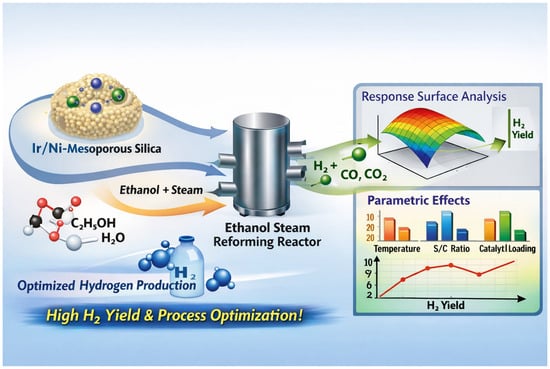
The need for a transition to a low-carbon economy has led to the growing demand for hydrogen as a clean energy source. Hence, ethanol steam reforming (ESR) is one of the promising technological pathways for hydrogen production. Ethanol, which is the major feedstock, can be obtained from abundant biomass. However, one of the major drawbacks is catalyst deactivation due to the high temperature requirement to start the reaction. This study therefore focused on employing a response surface approach to optimize the operating conditions (reaction temperature, steam-to-ethanol ratio and catalyst amount) of ethanol steam reforming over an Iridium-promoted Ni/MCM-41 catalyst. The Iridium-promoted Ni/MCM-41 catalyst was synthesized using the sequential wet impregnation method and characterized using field emission scanning electron microscopy (FESEM), energy dispersive X-ray spectroscopy (EDS), transmission electron microscopy (TEM), N 2 physisorption analysis, and X-ray diffraction (XRD). A central composite experiment design (CCD) was employed to study the effect of the variables on the hydrogen production from the ESR. The catalytic efficacy was ascertained by evaluating the H 2 yield under varied experimental conditions provided by the CCD. The characterization of the catalyst revealed well-dispersed Ir and Ni nanoparticles on a mesoporous MCM-41 support. Catalytic evaluations indicate that the H 2 yield was most influenced by the reaction temperature (correlation coefficient of 0.68), followed by the catalyst amount (correlation coefficient of 0.34) and steam-to-ethanol ratio (correlation coefficient of 0.28). A maximum H 2 yield of 5.82 mol/mol ethanol was obtained at 798.11 °C, a steam-to-ethanol ratio of 3.40, and 1.25 g of catalyst. These findings underscore the importance of Ir-promoted Ni/MCM-41 catalyst for efficient H 2 production, highlighting the reaction temperature as a critical parameter for process optimization. 1. Introduction The significant transformation in the global energy landscape has necessitated the urgent need to mitigate climate change and the transition towards sustainable energy systems [ 1, 2]. In this context, hydrogen (H 2) has emerged as a pivotal energy carrier with great potential to decarbonize various sectors, including transportation, industry, and power generation [ 3]. Its primary advantage lies in its clean combustion, producing only water as a byproduct when utilized in fuel cells or direct combustion, thereby offering a pathway to zero-emission energy [ 4]. However, the widespread adoption of a hydrogen-based economy faces several hurdles, primarily related to efficient and cost-effective hydrogen production, storage, and distribution [ 5]. Current H 2 production is predominantly reliant on fossil fuels, particularly natural gas, through processes like steam methane reforming, which are associated with significant carbon dioxide (CO 2) emissions [ 6]. Hence, the development of sustainable and renewable routes for hydrogen production is paramount. Among the various renewable feedstocks considered for hydrogen production, ethanol stands out as promising candidate. Ethanol can be produced from biomass sources such as lignocellulosic biomass, making it a truly renewable resource [ 7]. It possesses several attributes like high intrinsic H 2 content, theoretically yielding up to 6 moles of H 2 per mole of ethanol via steam reforming, and non-toxicity, which simplifies handling and reduces environmental risks [ 8]. Compared with methane, ethanol reforming offers a route to “green” hydrogen if the ethanol is produced sustainably [ 8]. The overall process can be part of a carbon-neutral cycle where the CO 2 released during reforming is offset by the CO 2 absorbed by the biomass during its growth. Several technological pathways have been explored as potential processes for H 2 production. Among the different processes, ethanol steam reforming (ESR) is considered one of the most promising technological pathways for producing hydrogen from ethanol [ 9, 10, 11]. The process involves reacting ethanol with steam at elevated temperatures in the presence of a catalyst. The ESR reaction is complex, involving a network of desired and undesired reactions, as shown in Equations (1)–(5) [ 12, 13]. The primary ideal reaction is the complete steam reforming of ethanol depicted in Equation (1). Equations (2)–(5) are parallel reactions representing ethanol decomposition, ethanol dehydration, methane reforming, and water gas shift reactions. C 2 H 5 O H + 3 H 2 O ⇌ C O 2 + 6 H 2 (1) C 2 H 5 O H ⇌ C H 4 + C O + H 2 (2) C 2 H 5 O H ⇌ C 2 H 4 + H 2 O (3) C H 4 + H 2 O ⇌ C O + 3 H 2 (4) C O + H 2 O ⇌ C O 2 + H 2 (5) While EDR remains a robust thermochemical conversion process, recent advancements have also highlighted complementary “green” pathways. Notably, the catalytic decomposition of formic acid has gained significant attention as a safe and efficient strategy for on-demand hydrogen generation [ 14, 15]. Unlike compressed hydrogen, FA serves as a high-density liquid organic hydrogen carrier that can be deconstructed at relatively low temperatures over specialized catalysts to yield H 2 and CO 2 with high selectivity. Recent studies have emphasized the development of atom-precise heterogeneous catalysts to minimize CO formation, further enhancing the purity of the produced H 2 stream. Furthermore, modern photocatalytic systems represent a paradigm shift in hydrogen production by directly utilizing solar energy to split water or reform organic “sacrificial” agents. These systems are particularly promising because they can operate under ambient conditions and, in ideal configurations, generate zero carbon-based by-products. Recent breakthroughs in semiconductor engineering, such as the design of 2D/2D heterojunctions and single atom photocatalysts, have significantly addressed the limitations of low quantum efficiency and charge carrier recombination [ 16, 17]. Integrating these solar-driven processes with thermochemical reforming provides a diversified portfolio for a resilient hydrogen economy. Nevertheless, ESR is still considered a robust thermos-catalytic hydrogen production pathway compared with the aforementioned process. Thermodynamically, ESR is an endothermic reaction that favors high temperatures and low pressure as a result of the net increase in the number of moles of gases. Moreover, having a high steam-to-ethanol molar ratio in the feed also shifts the equilibrium towards higher ethanol conversion and hydrogen yield according to Le Chatelier’s principle. Typically, the operating temperatures for ESR range from 400 to 800 °C. However, one of the constraints during the ESR reaction is catalyst deactivation. Hence, is it imperative to develop robust catalytic systems with synergistic combination of active metals, promoters, and the support materials. Several authors have investigated different types of catalytic systems for ESR reactions. Jia et al. [ 18] investigated the use of PdCu membrane for ESR reactions. The finding revealed that both H 2 yield and recovery were stable during the 240 h continuous testing of the membranes. However, the optimal conditions to maximize the H 2 yield was not reported. Quan et al. [ 19] investigated Ni–Ce/mesopore Y catalysts for ESR to H 2. The findings revealed that the performance of the Ni-catalyst was enhanced by the Ce promoter resulting in H 2 producing rate of 1.39 mmol/min. The findings did not report on the optimal experimental conditions to maximize the performance of the catalyst. In their review, Phung et al. [ 20] reported that the addition of promoters significantly enhances the performance of Ni-catalyst in ESR to H 2. Seriyala et al. [ 13] reported that CeO 2 promoters in enhancing the performance of Ni-Sn/ZrO 2 catalyst during ESR to H 2. The study revealed that the CeO 2 promoter facilitated the conversion of ethanol to reach 100% and H 2 selectivity of 69% and minimal coke deposition. However, one of the challenges of ESR reaction is obtaining optimal experimental conditions that could maximize the H 2 production. This study therefore focuses on exploring the robustness of response surface methodology (RSM) and central composite design (CCD) for optimizing the experimental variables in ESR for H 2 production over an Ir-promoted Ni/MCM-41 catalyst. To the best of the author’s knowledge, this has not been reported in the literature. The Ir-promoted Ni/MCM-41 catalytic system is synthesized to leverage the unique properties of each component to achieve enhanced H 2 production efficiency. The high surface area and spatial confinement offered by the MCM-41 mesopores facilitates the formation of highly dispersed metal nanoparticles. 2. Results and Discussion 2.1. Catalyst Characterization The FESEM image and the EDS micrograph of the Ir-promoted Ni/MC-41 catalyst is depicted in Figure 1. Figure 1a,b shows evidence of agglomerated nanoparticles simply due the series of heat treatments during the preparation stage. The Ir and Ni nanoparticles are roughly spherical but more predominantly irregularly shaped and appear to be clustered together. The particle sizes of the nanoparticles taken at different spots revealed a range from 28.89 nm to 75.95 nm, which further confirmed the irregularity of the nanoparticles. The evidence showing the presence of the Ir and Ni as well as the MCM-41 which constitute aluminosilicate (Al, Si, and O) is depicted in EDS micrograph shown in Figure 1c. It can be seen that the elemental composition of all the Ir-promoted Ni/MCM-41 catalysts are well represented and confirmed by the mapping in Figure 1c. The dominant peaks of Si and O revealed that a large proportion of the MCM-41 is made of SiO 2 (82.6%), which is consistent with the 80% reported for SiO 2 for Ni-Ce/Al-MCM-41 [ 21]. Figure 2a,b depicts the TEM micrograph of the Ir-promoted Ni/MCM-41 catalyst at 30,000× and 50,000× magnifications, respectively. The TEM image further corroborates the dispersion of Ir and Ni on the MCM-41 support. The dark visible electron-dense particles throughout the images suggest the presence of Ir and Ni metallic nanoparticles since heavier elements scatter electrons more strongly [ 22]. This indicates that Ir and Ni nanoparticles seem to be well-dispersed across the support materials. The Ir and Ni nanoparticles revealed varied morphologies. Many of the nanoparticles appear roughly spherical, while several distinct particles show a more cubic shape. The nanoparticle sizes vary with some very small and others being prominent with formation of small agglomerates or clusters. The presence of the MCM-41 can be identified by the lighter-grey background on which the dark nanoparticles are situated. The N 2 adsorption–desorption isotherm and the pore distribution of the Ir-promoted catalyst is depicted in Figure 3. The isotherm in Figure 3a portrays a typical characteristic of Type IV isotherm according to the IUPAC classification. The IUPAC type IV classification is consistent with mesoporous materials, which have pore diameters in the range of 2 to 50 nm [ 23]. A gradual increase in N 2 adsorption can be seen in the initial part of the curve at p/p° 0.8, which can be attributed to the condensation in larger pores or interparticle voids formed by the agglomeration of catalyst particles revealed by the FESEM and TEM images. A type-H1 hysteresis loop can be observed from the isotherm. This depicts the presence of cylindrical pores of uniform size and shape. This is typical of ordered, uniform mesoporous channels present in MCM-41 materials. The specific BET surface area of 567.0464 m 2/g was calculated for the Ir-promoted Ni/MCM-41, which is lower than 684.1510 m 2/g obtained for the Ni/MCM-41. This is an indication of the incorporation of the Ir promoter. The pore size distribution (PSD) plot in Figure 3b reveals a hierarchical porous structure characterized by a dominant, sharp peak in the micropore region (0.9–1.1 nm) and a broader distribution in the small mesopore range (3.5–5.5 nm). Thommes et al. [ 23] highlighted that this dual porosity is highly advantageous for ethanol steam reforming; the micropores provide a high specific surface area for the stable anchoring and high dispersion of Ni and Ir active sites, while the mesopores facilitate efficient mass transfer of reactants and products. This architectural arrangement minimizes internal diffusion limitations and provides enhanced tolerance against deactivation by carbon deposition, as the larger mesoporous channels can accommodate coke fragments without immediate pore plugging [ 24]. The pore size of the Ir-promoted Ni/MCM-41 and the unpromoted Ni/MCM-41 were calculated as 5.86 nm and 5.23 nm, respectively, providing an indication of a mesoporous material. The pore volumes of the Ir-promoted Ni/MCM-41 and the unpromoted Ni/MCM-41 are 0.95 cm 3/g and 1.05 cm 3/g, respectively. The XRD patterns of the reduced Ir-promoted Ni/MCM-41 catalyst in comparison with the unpromoted Ni/MCM-41 catalyst are depicted in Figure 4. Strong diffraction peaks with the Ni crystalline phase can be observed for the Ni/MCM-41. The more spread-out Ni and Ir species can be observed in the XRD pattern for the Ir-promoted Ni/MCM-41. The presence of the amorphous hump at 2θ range of 20–30° is typical of MCM-41. It is evident that both patterns displayed the amorphous aluminosilicates framework of the MCM-41 mesoporous support material. Strong Ni-peaks at 2θ = ~37.3°, ~43.3°, and ~44.7° can be attributed to metallic Ni with an FCC structure ( Table 1). Other Ni peaks can be identified at 2θ = ~62.9° and ~78.0°. These peaks can be attributed to the (111), (200), (311), and (222) reflections of the face-centered cubic (FCC) metallic Ni (JCPDS No. 04-0850) ( Table 1). As shown by the sharpness of the peaks, it is obvious that the Ni nanoparticles are well-crystallized with the possibility of a relatively larger crystallize size, as indicated by the TEM analysis. The presence of Ir can be confirmed at 2θ = ~40.7° and 47.3°, with corresponding reflection planes of (111) and (200) (Ir, FCC, JCPDS No. 06-0598), which is consistent with the EDS analysis, as well as the observation of Park et al. [ 25], who showed the XRD pattern of Ir-Ni nanoparticles employed for the oxygen evolution reaction. 2.2. Response Surface Optimization Table 2 summarizes the treatment combinations of the factors and the corresponding response obtained from the CCD experiment. The distributions of the experimental variables, as well as the correlation matrix of the data in Table 2, are depicted in Figure 5Figure 6, respectively. From Figure 5, the temperature range is between 531 °C and 868.2 °C, with a mean of 700.0 °C. The steam-to-ethanol ratio is between 1.32 and 4.68 mol/mol, with a mean of 3.0 mol/mol. The catalyst amount is in the range of 0.16 g to 1.84 g, with a mean of 1.0 g, while the H 2 yield obtained is in the range of 3.0 to 5.8 mol/mol ethanol, with a mean of 4.40 mol/mol ethanol. The relationship between the factors and their corresponding impact on the H 2 yield was measured using the correlation matrix in Figure 6. Based on the correlation matrix, a strong positive correlation (0.68) exists between the temperature and the H 2 yield, which implies that the production of H 2 from ethanol steam reforming is strongly influenced by the reaction temperature. On the other hand, a weak positive correlation (0.26) is observed between the steam-to-ethanol ratio and the H 2 yield. A moderate positive correlation (0.34) is observed between the catalyst amount and the H 2 yield. Overall, it is obvious that the reaction temperature is the most impactful factor that influences H 2 production from the ethanol steam reforming. This is followed by the catalyst amount and then the steam-to-ethanol ratio. To further analyze the data in Table 2, different models were tested on the data, and the summary of the model analysis is presented in Table 3. The performance of each of the models was judged based on the p-values, lack of fit, adjusted R 2 and predicted R 2. Although the linear model has a significant p-value, the lack of fit is significant, while the adjusted and predicted R 2 values are relatively low. The two-factor interaction (2FI) model is not significant, as indicated by the p-value, which is greater than 0.05. Moreover, the lack of fit is significant, as indicated by the p-value less than 0.0001. The adjusted and predicted R 2 values are also relatively low. Also, the cubic model is not significant, as indicated by the p-value of 0.0237. Although the lack of fit is significant and the adjusted and predicted R 2 are very high, the model could not be selected due to a non-significant sequential p-value. The response surface quadratic model highlighted in bold ( Table 3) was selected as the best model that fits the data, as indicated by the significant sequential p-value (<0.0001); non-significant lack of fit, as indicated by the p-value of 0.0634; and the high adjusted and predicted R 2 values. A further analysis of the response surface quadratic model based on ANOVA is summarized in Table 4. Again, the p-value of less than 0.0001 obtained from the ANOVA further verifies the significance of the response surface quadratic model. The F-value of 204.85 obtained for the response surface quadratic model also confirms that the model is significant. This implies that there is only a 0.01% probability that such an F-value could occur due to noise. All the individual factors A, B and C are significant, as indicated by p-values that are less than 0.0001. Similarly, the interaction factors AB, AC, and BC are also significant, as indicated by the p-values that are less than 0.05. The quadratic effects of the factors (A 2, B 2, and C 2) are also significant, as indicated by the p-values (<0.05). The lack of fit with a F-value of 4.46 is not significant, as indicated by the p-value, which is <0.05. The p-value of the lack of fit indicates that there is a 6.34% chance that the lack of fit F-value occurs due to noise, which implies that the model perfectly fit the data. The three-dimensional response surface and contour plots showing the relationship between the temperature and steam-to-ethanol ratio, the temperature and catalyst amount, and the steam-to-ethanol ratio and catalyst amount are depicted in Figure 7. In line with the correlation matrix analysis, it can be seen that the reaction temperature has the most significant influence on the H 2 yield, while the catalyst amount and steam-to-ethanol ratio have moderate and weaker positive influences on the H 2 yield, respectively. Moreover, the response depicted in Figure 7a revealed that the H 2 yield is strongly influenced by the interaction between the temperature and steam-to-ethanol ratio, which is consistent with the ANOVA analysis. The interaction between the temperature and steam-to-ethanol ratio resulted in the optimal H 2 yield of 5.5 mol/mol ethanol, as indicated on the contour plot. Similarly, Figure 7b revealed a strong interaction between the temperature and catalyst amount, which is also consistent with the ANOVA analysis. The interaction between the temperature and catalyst amount resulted in the optimal H 2 yield of 5.5 mol/mol ethanol, as indicated in the contour plot. In contrast, a weaker interaction is observed between the steam-to-ethanol ratio and catalyst amount, as indicated in Figure 8c. This can also be confirmed from the ANOVA analysis. Compared with the interaction between the temperature and steam-to-ethanol ratio, as well as between the temperature and catalyst amount, a lower optimal H 2 yield of 5.2 mol/mol ethanol is obtained from the interaction between the temperature and catalyst amount, as indicated in the contour plot. The diagnostic analysis of the response surface model is depicted in Figure 8. The normal plot of the residual is depicted in Figure 8a. The normal distribution plot reveals whether the residuals follow a normal distribution based on a straight line. As shown in Figure 8a, it shows that the data is normally distributed, and hence, it does not need any transformation. Figure 8b shows the residual versus predicted plot to test the assumption of constant variance. It can be seen that the plot displays a random scatter residual, which also confirms that there is no need for the transformation of the data. The plot of the residual versus experimental run order is depicted in Figure 8c. Figure 8c shows the absence of lurking variables that could have influenced the responses during the experiment. This can be ascertained from the random scatter plot in Figure 8c. The Box–Cox plot for power transformation is depicted in Figure 8d. The plot serves as a guide for selecting the appropriate power law transformation based on the lambda values. Since the 95% confidence interval around lambda does not include 1, there is no need for data transformation. The parity plot showing the predicted response values versus the actual response values is depicted in Figure 8e. It is obvious from the plot that the predicted response value is strongly consistent with the actual response values, as indicated by the R 2 of 0.995. The constraints used for the numerical optimization of the H 2 produced from the ethanol steam reforming is summarized in Table 5. The temperature was set in the range of 600–800 °C. The steam-to-ethanol ratio was in the range of 2 to 4. The catalyst amount was set in the range of 0.5 to 1.5. The targeted H 2 yield was set in the range of 3 to 5.8. A set of optimal solutions was suggested by Design Expert Software Version 13, as indicated in Table 6. Solution 1 with the temperature, steam-to-ethanol ratio and catalyst amounts of 798.11 °C, 3.40 and 1.25 g, respectively, was suggested. The response surface quadratic model in coded form is depicted in Equation (6). H 2 Yield = 5.15 + 0.7179A + 0.2696B + 0.3551C + 0.1000AB + 0.1750AC + 0.0750BC − 0.3153A 2 − 0.4037B 2 − 0.3860C 2 (6) The comparative analysis of the catalytic performance for ethanol reforming is summarized in Table 7, contrasting the Ir-Ni/MCM-41 catalyst developed in this study against various Ni- and Co-based systems reported in recent literature. The Ir-Ni/MCM-41 catalyst achieved a superior H 2 yield of 5.82 mol/mol at 798.11 °C, which is significantly closer to the theoretical maximum of 7 mol/mol compared with other reported systems. While the reaction temperature is higher than those used for Ni 10Fe 10/MgAl 2O 4 [ 26] or Co/CeO 2 [ 27], the enhanced yield highlights the synergistic effect of Ir promotion and the high surface area of the MCM-41 support in facilitating complete C-C bond cleavage. Key observations from the comparison include the following: Yield efficiency: Our catalyst outperformed traditional Ni/Al [ 24] and Ni/SiO 2 [ 25] systems, which yielded 4.30 and 3.90 mol/mol respectively, even when those studies employed higher Steam-to-Carbon (S/C) ratios (up to 9). Steam economy: The ability to reach a yield of 5.82 at an S/C ratio of 3.40 indicates high water–gas shift activity and efficient steam utilization, reducing the energy penalty associated with excess steam generation. Support influence: The mesoporous structure of MCM-41 likely provides better metal dispersion and accessibility compared to bulk alumina or silica supports, contributing to the observed yield stability. This comparison underscores the competitiveness of the Ir-Ni/MCM-41 system as a high-performance candidate for sustainable hydrogen production from ethanol. 3. Materials and Methods 3.1. Materials The materials used in the synthesis of the catalysts were Iridium (III) chloride (99.8% trace metals basis, Sigma Andrich, Darmstadt, Germany), Nickel (II) nitrate hexahydrate (Ni (NO 3) 2·6H 2O, 99.999% trace metals basis, Sigma Andrich), mesostructured silica (MCM-41, Sigma Aldrich, Darmstadt, Germany) and de-ionized water. The chemicals were used as received without any further modifications. 3.2. Catalyst Preparation The Ir-promoted Ni/MCM-41 catalyst was prepared using sequential wet impregnation method, which is vital in the synthesis of multi-component catalysts [ 31]. The method facilitates precise control over the deposition order and interactions of different active species on a support material. The sequential impregnation of one precursor at a time could have a direct effect on the electronic and geometric properties of the active sites resulting in an optimized catalytic activity [ 32]. The sequential wet impregnation was performed in two stages, as shown in Figure 9. The first stage involved the preparation of the Ni/MCM-41, and the second stage involved the preparation of the Ir-promoted Ni/MCM-41. To prepare 10 g of the catalyst containing 1 wt% Ir and 15 wt% Ni, 8.4 g of MCM-41 was weighed and dried in the oven at 120 °C for 2 h to remove any adsorbed moisture from the pores. In the first stage, 1.5 g of Ni (NiO 3) 26H 2O equivalent to 15 wt% Ni was dissolved in 8.23 mL deionized water exactly equal to the pore volume of the MCM-41 (determined by water titration). The prepared solution was gradually added to the MCM-41 support under continuous stirring. The resulting slurry was subsequently stirred for an additional 2 h to ensure homogeneity and uniform distribution of the precursor in the MCM-41 support. The impregnated sample was dried in the oven for 24 h at 120 °C and calcined thereafter at 500 °C for 3 h for the decomposition of the Ni-nitrate and anchor the Ni-species onto the MCM-41 support. In the second stage, 0.1 g Iridium (III) chloride equivalent to 1 wt% Ir was dissolved in 8 mL of de-ionized water. The use of 8 mL of deionized water, which is above the minimum solubility limit, was to ensure the Ir salt dissolved easily. The solution was subsequently added to the as-prepared Ni/MCM-41 under continuous stirring. The slurry was thereafter stirred continuously for an additional 2 h and dried in the oven at 120 °C for 24 h. The obtained dried sample to further calcined at 500 °C for 3 h to obtain the calcined Ir-promoted Ni/MCM-41 catalyst. 3.3. Catalyst Characterization The physicochemical properties of the Ir-promoted Ni/MCM-41 catalyst was determined by field emission scanning electron microscope (FESEM) coupled with energy dispersion X-ray spectroscopy (EDS), transmission electron microscopy (TEM), N 2 physisorption analysis, and X-ray diffraction analysis (XRD). Both the FESEM and TEM offer direct visualization of the Ni and Ir nanoparticles’ morphology and microstructure. While the EDS helps to map the elemental composition of the catalyst to ascertain the spatial distribution of the Ni and Ir nanoparticles. The XDR provided information on the crystallinity using the lattice fringes that help to identify the crystalline nature and potentially observe the Ni-Ir interfacial structures. The FESEM analysis was performed using FESEM (Zeiss, Supra 55VP, Jena, Germany), which operates through a direct focused beam of high-energy electrons on the given sample. The microscope utilizes a field emission gun to generate a highly focused electron beam, facilitating high-resolution imaging. The EDS detectors enable accurate analysis of the element composition in the sample. The TEM analysis was performed using a 120 kV HT7800 RuliTEM incorporated with multiple lens configurations. Panalytical Xpert3 Powder XRD machine was used to analyze the sample for the crystalline phase. The Xpert3 system provides high throughput and superior quality phase identification of the catalyst sample. A surface area and porosimetry analyzer (Micromeritics, ASAP 2020, Tristar 3020, Tristar 3020 Plus, Norcross, GA, USA) was employed to measure the BET specific surface area and pore distribution. The catalyst sample was degassed at 300 °C under vacuum overnight. 3.4. Response Surface Method and Central Composite Design The response surface methodology (RSM) is a robust technique employ for process optimization whereby a response of interest is influenced by several independent variables [ 33]. The relationships between the input variables and the responses are explored by the RSM to achieve targeted outcomes. A mathematical model, typically a polynomial equation, is often fitted to the experimental data [ 34]. A response surface (usually 2D contour or 3D surface plot) is then generated from the mathematical model. Through the analysis of the response surface, the optimal operating conditions can be obtained. These optimal operating conditions can give an insight into interactions between the different factors and help to predict the response for the untested combinations of variables [ 35]. The central composite design (CCD) is an effective experimental design often used with RSM, for fitting second-order polynomial models [ 36, 37]. It is highly efficient for investigating a response surface and detecting the optimal operating conditions when a quadratic relationship between factors and the response is suspected. Compared with other experimental design, the CCD offer the advantages facilitating the estimation of first-order, second-order and interactive effects. The addition of axial and center points in the CCD makes it effective in the detection and modelling of curvature in the response surface. Table 8 summarizes the details of the factors used in the CCD, while Table 9 presents the summary of the treatment combinations of the factors using CCD. The ethanol steam reforming reaction was performed in a stainless-steel fixed bed tubular reactor [ 38]. The Ir-promoted Ni/MCM-41 was sandwiched between pieces of quartz wool and loaded into the tubular reactor. The reactor is vertically placed in the furnace equipped with a temperature controller to regulate the reaction temperature. The ethanol and deionized water were fed into a pre-heater using peristaltic pumps to vaporize them prior to mixing and feeding to the reactor. The flow rate of the ethanol and deionized water was carefully adjusted in such to give the stipulated ratio stipulated in Table 9. Nitrogen gas was fed alongside the reactants to help sweet the reactants through the catalyst bed and help dilute the product stream. Prior to the reaction, the catalyst was reduced in situ at 800 °C in a stream of 60 mL/min of H 2/N 2 (1:1). The gaseous mixture then flows through the heated bed where the steam reforming reaction occurs. The product gas stream is cooled to condense any unreacted ethanol and water. The dry gaseous products are analyzed using gas chromatography coupled with thermal conductivity detectors to quantify the hydrogen produced. The hydrogen yield (mol/mol ethanol) is calculated using Equation (7). H 2 y i e l d ( m o l m o l e t h a n o l ) = M o l e s o f H 2 p r o d u c e d M o l e s o f e t h a n o l f e d (7) 4. Conclusions This study demonstrated the importance of optimizing H 2 production from ethanol steam reforming as promising pathway in the transition towards a low-carbon economy. Iridium promoted Ni/MCM-41 synthesized via sequential wet impregnation method and characterized using different instrument methods displayed appropriate physicochemical properties evidenced from the well-dispersed distribution of Iridium and Nickel nanoparticles over the high-surface-area mesoporous MCM-41 support. The catalytic performance evaluation of the catalyst based on central composite experimental design demonstrated that the reaction temperature exerted the most significant effect on the H 2, as indicated by the highest F-value of 860.09 obtained from the ANOVA and correlation coefficient of 0.68 obtained from the correlation matric analysis of the factors. This was followed by the catalyst amount and steam-to-ethanol, with F-values of 210.46 and 121.29, respectively. The optimization of the variables using the response surface methodology results in a maximum H 2 yield of 5.82 mol/mol ethanol under optimized conditions identified as a reaction temperature of 798.11 °C, a steam-to-ethanol ratio of 3.40, and a catalyst amount of 1.25 g. The study not only underscores the efficiency of the Ir-promoted Ni/MCM-41 catalyst for H 2 production from ethanol but also provides valuable quantitative insights into the process sensitivity. The pronounced effect of reaction temperature highlights it as a critical parameter for tuning the ESR process for maximal hydrogen output. These findings contribute significantly to the ongoing efforts to develop robust catalytic systems for sustainable hydrogen production, thereby supporting the broader global shift towards cleaner energy alternatives. While the current study confirms the high intrinsic activity of Ir-promoted Ni/MCM-41 catalyst, we explicitly acknowledge that long-term durability is the next critical milestone for industrial implementation. Consequently, our upcoming research phase will prioritize extended stability trials (50–100 h) and rigorous recycling tests to evaluate the catalyst’s resistance to sintering and carbonaceous deactivation under continuous operational stresses at the optimal conditions. These longitudinal studies will be coupled with post-reaction characterization (TGA-DTG and Raman spectroscopy) to provide a deeper understanding of the catalyst’s lifecycle and to further optimize its formulation for large-scale, sustainable hydrogen. Funding This research work was funded by Institutional Fund Projects under grant no. (IFPRC-195-135-2020). Therefore, the author gratefully acknowledges technical and financial support from the Ministry of Education and King Abdulaziz University, DSR, Jeddah, Saudi Arabia. Data Availability Statement The data used are given in the manuscript. Acknowledgments The author gratefully acknowledges technical and financial support from the Ministry of Education and King Abdulaziz University, DSR, Jeddah, Saudi Arabia. Conflicts of Interest The author declares that they have no known competing financial interests or personal relationships that could have appeared to influence the work reported in this paper. Abbreviations The following abbreviations are used in this manuscript: MCM-41 Mesoporous silica ANOVA Analysis of variance CCD Central composite design RSM Response surface methodology References ( a) FESEM image at 50,000 magnification; ( b) FESEM image at 100,000 magnification; ( c) EDS micrograph of the Ir-promoted Ni/MCM-41 catalyst. ( a) FESEM image at 50,000 magnification; ( b) FESEM image at 100,000 magnification; ( c) EDS micrograph of the Ir-promoted Ni/MCM-41 catalyst. TEM micrograph of the Ir-promoted Ni/MCM-41 catalyst at ( a) 30,000× magnification and ( b) 50,000× magnification. TEM micrograph of the Ir-promoted Ni/MCM-41 catalyst at ( a) 30,000× magnification and ( b) 50,000× magnification. ( a) N 2 adsorption–desorption isotherm and ( b) pore distribution of Ir-promoted Ni/MCM-41. ( a) N 2 adsorption–desorption isotherm and ( b) pore distribution of Ir-promoted Ni/MCM-41. XRD pattern of the Ir-promoted Ni/MCM-41 catalyst. XRD pattern of the Ir-promoted Ni/MCM-41 catalyst. The distribution of experimental variables: ( a) temperature, ( b) steam-to-ethanol ratio, ( c) catalyst amount, and ( d) hydrogen yield. The distribution of experimental variables: ( a) temperature, ( b) steam-to-ethanol ratio, ( c) catalyst amount, and ( d) hydrogen yield. Correlation matrix of factors and the hydrogen yield. Correlation matrix of factors and the hydrogen yield. Response surface and contour plots showing the relationships between the ( a) temperature and steam-to-ethanol ratio, ( b) temperature and catalyst amount, and ( c) steam-to-ethanol ratio and catalyst amount. Response surface and contour plots showing the relationships between the ( a) temperature and steam-to-ethanol ratio, ( b) temperature and catalyst amount, and ( c) steam-to-ethanol ratio and catalyst amount. The diagnostic analysis of the response surface quadratic model showing ( a) the normal plot of residuals, ( b) residual versus the predicted, ( c) residual versus runs, ( d) Box–Cox plot, and ( e) parity plot showing the predicted and actual H 2 yields. The diagnostic analysis of the response surface quadratic model showing ( a) the normal plot of residuals, ( b) residual versus the predicted, ( c) residual versus runs, ( d) Box–Cox plot, and ( e) parity plot showing the predicted and actual H 2 yields. Schematic representation of the steps involved in the catalyst preparation. Schematic representation of the steps involved in the catalyst preparation. Peak assignment for the Ir-promoted Ni/MCM-41 and Ni/MCM-41 catalysts. Peak assignment for the Ir-promoted Ni/MCM-41 and Ni/MCM-41 catalysts. 2θ Position (°) Assigned Phase Plane (hkl) Remarks ~37.3° Ni (111) Metallic Nickel (FCC structure) ~43.3° Ni (111) Metallic Nickel (FCC structure) ~62.9° Ni (200) Confirms presence of crystalline Ni ~25°–30° Amorphous SiO 2 (MCM-41) Broad hump Represents the mesoporous silica framework ~44.7° Ni Possible overlap Likely overlapping contribution from NiO and metallic Ni ~78.0° Ni (311) Weak but consistent with Ni reflections ~47.5°, ~55.2° Ni/minor peaks (222) May indicate Ni or lattice strain shift Slight peak shift in Ir-Ni sample Ir/Ni alloying effect — Slight peak shifts suggest lattice modification The summary of the treatment combinations of the factors and the corresponding responses obtained from the CCD experiment. The summary of the treatment combinations of the factors and the corresponding responses obtained from the CCD experiment. Run A: Temperature (°C) B: Steam-to-Ethanol Ratio (mol/mol) C: Catalyst Amount (g) H 2 Yield (mol/mol EtOH) 1 800.00 2.00 1.50 4.80 2 531.82 3.00 1.00 3.00 3 700.00 3.00 1.00 5.20 4 600.00 2.00 1.50 3.40 5 700.00 3.00 1.00 5.20 6 700.00 3.00 0.16 3.50 7 700.00 3.00 1.00 5.10 8 800.00 4.00 1.5 5.80 9 700.00 3.00 1.00 5.20 10 700.00 3.00 1.00 5.10 11 700.00 1.32 1.00 3.50 12 868.18 3.00 1.00 5.50 13 800.00 2.00 0.5 4.00 14 600.00 4.00 1.5 3.70 15 700.00 4.68 1.00 4.50 16 700.00 3.00 1.00 5.10 17 600 4 0.5 3.3 18 600 2 0.5 3 19 700 3 1.8409 4.6 20 800 4 0.5 4.4 Performance of different models. Performance of different models. Model Source Sequential p-Value Lack of Fit p-Value Adjusted R 2Predicted R 2Linear 0.0007 <0.0001 0.5760 0.5068 2FI 0.8124 <0.0001 0.5139 0.1516 Quadratic <0.0001 0.0634 0.9897 0.9604 Suggested Cubic 0.0237 0.6737 0.9967 0.9899 Aliased The analysis of variance results for the response surface quadratic model. The analysis of variance results for the response surface quadratic model. Source Sum of Squares df Mean Square F-Value p-Value Model 15.09 9 1.68 204.85 <0.0001 significant A—Temperature 7.04 1 7.04 860.09 <0.0001 B—Steam-to-Ethanol Ratio 0.9926 1 0.9926 121.29 <0.0001 C—Catalyst Amount 1.72 1 1.72 210.46 <0.0001 AB 0.0800 1 0.0800 9.78 0.0108 AC 0.2450 1 0.2450 29.94 0.0003 BC 0.0450 1 0.0450 5.50 0.0410 A 21.43 1 1.43 175.07 <0.0001 B 22.35 1 2.35 286.99 <0.0001 C 22.15 1 2.15 262.40 <0.0001 Residual 0.0818 10 0.0082 Lack of Fit 0.0668 5 0.0134 4.46 0.0634 not significant Pure Error 0.0150 5 0.0030 Cor Total 15.17 19 Summary of the constraints for the H 2 optimization. Summary of the constraints for the H 2 optimization. Name Goal Lower Limit Upper Limit Lower Weight Upper Weight Importance A: Temperature In range 600 800 1 1 3 B: Steam-to-Ethanol Ratio In range 2.0 4.0 1 1 3 C: Catalyst Amount In range 0.5 1.5 1 1 3 H 2 Yield Maximized 3.0 5.9 1 1 5 Suggested optimal conditions obtained from the response surface quadratic model. Suggested optimal conditions obtained from the response surface quadratic model. Temperature (°C) Steam-to-Ethanol Ratio Catalyst Amount (g) H 2 Yield (mol/mol Ethanol) Desirability 1 798.11 3.40 1.25 5.82 1 Selected 2 790.92 3.53 1.32 5.81 1 3 793.90 3.47 1.38 5.83 1 4 795.00 3.75 1.37 5.81 1 5 789.87 3.39 1.37 5.81 1 Comparison of the optimal conditions obtained for Ir-Ni/MCM-41 catalyst with literature. Comparison of the optimal conditions obtained for Ir-Ni/MCM-41 catalyst with literature. Catalyst Temp (°C) S/C Ratio Catalyst Amount (g) H 2 Yield (mol/mol) Reference Summary of the central composite experimental design. Summary of the central composite experimental design. Factor Name Units Minimum Maximum Coded Low Coded High A Temperature °C 531.82 868.18 −1 ↔ 600.00 +1 ↔ 800.00 B Steam-to-Ethanol Ratio mol/mol 1.32 4.68 −1 ↔ 2.00 +1 ↔ 4.00 C Catalyst Amount g 0.16 1.84 −1 ↔ 0.50 +1 ↔ 1.50 Summary of the treatment combination of the factors using CCD. Summary of the treatment combination of the factors using CCD. Run A: Temperature (°C) B: Steam-to-Ethanol Ratio (mol/mol) C: Catalyst Amount (g) 1 800.00 2.00 1.50 2 531.82 3.00 1.00 3 700.00 3.00 1.00 4 600.00 2.00 1.5 5 700.00 3.00 1.00 6 700.00 3.00 0.16 7 700.00 3.00 1.00 8 800.00 4.00 1.50 9 700.00 3.00 1.00 10 700.00 3.00 1.00 11 700.00 1.32 1.00 12 868.18 3.00 1.00 13 800.00 2.00 0.50 14 600.00 4.00 1.50 15 700.00 4.68 1.00 16 700.00 3.00 1.00 17 600.00 4.00 0.50 18 600.00 2.00 0.50 19 700.00 3.00 1.84 20 800.00 4.00 0.50 Disclaimer/Publisher’s Note: The statements, opinions and data contained in all publications are solely those of the individual author(s) and contributor(s) and not of MDPI and/or the editor(s). MDPI and/or the editor(s) disclaim responsibility for any injury to people or property resulting from any ideas, methods, instructions or products referred to in the content. © 2026 by the author. Licensee MDPI, Basel, Switzerland. This article is an open access article distributed under the terms and conditions of the Creative Commons Attribution (CC BY) license. MDPI and ACS Style Kanthasamy, R. Response Surface Optimization and Parametric Analysis of Hydrogen Production by Ethanol Steam Reforming over Iridium Promoted Mesoporous-Silica Supported Ni Catalyst. Catalysts 2026, 16, 532. https://doi.org/10.3390/catal16060532 AMA Style Kanthasamy R. Response Surface Optimization and Parametric Analysis of Hydrogen Production by Ethanol Steam Reforming over Iridium Promoted Mesoporous-Silica Supported Ni Catalyst. Catalysts. 2026; 16(6):532. https://doi.org/10.3390/catal16060532 Chicago/Turabian Style Kanthasamy, Ramesh. 2026. "Response Surface Optimization and Parametric Analysis of Hydrogen Production by Ethanol Steam Reforming over Iridium Promoted Mesoporous-Silica Supported Ni Catalyst" Catalysts 16, no. 6: 532. https://doi.org/10.3390/catal16060532 APA Style Kanthasamy, R. (2026). Response Surface Optimization and Parametric Analysis of Hydrogen Production by Ethanol Steam Reforming over Iridium Promoted Mesoporous-Silica Supported Ni Catalyst. Catalysts, 16(6), 532. https://doi.org/10.3390/catal16060532
Response Surface Optimization and Parametric Analysis of Hydrogen Production by Ethanol Steam Reforming over Iridium Promoted Mesoporous-Silica Supported Ni Catalyst