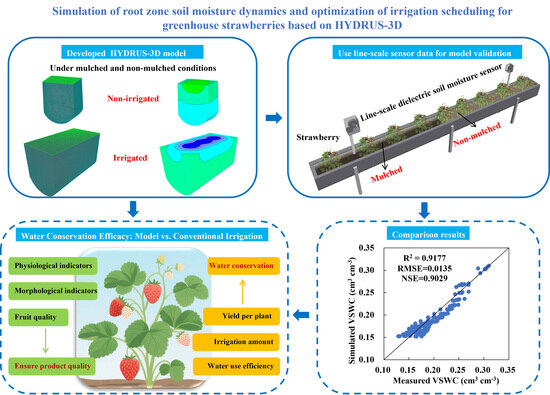
Open AccessArticle Simulation of Root Zone Soil Moisture Dynamics and Optimization of Irrigation Scheduling for Greenhouse Strawberries Based on HYDRUS-3D 1 College of Horticulture, Hebei Agricultural University, Baoding, 071001, China 2 Key Laboratory of North China Water-Saving Agriculture, Ministry of Agriculture and Rural Affairs, Baoding 071001, China * Authors to whom correspondence should be addressed. Horticulturae 2026, 12(6), 715; https://doi.org/10.3390/horticulturae12060715 (registering DOI) Submission received: 10 May 2026 / Revised: 5 June 2026 / Accepted: 6 June 2026 / Published: 9 June 2026 Abstract Understanding the dynamics of root zone soil water content is crucial for precision irrigation scheduling in protected strawberry cultivation. The HYDRUS-3D model is capable of simulating three-dimensional water flow and root water uptake. Although the model has been tested in various settings, its validation under realistic greenhouse cultivation rack systems with direct soil moisture measurements remains limited. In this study, a HYDRUS-3D model was developed to simulate root zone soil water dynamics in a greenhouse U-shaped strawberry cultivation system under both irrigated and non-irrigated conditions, with and without plastic mulch. In the first year, the model’s accuracy was evaluated using a newly developed line-scale dielectric soil moisture sensor. The simulated volumetric soil water content showed good agreement with sensor measurements across all scenarios (R 2 ≥ 0.8302, RMSE ≤ 0.0309, NSE ≥ 0.5979). In the following two years, we utilized the established model to schedule irrigation and investigated its water-saving effects. Model-scheduled irrigation reduced water use by 8.45–13.36% compared with conventional irrigation scheduling. No significant differences were observed in most morphological, physiological, fruit quality, or yield indicators ( p > 0.05). However, occasional improvements were detected in chlorophyll content, root activity, ascorbic acid and total soluble solids. These findings demonstrate that HYDRUS-3D effectively simulates root zone water content dynamics throughout the strawberry growth cycle and serves as a practical tool for precision soil water management in greenhouse cultivation rack systems. Graphical Abstract 1. Introduction In greenhouse horticultural crops, interactions between soil water movement and root uptake are further affected by localized irrigation and restricted evaporation, making accurate simulation of root zone processes essential for effective irrigation management [ 9]. The root water uptake process is strongly influenced by root distribution, soil hydraulic properties, and environmental conditions, particularly under protected cultivation systems where soil water dynamics are highly heterogeneous. Modelling remains the primary approach for estimating soil water infiltration and root water uptake [ 10, 11]. Although theoretical models can be computationally complex, advancements in computer simulation technology have made numerical modelling software an effective tool for studying water dynamics in the root zone [ 12]. Among these, the HYDRUS model is the most representative [ 13, 14, 15, 16, 17, 18]. Its ability to operate independently of specific spatial or temporal scales has led to its widespread application in simulating soil water infiltration and root water uptake [ 19, 20, 21, 22]. Increasing the dimensionality of simulations brings the modelling environment closer to real-world cultivation conditions and improves simulation accuracy [ 23]. García Morillo et al. (2017) [ 24] evaluated the application of HYDRUS-2D in a laboratory setting for strawberry cultivation, focusing on the wetted area generated by drip irrigation as the primary validation metric. Saefuddin et al. (2019) [ 25] employed HYDRUS-3D to simulate root zone moisture dynamics in strawberries. Their work was restricted to demonstrating the performance of a newly developed ring-shaped emitter through numerical modelling alone, without any experimental validation. Soil moisture sensing technology is more efficient compared to other methods, such as labor-intensive soil sampling and weighing methods (often used in infiltration studies) [ 26], and stable isotope techniques (commonly used in root water uptake research) which are often limited by their inability to provide continuous or large-scale estimates of root water uptake [ 27, 28, 29, 30]. Comparative studies between HYDRUS-3D simulation results and actual sensor-based measurements of soil moisture dynamics in the strawberry root zone are extremely limited, and this limitation also hampers the evaluation of the HYDRUS-3D model for practical irrigation scheduling purposes. Point-scale soil moisture sensors have limited spatial coverage [ 31]. In contrast, horizontally mobile line-scale soil moisture sensors have successfully extended point-scale measurements to a line scale [ 32]. This breakthrough in overcoming spatial limitations offers a powerful tool for dynamically monitoring soil moisture in the root zone of strawberry crops. Although irrigation scheduled by HYDRUS-3D simulation results has been preliminarily validated as an effective approach, existing studies have primarily focused on field crops. For example, Magyar et al. (2023) [ 33] developed a water flow model using HYDRUS-3D and applied it to maize irrigation, achieving water conservation while significantly increasing yields. Shan et al. [ 34] (2022) extended HYDRUS-3D simulations to design an optimal brackish-water drip irrigation system for cotton, and proposed a recommended irrigation quota of 5160 m 3 hm −2. However, few studies to date have employed HYDRUS-3D to guide irrigation scheduling in greenhouse cultivation rack systems. In cultivation rack systems, trough restricts lateral root expansion and creates a convex soil surface profile, which exacerbates gravitational water loss from the sides and promotes preferential flow paths along the trough walls [ 35]. These geometric constraints complicate uniform water distribution and increase the risk of localized waterlogging or drought, making precise irrigation scheduling particularly critical. Such systems, however, present distinct physical challenges for 3D water flow modeling. Unlike open-field soils, the growing substrate in a rack is geometrically confined by physical walls, creating specific boundary conditions (e.g., no-flux lateral boundaries and free-drainage bottom). These constraints can drastically alter water redistribution patterns, making accurate simulation of root-zone moisture dynamics in such systems more complex and requiring a 3D approach. In addition, plastic mulching, a common practice used to modify the partitioning between soil evaporation and plant transpiration, further influences root-zone water dynamics. Therefore, we hypothesized that a HYDRUS-3D model parameterized with site-specific soil and root data can accurately simulate root-zone moisture dynamics in a greenhouse strawberry cultivation rack system under varying mulching and irrigation regimes. We further hypothesized that model-based irrigation scheduling could achieve substantial water savings without compromising strawberry yield or quality. To test these hypotheses, this study aims to: (1) develop a HYDRUS-3D-based dynamic model to simulate root-zone soil moisture dynamics in strawberry cultivation rack systems across the entire growth cycle, encompassing both mulching scenarios and distinct irrigation phases; (2) directly validate the model accuracy by monitoring root-zone moisture changes using a newly developed line-scale dielectric soil moisture sensor; (3) assess the water conservation efficacy of the irrigation protocol established by this model through a comparative analysis with conventional-scheduled irrigation practices. 2. Materials and Methods 2.1. Experimental Setup for HYDRUS-3D (Version 2.04) Model Validation The experiment was carried out in a solar greenhouse situated at the Experimental Teaching Base of Hebei Agricultural University (38.827133° N, 115.447448° E). As shown in Figure 1a, strawberries were planted using a dual-row cultivation rack system. The iron cultivation racks housed U-shaped soil troughs measuring 40 cm in height, 600 cm in length, and 30 cm in width. The experiment was conducted using a natural loam soil collected from the greenhouse site. Fertilization was kept identical across all treatments to avoid confounding effects. Before transplanting, each cultivation rack received 20 kg of well-decomposed sheep manure as a basal organic fertilizer. No additional soluble fertilizers or fertigation were applied during the growth cycle. Therefore, all observed differences between irrigation schedules are mainly attributable to water management, not to nutrient variability. The row spacing was 10 cm, and the intra-row plant spacing was 20 cm. The strawberries were transplanted on 5 December 2023, and the experiment lasted 120 days. The irrigation frequency and amount were determined empirically by the farm manager based on routine greenhouse practice. Each irrigation event was terminated when water began to exude from the bottom of the cultivation rack, ensuring that the entire soil profile in the trough had approached near-saturation. To continuously monitor changes in root zone soil moisture during strawberry growth, a line-scale soil moisture sensor was installed at a depth of 15 cm below the soil surface. Half of the strawberry plants above the sensor were mulched, while the other half were not. Drip irrigation was applied using drip tapes with emitter spacing equal to the plant spacing (20 cm) and an emitter flow rate of 2.4 L h −1 (Hebei Shuirun Jiahe Modern Agricultural Science and Technology Co., Ltd., Baoding, China). A completely randomized design was adopted for continuous root-zone moisture monitoring. Three replicate cultivation racks were used to capture the complete moisture dynamics throughout the strawberry growth period. Another three racks without sensors were set up for parallel destructive root sampling to avoid interference with the moisture measurements. As illustrated in Figure 1b, the line-scale soil moisture sensing system features a dual-ring electrode probe connected to an electronic oscillator (100 MHz). The fringing electric field generated by the oscillator penetrates the PVC tubing to detect the soil’s dielectric properties, enabling real-time monitoring of volumetric water content. The probe is connected at both ends via nylon cords and signal cables to a DC motor (Mingyang Motor Co. Ltd., Shenzhen, China) and a stepper motor (Beijing Shidai Chaoqun Electrical Technology Co. Ltd., Beijing, China), which together control horizontal movement within a 4 m PVC pipe at 5 cm intervals. Excluding pulley and proximity switch structures at both ends, each measurement yields 75 data points. The sensor has a measurement radius of 7 cm and a response time of 1) K ssaturated K(cm h −1) l pore connectivity parameter S e effective water content (cm 3 cm −3) b x , y , z spatial distribution of root water uptake T p potential transpiration rate (cm h −1) S t is the area of evaporation on the soil surface (cm 2) h 0 root water absorption anaerobic point pressure head (cm) h 1 optimal root water absorption pressure head (cm) h 2 root water absorption best endpoint pressure head (cm) h 3 root water absorption endpoint pressure head (cm) xm, ym, zmMaximum rooting lengths in x, y, z directions (cm) x*, y*, z*Max root water uptake location in x, y, z directions px, py, pzempirical coefficients Figure 2. Boundary conditions for water flow in the simulation domain: ( a) irrigated, non-mulched; ( b) irrigated, mulched; ( c) non-irrigated, non-mulched; ( d) non-irrigated, mulched. Figure 2. Boundary conditions for water flow in the simulation domain: ( a) irrigated, non-mulched; ( b) irrigated, mulched; ( c) non-irrigated, non-mulched; ( d) non-irrigated, mulched. Table 2. Soil physical and hydraulic parameters utilized in HYDRUS-3D model simulations. Table 2. Soil physical and hydraulic parameters utilized in HYDRUS-3D model simulations. Soil Physical Parameters Water Flow Parameters Type loam θr (cm 3·cm −3) 0.037 Bulk density (g cm −3) 1.28 θs (cm 3·cm −3) 0.38 Field capacity (cm 3·cm −3) 0.23 α (cm −1) 0.0079 %clay (0–2 um) 3.18 n (-) 1.5831 %silt (2–50 um) 69.74 Ks (cm·h −1) 4.06 %sand (50–2000 um) 27.07 l (–) 0.5 Table 3. Technical specifications of environmental sensors. Table 3. Technical specifications of environmental sensors. Parameter Manufacturer Range Accuracy Temperature Jianda Renke Ltd. Jinan, China −40 °C~+120 °C ±0.4 °C (25 °C) Humidity Jianda Renke Ltd. Jinan, China 0%RH–100%RH ±2%RH (60%RH, 25 °C) PAR Jianda Renke Ltd. Jinan, China 0~2500 μmol/m 2·s ±5% (1000 umol m −2 s −1, 550 nm, 60%RH, 25 °C) 2.3. Experimental Setup for Studying Model-Scheduled Irrigation Effect In the following two years, two separate validation experiments were carried out in the same greenhouse where the model was originally established and validated, aiming to assess its water-saving performance over two consecutive growing seasons (2024–2025: December 2024 to April 2025; 2025–2026: December 2025 to April 2026). The strawberry planting method was consistent with that in the previous model establishment process, with the same dimensions of the cultivation rack production mode. Under mulched and non-mulched conditions separately, a completely randomized design was implemented to evaluate the difference between model-scheduled irrigation and conventional irrigation, yielding four treatment combinations. Each treatment had four replicate cultivation racks. Among the four replicates, three were used for growth, physiological, quality, and yield measurements, while the remaining rack was dedicated to periodic root sampling to avoid disturbing the plants in the other replicates. Root distribution was measured prior to each irrigation event, and the data were used to simulate root zone water dynamics during the preceding period. The irrigation amount for HYDRUS-3D scheduled irrigation was determined based on cumulative root water uptake and cumulative atmospheric boundary conditions derived from model simulations: for mulched sections, only cumulative root water uptake was considered; for non-mulched sections, the sum of both was used. The primary purpose of this approach was to achieve precision irrigation based on real-time root zone water dynamics (i.e., according to changes in root zone moisture content). The irrigation schedule based on the model was the same as that under conventional irrigation scheduling, and a flow meter (measured range: 0.1–7 L min −1, Yongjia County Wengang Hardware Products Co., Ltd., Wenzhou, China) was mounted at the front of each cultivation rack to log irrigation volume. Throughout the experiment, three plants were randomly selected from mulched and non-mulched cultivation racks under different irrigation schedules, respectively, to measure strawberry morphological indicators (plant height and leaf area), physiological indicators (relative chlorophyll content and root activity), fruit quality (ascorbic acid, organic acids, soluble sugars, and soluble solids) and yield, aiming to compare the differences between model-scheduled irrigation and conventional-scheduled irrigation. Plant height was measured at the tallest part of the plant with a straightedge. Leaf area was estimated via the leaf width-leaf area regression method [ 47]. Relative chlorophyll content was quantified using a portable chlorophyll meter (SPAD-502; Konica Minolta, Inc., Tokyo, Japan), while root activity was assayed by the TTC method [ 48]. Ascorbic acid content was determined through titration [ 49], organic acids via acid-base titration [ 50], soluble sugars by the anthrone reagent method [ 51], and soluble solids (TSS) with a refractometer (PR-32α; Atago Co., Ltd., Japan). Irrigation water use efficiency (IWUE) was calculated as the ratio of fruit yield (kg) to total irrigation volume (L) per cultivation rack. 2.4. Statistical Analysis Three indicators, including the determination coefficient (R 2), the root mean square error (RMSE) and Nash-Sutcliffe efficiency (NSE), were considered to evaluate the simulation accuracy of the model: R 2 = ∑ i = 1 n ( a i − a ପ୍ତ ) ( b i − b ପ୍ତ ) 2 ∑ i = 1 n a i − a ପ୍ତ 2 ∑ i = 1 n ( b i − b ପ୍ତ ) 2 R M S E = ∑ i = 1 n ( a i − b i ) 2 n N S E = 1 − ∑ i = 1 n ( a i − b i ) 2 ∑ i = 1 n ( a i − a ପ୍ତ ) 2 where n is the total number of data points, a i is the measured value from the line-scale soil moisture sensor, b i is the simulated value from HYDRUS-3D, a ପ୍ତ and b ପ୍ତ are the mean of the measured value and the mean of the simulated value. One-way ANOVA was conducted to detect significant differences in the measured indicators between model-scheduled irrigation and conventional-scheduled irrigation. The probability level for determination of significance was 0.05. Normality was assessed by Shapiro–Wilk test ( p > 0.05) and homogeneity of variances by Levene’s test ( p > 0.05) before performing one-way ANOVA. 3. Results and Discussion 3.1. Dynamics of Soil Moisture in the Strawberry Root Zone Figure 3 presents the root zone volumetric soil water content (VSWC) dynamics throughout the 120-day strawberry growth cycle as measured by the line-scale sensor. A clear difference can be observed between mulched and non-mulched treatments, with mulching significantly enhancing soil water content by suppressing surface evaporation and reducing unproductive water loss [ 52, 53]. Regardless of mulching, the spatial distribution of VSWC within the root zone was uneven, which might be ascribed to soil heterogeneity, emitter placement, and the spatial distribution of strawberry roots. This level of detail cannot be captured by point-scale sensors, highlighting the technical advantages of the line-scale sensor in the drip irrigation system [ 36]. Six distinct irrigation events were recorded. As strawberry plants grew, their root systems and leaf area expanded, leading to increased root water uptake. Accordingly, irrigation frequency increased during the later growth stages ( Figure 3). From the fourth irrigation onward, notable differences in root zone moisture between mulched and non-mulched treatments emerged. As reported in the study conducted by García Morillo et al. (2017), when VSWC falls between 0.15 and 0.20 cm 3·cm −3, strawberry roots experience water stress [ 24]. Based on this threshold, the strawberries in the non-mulched treatment reached a stress state approximately seven days after each irrigation event. 3.2. 3D Simulation of Root Zone VSWC 3.3. Comparison of Simulated and Measured VSWC Dynamics As illustrated in Figure 7, during the 16 days without irrigation, the temporal decline in root zone VSWC exhibited a consistent downward trend for both the mulched and non-mulched treatments. While certain deviations were observed between simulated and measured data, the temporal trends exhibited synchrony without a distinct time lag. This alignment is likely due to the broader temporal resolution (shifting from minutes during irrigation to days) during the drying phase. At observation points located −5 cm, 0 cm, and 5 cm from the emitter, no consistent pattern was observed in the decrease in water content over 16 days between mulched and non-mulched conditions, possibly due to the influence of initial water content. Additionally, the total change in VSWC over the 16 days was relatively similar across the three positions. This may be due to the proximity of the observation points, resulting in similar root distribution patterns in the strawberry plants [ 55]. 3.4. Evaluation of HYDRUS-3D Simulation Accuracy for Root Zone VSWC Dynamics As shown in Figure 8, the simulated values from HYDRUS-3D and the sensor measurements during both irrigated and non-irrigated periods under both mulched and non-mulched conditions were distributed closely around the 1:1 line. The high R 2 values (0.8302–0.9177), NSE values (0.5979–0.9029) and low RMSE values (0.0135–0.0309) indicate that the model performs well in capturing the dynamics of VSWC in the strawberry root zone. However, it should be noted that some spatial variability of soil moisture within the cultivation racks and potential edge effects may exist, which could be attributed to the non-uniform root water uptake, the lateral distribution of irrigation water, and the greenhouse environmental conditions [ 59, 60]. These factors might introduce minor discrepancies between line-scale sensor measurements and domain-scale model simulations. As noted by dos Santos et al. (2025), such spatial heterogeneity must be considered in precision irrigation design [ 61]. Under mulched treatments, the simulation results during non-irrigated periods exhibited significantly higher accuracy (higher R 2, higher NSE, lower RMSE) compared to those during irrigated periods ( p < 0.05). This may be due to the following reasons: (1) During the irrigated phase, simulations were performed at minute-scale intervals, resulting in a highly dynamic soil water movement. (2) During non-irrigated periods, simulations were carried out daily, and the root water uptake process occurred at a relatively slow pace. In the non-mulched treatment, the R 2 of the non-irrigated condition was significantly higher than that of the irrigated condition, whereas the NSE of the irrigated condition was higher than that of the non-irrigated condition, with no significant difference in RMSE. The reason may be that environmental factors had a greater impact on the model performance in the non-mulched treatment. Additionally, across both irrigated and non-irrigated periods, simulations under the mulched condition achieved significantly higher accuracy than those under non-mulched conditions ( p < 0.05). A likely explanation is that under non-mulched conditions, the estimation of soil evaporation based on environmental parameters may be less accurate, thereby affecting simulation performance. Compared with previous studies in which researchers used HYDRUS-2D to simulate the wetted area in the strawberry root zone and HYDRUS-3D for theoretical simulation of strawberry root water uptake dynamics [ 24, 25], the present study represents the first attempt to validate HYDRUS-3D simulations of both drip water infiltration and root water uptake under actual strawberry cultivation. Good agreement across various processes and time scales between simulations and measurements validates the model’s capacity to forecast root zone soil water dynamics under practical cultivation conditions. Figure 8. Comparison between HYDRUS-3D simulation results and sensor measurements during irrigated ( a, c) and non-irrigated periods ( b, d) under mulched ( a, b) and non-mulched ( c, d) conditions. Figure 8. Comparison between HYDRUS-3D simulation results and sensor measurements during irrigated ( a, c) and non-irrigated periods ( b, d) under mulched ( a, b) and non-mulched ( c, d) conditions. 3.5. Model-Scheduled Irrigation Effect Based on data from two growing seasons, as shown in Figure 9, no significant differences in strawberry leaf area and plant height were observed between model-scheduled irrigation (MS) and conventional-scheduled irrigation (CS) under both mulch and non-mulch conditions. This is likely due to the two irrigation regimes both meeting the basic water requirements of strawberry roots, and the differences between them have not reached the threshold required to drive significant changes in leaf area and plant height [ 62, 63]. In the mulched area, the SPAD of strawberries showed significant differences at multiple time points, with MS being higher than CS. This could be due to excessive soil water content in the CS treatment suppressing the activity of enzymes associated with chlorophyll synthesis [ 64, 65]. In terms of root activity, there were no significant differences in strawberries in the mulched area. In contrast, strawberries in the non-mulched area showed differences at a small number of time points. This may be due to the drastic changes in VSWC in the non-mulched area, where the relatively high irrigation amount in CS easily induces ‘repeated wetting-drying cycles’, inhibiting root respiration and reducing root activity [ 66]. These results suggest that model-scheduled irrigation can influence certain measured physiological variables (e.g., chlorophyll content and root activity), but the overall physiological performance was not comprehensively evaluated. Figure 9. Measurement results of strawberry leaf area ( a, e), plant height ( b, f), chlorophyll content ( c, g), and root activity ( d, h) under model-scheduled irrigation (MS) and conventional-scheduled irrigation (CS) with and without plastic mulch across two growing seasons. Under the same condition (either plastic mulching or non-plastic mulching), different lowercase letters indicate statistically significant differences in measured values between different irrigation schedules ( p < 0.05). Figure 9. Measurement results of strawberry leaf area ( a, e), plant height ( b, f), chlorophyll content ( c, g), and root activity ( d, h) under model-scheduled irrigation (MS) and conventional-scheduled irrigation (CS) with and without plastic mulch across two growing seasons. Under the same condition (either plastic mulching or non-plastic mulching), different lowercase letters indicate statistically significant differences in measured values between different irrigation schedules ( p < 0.05). As presented in Table 4, no significant differences were observed between the two irrigation schedules in single fruit weight and per-plant yield. Our results do not align with previous findings that yield increases with increasing irrigation amount [ 54, 65]. This discrepancy may be attributed to the different cultivation patterns; previous studies were conducted under field planting conditions, whereas ours adopted a cultivation rack system [ 6, 54]. The root zone moisture environments created by the two irrigation schedules were adequate to support the healthy growth of strawberry plants. However, throughout the entire growth cycle, the irrigation amount under model-scheduled irrigation decreased by 8.45% ± 4.33% and 13.36% ± 3.15% in mulched and non-mulched conditions, respectively. Additionally, irrigation water use efficiency increased by 1.41 ± 0.49 and 1.70 ± 1.04 kg m −3, respectively. The difference in irrigation water use efficiency between the two irrigation regimes can be attributed to the fact that growers generally apply excessive irrigation under conventional scheduling to avoid crop water stress. The surplus water is lost through deep percolation and ineffective soil surface evaporation, which substantially reduces irrigation water use efficiency. In contrast, model-based quantitative irrigation is formulated according to root zone soil moisture dynamics and actual crop water demand, matching the root water uptake pattern of strawberries across different growth stages. This approach minimizes unproductive water consumption and converts a greater proportion of irrigation water into vegetative biomass and fruit yield [ 69, 70]. From the above results, it is evident that model-scheduled irrigation achieves water savings by reducing water consumption and improving water productivity, while ensuring strawberry quality. This finding further confirms that minimizing ineffective water loss is key to enhancing water use efficiency [ 53, 71, 72]. As emphasized by Rosa & Marin (2025), crop water productivity is co-regulated by irrigation amount, microclimate, and management practices [ 73]. Our findings support this view, as water savings varied with mulching and seasonal conditions. Figure 10. Measurement results of organic acids ( a, e), ascorbic acid ( b, f), total soluble solids (TSS) ( c, g), and soluble sugars ( d, h) in strawberries under model-scheduled irrigation (MS) and conventional-scheduled irrigation (CS) with and without film mulching across two growing seasons. Under the same condition (either plastic mulching or non-plastic mulching), different lowercase letters indicate statistically significant differences in measured values between different irrigation schedules ( p < 0.05). Figure 10. Measurement results of organic acids ( a, e), ascorbic acid ( b, f), total soluble solids (TSS) ( c, g), and soluble sugars ( d, h) in strawberries under model-scheduled irrigation (MS) and conventional-scheduled irrigation (CS) with and without film mulching across two growing seasons. Under the same condition (either plastic mulching or non-plastic mulching), different lowercase letters indicate statistically significant differences in measured values between different irrigation schedules ( p < 0.05). Water savings achieved by model-scheduled irrigation, without compromising strawberry yield or quality, can be explained physiologically. The HYDRUS-3D model maintains soil water content near field capacity within the main root absorption zone (the “wet bulb”), avoiding both root asphyxiation caused by over-irrigation and severe water stress caused by deficit irrigation. This optimal moisture regime supports root activity, chlorophyll synthesis (as reflected by SPAD values), and efficient translocation of photosynthetic assimilates to fruits, ultimately sustaining yield and quality while reducing unnecessary water loss. This aligns with Gültaş (2025), who showed that irrigation management directly modulates crop water stress dynamics and that maintaining soil moisture above critical thresholds prevents the negative physiological impacts of reduced water inputs [ 74]. Table 4. Results of strawberry fruit yield, irrigation amount and irrigation water use efficiency (IWUE) under different irrigation schedules with and without plastic mulching across two growing seasons, Under the same condition (either plastic mulching or non-plastic mulching), different lowercase letters indicate statistically significant differences in measured values between different irrigation schedules ( p < 0.05). Table 4. Results of strawberry fruit yield, irrigation amount and irrigation water use efficiency (IWUE) under different irrigation schedules with and without plastic mulching across two growing seasons, Under the same condition (either plastic mulching or non-plastic mulching), different lowercase letters indicate statistically significant differences in measured values between different irrigation schedules ( p < 0.05). Indicators Mulched Non-mulched MS CS MS CS 2024–2025 Weight of per fruit (g) ୨୨.୪୧ ବ୍ଦ ୨.୯୫ a୨୩.୨୮ ବ୍ଦ ୨.୦୨ a୨୩.୭୧ ବ୍ଦ ୩.୩୭ a୨୪.୨୧ ବ୍ଦ ୨.୩୧ aYield per plant (g) ୫୫୯.୫୫ ବ୍ଦ ୩୧.୦୩ a୫୬୯.୮୩ ବ୍ଦ ୨୦.୮ a୫୪୬.୩ ବ୍ଦ ୨୨.୩ a୫୫୦.୫ ବ୍ଦ ୩୧.୯ aIrrigation amount (L) ୨୩୫୮.୯୧ ବ୍ଦ ୪୪.୭ a୨୭୧୫.୬ ବ୍ଦ ୫୫.୨ b୨୪୫୨.୯ ବ୍ଦ ୪୭.୩୧ a୨୮୩୧.୧ ବ୍ଦ ୪୧.୮୩ bIWUE (kg m −3) ୧୪.୨୩ ବ୍ଦ ୦.୫୩ a୧୨.୬ ବ୍ଦ ୦.୫୭ b୧୩.୩୬ ବ୍ଦ ୦.୪୪ a୧୧.୬୬ ବ୍ଦ ୦.୬ b2025–2026 Weight of per fruit (g) ୨୩.୩୭ ବ୍ଦ ୩.୮୮ a୨୪.୬୧ ବ୍ଦ ୩.୬୬ a୨୩.୩୪ ବ୍ଦ ୨.୬୩ a୨୩.୭୧ ବ୍ଦ ୪.୫୩ aYield per plant (g) ୫୨୪.୮୮ ବ୍ଦ ୨୯.୯୬ a୫୧୮.୧୬ ବ୍ଦ ୩୧.୪୧ a୪୯୫.୩୪ ବ୍ଦ ୨୭.୪୮ a୫୨୩.୭୮ ବ୍ଦ ୪୦.୫୭ aIrrigation amount (L) ୨୦୫୮.୯୧ ବ୍ଦ ୪୪.୯ a୨୨୪୮.୯୩ ବ୍ଦ ୫୨.୪ b୨୫୫୯.୫୭ ବ୍ଦ ୪୮.୮୬ a୨୮୪୭.୭୩ ବ୍ଦ ୪୧.୪ bIWUE (kg m −3) ୧୪.୦୩ ବ୍ଦ ୦.୨୧ a୧୨.୬୨ ବ୍ଦ ୦.୨୮ b୧୩.୨୫ ବ୍ଦ ୦.୫୩ a୧୧.୭୮ ବ୍ଦ ୦.୬୫ b The validated HYDRUS-3D model offers a practical tool for precision irrigation management in greenhouse strawberry production. By dynamically simulating root zone water content and crop water demand, the model enables irrigation scheduling that aligns with actual plant needs, thereby reducing water waste and enhancing water productivity. A limitation of this study is that we did not directly measure the soil water retention curves. Instead, we relied on the Rosetta pedotransfer function. While the good agreement between simulated and measured soil moisture (R 2 ≥ 0.8302, RMSE ≤ 0.0309, NSE ≥ 0.5979) supports the adequacy of the estimated parameters for this specific loam soil and rack system, pedotransfer functions carry inherent uncertainty. Direct measurement of retention curves in future studies would further enhance model reproducibility and transferability. Another limitation is that root system representation may also introduce uncertainty into the simulations. Although measured three-dimensional root length density distributions were incorporated into HYDRUS-3D, root sampling was conducted only at discrete dates rather than continuously throughout the growth cycle. Since root distribution directly affects the spatial pattern of root water uptake and soil water depletion, temporal changes in root growth may have influenced model performance, particularly during rapid growth stages. Future studies should include higher-frequency root observations or dynamic root-growth modules to improve the temporal representation of root water uptake. 4. Conclusions This study developed and validated a HYDRUS-3D model for simulating root-zone water dynamics in a greenhouse strawberry cultivation rack system. The model showed high predictive accuracy when validated against continuous measurements from a novel line-scale dielectric soil moisture sensor, confirming its ability to capture both irrigation infiltration and root water uptake processes under mulched and non-mulched conditions. Over two subsequent growing seasons, irrigation scheduling based on this model reduced water use by 8.45–13.36% while maintaining or slightly improving fruit quality and yield. A limitation of this study is that soil hydraulic parameters were not directly measured but estimated via the Rosetta pedotransfer function. Furthermore, other important physicochemical properties—such as organic matter content, pH, electrical conductivity (EC), and nutrient status—remain unavailable. While these limitations do not invalidate the modeling exercise, they reduce reproducibility and limit the transferability of the proposed irrigation strategy to other production systems. Therefore, the model’s transferability to other soils or substrates requires site-specific calibration, preferably including experimentally determined water retention curves. Without independent validation and parameter adjustment, direct transfer of the model-scheduled irrigation amounts from this study to greenhouses with different substrates, rack dimensions, emitter layouts, or climatic conditions is not recommended. Future work should focus on developing a generalized calibration framework that accounts for all these variables. Additionally, we did not evaluate nutrient dynamics or fertigation effects, whereas commercial greenhouse strawberry production commonly uses fertigation. Future research should focus on integrating solute transport modules within HYDRUS-3D to optimize combined water and nutrient delivery, and combining the validated HYDRUS-3D model with real-time sensor feedback and Internet of Things (IoT) technologies to develop a closed-loop, automated decision support system (DSS) for precision irrigation and fertigation management in protected horticulture. Author Contributions Conceptualization, G.S. and B.D.; Methodology, Z.J., Y.Y. and J.S.; Investigation, Z.J., Y.Y. and J.S.; Data Curation, Z.J. and C.S.; Software, Z.J., C.S. and J.Q.; Validation, J.Q., G.S. and B.D.; Writing—Original Draft, Z.J., Y.Y., J.S., G.S. and B.D.; Writing—Review and Editing, Z.J., G.S. and B.D.; Project administration, G.S. and B.D. All authors have read and agreed to the published version of the manuscript. Funding This research was funded by the Natural Science Foundation of Hebei Province [C2024204061], 2023 Project for the Introduction of Overseas Scholars in Hebei Province [C20230338], Introduction of Talents for Scientific Research of State Key Laboratory of North China Crop Improvement and Regulation (NCCIR2022RC-3), Introduction of Talents for Scientific Research of Hebei Agriculture University (YJ2022006) and Hebei Agriculture Research System (HBCT2024200404). Data Availability Statement The original contributions presented in this study are included in the article. Further inquiries can be directed to the corresponding authors. Conflicts of Interest The authors declare no conflicts of interest. References Disclaimer/Publisher’s Note: The statements, opinions and data contained in all publications are solely those of the individual author(s) and contributor(s) and not of MDPI and/or the editor(s). MDPI and/or the editor(s) disclaim responsibility for any injury to people or property resulting from any ideas, methods, instructions or products referred to in the content. © 2026 by the authors. Licensee MDPI, Basel, Switzerland. This article is an open access article distributed under the terms and conditions of the Creative Commons Attribution (CC BY) license. Share and Cite MDPI and ACS Style Jing, Z.; Yang, Y.; Song, J.; Song, C.; Qian, J.; Shan, G.; Di, B. Simulation of Root Zone Soil Moisture Dynamics and Optimization of Irrigation Scheduling for Greenhouse Strawberries Based on HYDRUS-3D. Horticulturae 2026, 12, 715. https://doi.org/10.3390/horticulturae12060715 AMA Style Jing Z, Yang Y, Song J, Song C, Qian J, Shan G, Di B. Simulation of Root Zone Soil Moisture Dynamics and Optimization of Irrigation Scheduling for Greenhouse Strawberries Based on HYDRUS-3D. Horticulturae. 2026; 12(6):715. https://doi.org/10.3390/horticulturae12060715 Chicago/Turabian Style Jing, Ze, Yang Yang, Jiashuai Song, Chunyu Song, Ji Qian, Guilin Shan, and Bao Di. 2026. "Simulation of Root Zone Soil Moisture Dynamics and Optimization of Irrigation Scheduling for Greenhouse Strawberries Based on HYDRUS-3D" Horticulturae 12, no. 6: 715. https://doi.org/10.3390/horticulturae12060715 APA Style Jing, Z., Yang, Y., Song, J., Song, C., Qian, J., Shan, G., & Di, B. (2026). Simulation of Root Zone Soil Moisture Dynamics and Optimization of Irrigation Scheduling for Greenhouse Strawberries Based on HYDRUS-3D. Horticulturae, 12(6), 715. https://doi.org/10.3390/horticulturae12060715 Note that from the first issue of 2016, this journal uses article numbers instead of page numbers. See further details here. Article Metrics Article metric data becomes available approximately 24 hours after publication online.
Simulation of Root Zone Soil Moisture Dynamics and Optimization of Irrigation Scheduling for Greenhouse Strawberries Based on HYDRUS-3D