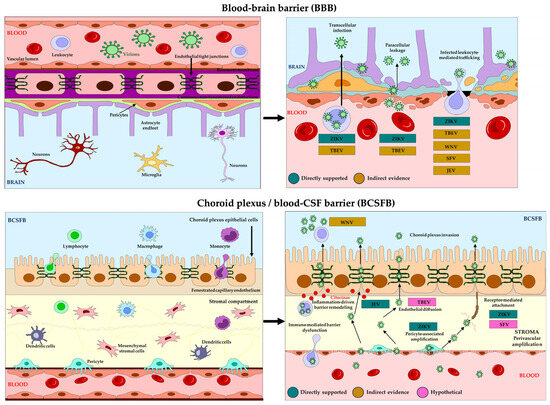
Open AccessReview The Forgotten Gate: Choroid Plexus and Blood-CSF Barrier in Arboviral Encephalitis 1 Laboratory of Fish Physiology and Biotechnology (LabFISH), Department of Biosciences, Federal University of Jataí (UFJ), Jataí 75801-615, GO, Brazil 2 Genomics Laboratory, Department of Biology, São Paulo State University (UNESP), São José do Rio Preto 15054-000, SP, Brazil 3 Laboratory of Cardiovascular Pharmacology and Toxicology (LAFTOCAR), Department of Health Sciences, Federal University of Jataí (UFJ), Jataí 75801-615, GO, Brazil 4 Laboratory of Virology Research, Department of Dermatological, Infectious and Parasitic Diseases, School of Medicine of São José do Rio Preto (FAMERP), São José do Rio Preto 15090-000, SP, Brazil * Author to whom correspondence should be addressed. Life 2026, 16(6), 975; https://doi.org/10.3390/life16060975 (registering DOI) Submission received: 20 April 2026 / Revised: 31 May 2026 / Accepted: 4 June 2026 / Published: 9 June 2026 Abstract Mechanisms of arboviral neuroinvasion are still incompletely resolved, despite longstanding emphasis on the blood-brain barrier (BBB) as the principal interface for central nervous system (CNS) entry. While BBB-centered models have been highly informative, they may underrepresent the contribution of other CNS border structures, particularly the choroid plexus and the blood-cerebrospinal fluid barrier (BCSFB). Here, we re-examine the BCSFB as a relevant but unevenly supported neuroinvasion interface in arboviral encephalitis. The strongest direct evidence is currently available for Zika virus (ZIKV), for which experimental studies support infection of choroid plexus-associated cells and CNS access through the blood-CSF axis. Semliki Forest virus (SFV) provides additional direct, although still limited, support for this concept. In contrast, for West Nile virus (WNV), Japanese encephalitis virus (JEV), and tick-borne encephalitis virus (TBEV), evidence for choroid plexus involvement remains indirect or insufficiently resolved, even though neuroinvasion itself is well established. We therefore argue not for replacement of BBB-centered models, but for broader integration of the BCSFB into current frameworks of arboviral CNS invasion. This evidence-based perspective supports a hierarchical, virus-dependent view of choroid plexus involvement and highlights the need for mechanistic studies that directly test when and how this interface contributes to encephalitic disease. Graphical Abstract 1. Introduction The choroid plexus is not merely a CSF-producing tissue [ 6, 8]. It is a specialized neuroepithelial structure composed of fenestrated stromal capillaries, resident immune and stromal elements, and a polarized epithelial layer sealed by tight junctions that forms the BCSFB [ 6, 8, 9]. Because this barrier differs from the non-fenestrated endothelial architecture of the BBB, it is likely to impose distinct constraints on pathogen exposure, cellular tropism, immune sensing, and barrier crossing [ 6, 8]. In parallel, the choroid plexus is increasingly recognized as an active participant in CNS immune surveillance, regulating cytokine signaling and leukocyte trafficking under both homeostatic and inflammatory conditions [ 7, 9]. Taken together, these properties support the BCSFB as a potential site of arbovirus-host interaction, even if its contribution is unlikely to be uniform across all neurotropic viruses [ 6, 7, 8, 9]. 2. Materials and Methods Search Strategy and Evidence Synthesis This article was developed as a structured narrative review focused on the potential role of the choroid plexus and the blood-cerebrospinal fluid barrier (BCSFB) in arboviral neuroinvasion. A targeted literature search was conducted in PubMed, Scopus, and Web of Science to identify studies relevant to arboviral encephalitis, neuroinvasion pathways, choroid plexus biology, BCSFB function, cerebrospinal fluid biomarkers, and experimental models of CNS barriers. Search terms included combinations of “arbovirus,” “arboviral encephalitis,” “neuroinvasion,” “choroid plexus,” “blood-cerebrospinal fluid barrier,” “blood-CSF barrier,” “blood-brain barrier,” “cerebrospinal fluid,” “Zika virus,” “West Nile virus,” “Japanese encephalitis virus,” “tick-borne encephalitis virus,” “Semliki Forest virus,” “flavivirus,” “alphavirus,” “neuroinflammation,” “barrier dysfunction,” “single-cell transcriptomics,” and “choroid plexus immune response.” 3. Main Concepts and Evidence 3.1. Anatomy and Biology of the Choroid Plexus and the Blood-CSF Barrier The choroid plexus forms the structural and functional basis of the BCSFB and represents a key interface regulating molecular exchange and immune interactions between the systemic circulation and the CNS. Its primary physiological functions include the production of CSF and the regulation of molecular transport between the systemic circulation and the ventricular compartment ( Figure 1). In contrast, the BBB is formed by non-fenestrated endothelial cells of cerebral capillaries, associated with tight junction complexes, pericytes, and astrocytic end-feet, collectively constituting the neurovascular unit. This structural organization establishes a selective system for the transport of substances between the blood and the brain parenchyma. The BBB plays a central role in maintaining neuronal homeostasis by restricting the entry of potentially harmful compounds and regulating the supply of essential nutrients [ 15]. However, this high degree of structural restriction contrasts with the organization of the BCSFB, in which selectivity is predominantly determined by the choroid epithelium, rich in fenestrated blood vessels, suggesting important functional differences in interactions with circulating pathogens. These structural and functional differences highlight that multiple CNS interfaces may interact with circulating pathogens; however, the interpretation of neuroinvasion has historically been dominated by a BBB-centered framework. 3.2. Why the Field Became BBB-Centric Although the BBB and the BCSFB are frequently grouped as neuroimmune barriers, their differences in anatomical and physiological organization imply distinct consequences for neuroinvasion. Whereas the BBB is composed of continuous microvascular endothelial cells interconnected by highly restrictive tight junctions, the BCSFB is characterized by vascularized stromal structures and a fenestrated epithelium containing resident immune cells and pronounced secretory activity. This distinction suggests that the choroid plexus is more closely associated with immunological functions linked to systemic inflammatory signaling, differing from the traditionally dominant experimental focus centered on the BBB [ 16, 19]. Within this BBB-centered framework, a set of canonical mechanisms of neuroinvasion has been established and widely adopted. These include transcellular transport across endothelial cells, paracellular leakage associated with inflammation-induced disruption of tight junctions, immune cell-mediated transport (“Trojan horse” mechanism), and cytokine and matrix metalloproteinase-mediated barrier dysfunction. Together, these mechanisms have provided the dominant framework for interpreting viral entry into the CNS for decades [ 20]. Emerging evidence indicates that this model does not fully account for all observed patterns of neuroinvasion. In several viral infections, including arboviral models, viral presence in the CNS has been detected in the absence of overt BBB disruption. Additional findings, such as early detection of viral components in the CSF and preferential involvement of periventricular regions, suggest that alternative interfaces may contribute to viral entry and dissemination [ 21]. These observations suggest that the historical emphasis on the BBB has left other CNS interfaces largely underexplored, including the choroid plexus and the BCSFB. Reassessing these structures is therefore justified, not as a replacement for BBB-centered models, but as a way to test whether current frameworks have incompletely captured the range of neuroinvasion routes used by different neurotropic arboviruses. 3.3. Evidence for Choroid Plexus Involvement in Arboviral Infections Evidence supporting involvement of the choroid plexus and the BCSFB in arboviral neuroinvasion remains uneven and should not be interpreted as equivalent across viral systems ( Table 1). The strongest direct experimental support is currently available for ZIKV, for which experimental work has shown infection of choroid plexus-associated pericytes and CNS access through the blood-CSF interface [ 10]. SFV provides a more recent and mechanistically important example, with evidence that neuroinvasion can occur through the BCSFB via VLDLR-expressing choroid plexus epithelial cells [ 11]. In contrast, for WNV, JEV, and TBEV, the available literature primarily supports established neuroinvasion through BBB-associated disruption, inflammatory amplification, leukocyte trafficking, or neuronal routes, whereas the specific contribution of the choroid plexus remains indirect, incompletely resolved, or speculative [ 1, 2, 3, 4, 5]. Therefore, the current literature supports a hierarchical interpretation rather than a universal model in which all arboviruses use the BCSFB through similar mechanisms [ 1, 2, 10, 11]. The situation is considerably less resolved for WNV, JEV, and TBEV. WNV neuroinvasion has been extensively studied, but dominant models emphasize BBB dysfunction, hematogenous spread, inflammatory permeability changes, leukocyte-associated trafficking, and neuronal routes, while the role of the blood-CSF barrier remains comparatively underexplored [ 2]. JEV neuroinvasion has similarly been discussed in relation to inflammatory responses, interactions with host cells, immune-cell-associated spread, and mechanisms of entry into the brain, but direct BCSFB traversal through the choroid plexus has not been clearly established [ 3]. For TBEV, experimental evidence supports BBB permeability changes during infection, but this does not establish the BCSFB as a primary entry route [ 4, 5]. Taken together, the available evidence supports a cautious and virus-dependent model of choroid plexus involvement in arboviral encephalitis. In ZIKV infection, direct experimental evidence places the choroid plexus and BCSFB within the neuroinvasion process [ 10]. In SFV infection, receptor-based evidence involving VLDLR-expressing choroid plexus epithelial cells provides additional direct support, although this remains limited to specific experimental models [ 11]. For WNV, JEV, and TBEV, the choroid plexus should not yet be presented as a confirmed primary gateway. In these infections, BCSFB involvement remains biologically plausible but experimentally unresolved [ 1, 2, 3, 4, 5]. This distinction is important because CSF abnormalities, periventricular inflammation, or barrier dysfunction may reflect secondary inflammatory effects rather than direct viral entry through the choroid plexus [ 6, 12, 13]. Table 1. Current evidence supporting the involvement of the choroid plexus and blood-cerebrospinal fluid barrier (BCSFB) in arboviral neuroinvasion. Evidence is classified as direct, indirect, or speculative according to whether the cited studies experimentally demonstrate choroid plexus/BCSFB involvement, only suggest it through associated findings, or propose biologically plausible but unvalidated mechanisms. Table 1. Current evidence supporting the involvement of the choroid plexus and blood-cerebrospinal fluid barrier (BCSFB) in arboviral neuroinvasion. Evidence is classified as direct, indirect, or speculative according to whether the cited studies experimentally demonstrate choroid plexus/BCSFB involvement, only suggest it through associated findings, or propose biologically plausible but unvalidated mechanisms. Virus Evidence Level for Choroid Plexus/BCSFB Involvement Main Evidence Relevant to the Choroid Plexus or BCSFB Experimental Models Cell Types or Structures Implicated Main Limitations WNV Indirect or unresolved evidence WNV neuroinvasion is well established, but most evidence emphasizes BBB dysfunction, inflammatory permeability changes, leukocyte-associated trafficking, and neuronal routes. The blood-CSF barrier remains comparatively underexplored [ 2]. In vivo models, BBB-focused studies, and neuroinvasion/pathogenesis studies [ 2]. Endothelial cells, leukocytes, neurons, and possibly other CNS interface-associated cells [ 2]. Direct choroid plexus traversal has not been sufficiently demonstrated; BBB and BCSFB contributions are difficult to separate [ 2]. JEV Indirect or unresolved evidence JEV entry into the brain has been discussed in relation to inflammatory responses, host-cell interactions, immune-cell-associated spread, and intercellular dissemination, but direct BCSFB traversal remains insufficiently established [ 3]. In vivo and in vitro infection/pathogenesis models [ 3]. Endothelial cells, neurons, microglia, immune cells, and potentially barrier-associated compartments [ 3]. Direct infection or traversal of choroid plexus epithelial cells has not been clearly demonstrated [ 3]. 3.4. Mechanisms of Viral Crossing of the Blood-CSF Barrier Transcellular traversal refers to direct infection of barrier-forming cells followed by viral release toward the CSF compartment. In the context of arboviral neuroinvasion, direct evidence for this route remains limited. In ZIKV infection, experimental evidence supports infection of choroid plexus-associated pericytes and suggests viral access to the CNS through the blood-CSF interface [ 10]. In SFV infection, recent evidence indicates that VLDLR-expressing choroid plexus epithelial cells can mediate neuroinvasion through the BCSFB [ 11]. For most other arboviruses, direct epithelial traversal through the choroid plexus has not been sufficiently demonstrated [ 1, 2, 3, 4, 5]. Paracellular passage may occur when inflammatory mediators alter tight junction organization and increase epithelial permeability. The BCSFB is formed by choroid plexus epithelial cells connected by tight junction complexes, and inflammatory or infectious stimuli can compromise barrier integrity in experimental models [ 6, 12, 13, 22, 23]. However, in arboviral encephalitis, it remains difficult to determine whether paracellular leakage represents a primary route of viral entry or a secondary consequence of systemic and CNS inflammation [ 1, 2, 6, 12]. This distinction is important because barrier disruption observed during infection does not necessarily prove that the BCSFB served as the initial anatomical route of neuroinvasion [ 1, 2, 6]. Immune cell-mediated transport, often described as a “Trojan horse” mechanism, involves the migration of infected leukocytes across CNS interfaces. The choroid plexus and BCSFB can participate in immune-cell recruitment, leukocyte trafficking, and compartmentalized immune responses within the CNS [ 9, 12, 13, 24]. In arboviral disease, leukocyte-associated trafficking is frequently discussed as a possible neuroinvasion mechanism, particularly in relation to WNV and JEV pathogenesis [ 2, 3]. However, direct evidence that this mechanism specifically mediates arboviral traversal through the BCSFB remains limited [ 2, 3, 12, 13]. Infection of stromal components, particularly pericytes and resident immune cells, represents another possible mechanism. This pathway is most directly supported by ZIKV, for which infection of choroid plexus pericytes has been experimentally reported [ 10]. Stromal infection could create a local viral reservoir and promote inflammatory or structural changes that facilitate viral access to the CSF [ 10]. Nevertheless, whether stromal infection alone is sufficient for productive BCSFB crossing, and whether this mechanism applies broadly to other arboviruses, remains unclear [ 1, 6, 10, 12]. Receptor-mediated transcytosis is biologically plausible but currently speculative in the context of arboviral BCSFB traversal. Receptors expressed in the choroid plexus, including FcRn and LRP2, participate in transport processes and may theoretically influence movement of therapeutic molecules, proteins, immune complexes, or potentially viral particles across epithelial barriers [ 23, 25]. However, direct experimental evidence demonstrating FcRn- or LRP2-mediated arboviral neuroinvasion through the BCSFB is currently lacking. These pathways should therefore be presented as hypothetical and not as validated mechanisms in arboviral infections [ 23, 25]. The local immune response of the choroid plexus may influence several of these potential routes. Choroid plexus epithelial and stromal cells can participate in immune surveillance, cytokine signaling, chemokine production, and leukocyte recruitment [ 9, 12, 13, 24]. This immune activation may restrict viral replication but may also increase barrier permeability and promote leukocyte trafficking [ 9, 12, 13, 24]. Thus, the choroid plexus should be understood as a dynamic immune-barrier interface rather than as a passive anatomical gate [ 6, 9, 12, 13]. The interpretation of these mechanisms depends strongly on the experimental model used. Two-dimensional epithelial monolayers allow controlled analysis of permeability and tight junction integrity but lack vascular, stromal, and immune complexity [ 23, 26, 27]. Choroid plexus organoids can reproduce aspects of epithelial polarity, selective barrier function, and CSF-like fluid production, but they often lack mature vascularization and immune components [ 28]. Animal models permit integrated analysis of systemic inflammation, viral dissemination, and neuroinvasion, but interspecies differences limit direct extrapolation to human disease [ 1, 6, 29]. These limitations help explain why the relative contribution of each BCSFB crossing mechanism remains unresolved. 3.5. The Choroid Plexus as an Immune Signaling Hub The choroid plexus is increasingly recognized as an active neuroimmune interface rather than only a CSF-producing structure. Its epithelial, stromal, vascular, and immune compartments contribute to immune surveillance, cytokine sensing, leukocyte trafficking, and regulation of the CSF inflammatory environment [ 6, 8, 9, 12, 13, 24]. This is relevant to arboviral encephalitis because the choroid plexus is anatomically positioned to detect systemic inflammatory signals and to shape immune communication between blood, CSF, and brain-associated compartments [ 6, 9, 12, 13]. Recent studies have shown that the choroid plexus contains heterogeneous epithelial, stromal, endothelial, macrophage, dendritic-cell, and lymphocyte-associated populations [ 12, 13, 24]. Choroid plexus immune cells, especially macrophage populations, contribute to barrier function, CSF cytokine regulation, and neuroimmune responses [ 24]. In addition, the BCSFB has been described as an interface capable of recruiting, modulating, and suppressing immune cells within the CNS environment [ 9]. These findings support the concept that the choroid plexus can participate in compartmentalized immune responses, although much of this evidence derives from broader neuroinflammatory, infectious, aging, autoimmune, or non-arboviral contexts rather than from direct arboviral models [ 9, 12, 13, 24, 30]. During viral infection or systemic inflammation, activation of type I and type II interferon pathways may induce JAK/STAT signaling, phosphorylation of STAT1/STAT2, and expression of interferon-stimulated genes [ 9, 12, 13, 24]. These responses may restrict viral replication and contribute to antiviral defense. At the same time, inflammatory activation can induce chemokines such as CCL2 and CXCL10 and cytokines such as TNF-α, IL-1β, and IL-6, which may promote leukocyte recruitment and alter barrier permeability [ 9, 12, 13, 24]. Therefore, immune signaling at the choroid plexus may have a dual effect: it may protect the CNS by limiting viral spread, but it may also contribute to inflammatory barrier dysfunction when excessive or poorly regulated [ 9, 12, 13, 24]. In arboviral encephalitis, this immune-hub model remains plausible but incompletely validated. It is currently better supported as a framework for generating testable hypotheses than as a fully established mechanism of disease [ 1, 2, 6, 12, 13]. For ZIKV and SFV, direct evidence supports involvement of the choroid plexus/BCSFB axis in neuroinvasion [ 10, 11]. For WNV, JEV, TBEV, and other arboviruses, the role of choroid plexus immune signaling remains less clearly defined and should be interpreted as a potential contributor rather than a proven driver of neuroinvasion [ 1, 2, 3, 4, 5]. Thus, the choroid plexus should not be regarded solely as a barrier, but as a dynamic component that integrates systemic inflammatory signals, local immune responses, and neuroinvasion processes ( Figure 3). 3.6. Diagnostic Implications CSF abnormalities may be compatible with choroid plexus or BCSFB involvement, especially when viral RNA, inflammatory mediators, or immune cells are detected early in the disease course [ 10, 12, 13, 31]. However, such findings are not specific. Viral RNA in CSF may reflect direct access through the BCSFB, secondary spread from infected brain tissue, BBB disruption, leukocyte-associated trafficking, or inflammatory propagation between CNS compartments [ 1, 2, 6, 10, 12]. Similarly, intrathecal cytokines and chemokines may reflect local choroid plexus activation, but they may also arise from meningeal, perivascular, glial, or parenchymal immune responses [ 9, 12, 13, 24]. At present, no validated clinical biomarker can reliably distinguish primary BCSFB dysfunction from BBB disruption or secondary systemic inflammation in arboviral encephalitis [ 6, 12, 31, 32]. This is an important translational gap. A more informative diagnostic approach would require paired serum and CSF analysis, temporal sampling, viral load kinetics, barrier-specific injury markers, neuroimaging, CSF immune profiling, and experimental correlation with tissue-level changes in the choroid plexus and BBB [ 6, 12, 13, 24, 31, 32]. Therefore, the diagnostic relevance of the BCSFB should be framed cautiously. Current CSF tests are useful for confirming neuroinvasive arboviral disease, but they cannot define the precise route of neuroinvasion [ 31, 32]. Future studies should aim to identify biomarker combinations that can distinguish BBB-associated injury from BCSFB-associated dysfunction and determine whether specific CSF signatures correlate with choroid plexus infection, epithelial injury, or compartmentalized immune activation [ 6, 12, 13, 24]. 3.7. Therapeutic Implications A second potential application involves drug delivery through the choroid plexus. Because the BCSFB regulates molecular exchange between blood and CSF, receptor-mediated transport pathways at this interface could theoretically be used to deliver antiviral or neuroprotective compounds into the CSF [ 23, 25]. Receptors such as FcRn and LRP2 have been discussed in relation to transport biology and protein drug delivery, but their role in arboviral neuroinvasion or arbovirus-specific therapeutic delivery has not been demonstrated [ 23, 25]. These pathways should therefore be considered speculative in the present context [ 23, 25]. Intrathecal or intraventricular administration can bypass some physiological barriers and increase drug exposure within the CSF [ 33]. However, these approaches are invasive and may be limited by infection risk, uneven drug distribution, CSF clearance, and uncertain penetration into brain parenchyma [ 33]. In addition, CSF delivery does not automatically ensure effective concentrations at infected neural or glial targets [ 25, 33]. Overall, the therapeutic implications of the BCSFB in arboviral encephalitis should be presented as an emerging research direction rather than an established intervention strategy. Future studies should determine whether preserving BCSFB integrity, blocking virus-specific entry pathways, modulating local immune signaling, or optimizing CSF-directed drug delivery can meaningfully reduce CNS infection or neurological injury [ 1, 2, 6, 10, 11, 12, 25]. 3.8. Experimental Models to Study the Blood-CSF Barrier 3.9. Knowledge Gaps and Future Directions Despite increasing interest in the BCSFB as a potential interface in viral neuroinvasion, major knowledge gaps continue to limit interpretation of its role in arboviral encephalitis. A central unresolved question is which arboviruses use the choroid plexus or BCSFB as a true route of CNS entry, and under which conditions this occurs. Current evidence supports direct involvement most clearly for ZIKV and, more recently, SFV [ 10, 11]. For WNV, JEV, TBEV, and several other neurotropic arboviruses, the contribution of the choroid plexus remains suggestive or insufficiently tested [ 1, 2, 3, 4, 5]. A second major gap concerns viral tropism and receptor usage within the choroid plexus. Specific receptors or entry factors have been identified for some viral systems, such as VLDLR in SFV neuroinvasion through the BCSFB [ 11]. However, systematic validation across arboviruses is lacking [ 1, 2, 6, 10, 11]. In many cases, receptor expression in choroid plexus epithelial or stromal cells supports biological plausibility, but expression alone does not prove functional involvement in viral entry [ 6, 23, 25]. Future studies should combine receptor mapping, loss-of-function approaches, infection assays, and in vivo validation to define whether candidate receptors are required for BCSFB-mediated neuroinvasion [ 10, 11, 23, 27]. The relationship between the BBB and BCSFB also remains unresolved. These barriers are anatomically and functionally distinct, but they may act in parallel or sequentially during infection [ 6, 8, 9, 12]. CSF abnormalities, barrier leakage, and neuroinflammation may reflect primary BCSFB dysfunction, secondary BBB disruption, systemic inflammation, or combined effects across multiple CNS interfaces [ 1, 2, 6, 12, 31, 32]. Current experimental and clinical tools are not sufficient to separate these possibilities with precision [ 6, 12, 31, 32]. Another important limitation is the lack of validated biomarkers of BCSFB dysfunction in human arboviral encephalitis. Routine CSF findings, including viral RNA, intrathecal antibodies, pleocytosis, protein elevation, and inflammatory mediators, can support the diagnosis of neuroinvasive disease but do not define the route of CNS entry [ 31, 32]. Future work should aim to identify barrier-specific biomarker panels that can distinguish BBB injury from BCSFB dysfunction and correlate these signatures with imaging, viral kinetics, and tissue-level pathology [ 6, 12, 13, 24, 31, 32]. Model limitations also remain substantial. Two-dimensional in vitro systems provide mechanistic control but lack immune, vascular, and stromal complexity [ 23, 26, 27]. Organoids reproduce some aspects of choroid plexus epithelial organization but often lack mature vascularization and immune components [ 27, 28]. Organ-on-chip systems can incorporate flow and multicellular interactions but remain technically demanding and incompletely standardized [ 23, 27]. Animal models allow systemic analysis but are affected by species-specific differences in barrier biology and immune responses [ 1, 6, 29]. No single model is sufficient; integrated approaches will be required [ 6, 23, 27, 28, 29]. 4. Conclusions Author Contributions Conceptualization, M.H.B.F. and M.V.S.; investigation, C.M.W., M.H.B.F. and P.S.N.; formal analysis, C.M.W., M.H.B.F. and P.S.N.; data curation, C.M.W.; writing original draft preparation, C.M.W., M.H.B.F. and P.S.N.; writing review and editing, M.H.B.F., M.R.F.M., R.M.d.C., V.G.d.C. and M.V.S.; visualization, C.M.W. and M.H.B.F.; supervision, M.R.F.M., R.M.d.C., V.G.d.C. and M.V.S.; project administration, M.V.S. All authors have read and agreed to the published version of the manuscript. Funding This research received no external funding. Institutional Review Board Statement Not applicable. Informed Consent Statement Not applicable. Data Availability Statement No new data were created or analyzed in this study. Data sharing is not applicable to this article. Acknowledgments M.H.B.F. acknowledges the Fundação de Amparo à Pesquisa do Estado de Goiás (FAPEG) for the master’s scholarship granted under Public Call No. 06/2024. P.S.N. thanks the Instituto de Desenvolvimento Econômico e Socioambiental (IDESA) for the master’s scholarship. V.G.d.C. acknowledges the CNPq/FAPESP postdoctoral scholarship (process nº 151207/2023-2, 2023/10809-3). M.V.S. acknowledges FAPESP for the support received. Conflicts of Interest The authors declare no conflicts of interest. Abbreviations The following abbreviations are used in this manuscript: Abbreviation Definition BBB Blood-brain barrier BCSFB Blood-cerebrospinal fluid barrier CCL2 C-C motif chemokine ligand 2 CNS Central nervous system CSF Cerebrospinal fluid CXCL10 C-X-C motif chemokine ligand 10 FcRn Neonatal Fc receptor IFN Interferon IFN-β Interferon beta IFN-γ Interferon gamma IgG Immunoglobulin G IgM Immunoglobulin M IL-1β Interleukin 1 beta IL-6 Interleukin 6 ISGs Interferon-stimulated genes JAK1 Janus kinase 1 JAK2 Janus kinase 2 JEV Japanese encephalitis virus LRP2 Low-density lipoprotein receptor-related protein 2 RNA Ribonucleic acid RT-PCR Reverse transcription polymerase chain reaction SFV Semliki Forest virus STAT1 Signal transducer and activator of transcription 1 STAT2 Signal transducer and activator of transcription 2 TBEV Tick-borne encephalitis virus TNF-α Tumor necrosis factor alpha TYK2 Tyrosine kinase 2 VLDLR Very low-density lipoprotein receptor WNV West Nile virus ZIKV Zika virus References Marshall, E.M.; Koopmans, M.P.G.; Rockx, B. A Journey to the Central Nervous System: Routes of Flaviviral Neuroinvasion in Human Disease. Viruses 2022, 14, 2096. [] [ CrossRef] Suen, W.W.; Prow, N.A.; Hall, R.A.; Bielefeldt-Ohmann, H. Mechanism of West Nile Virus Neuroinvasion: A Critical Appraisal. Viruses 2014, 6, 2796–2825. [] [ CrossRef] Filgueira, L.; Lannes, N. Review of Emerging Japanese Encephalitis Virus: New Aspects and Concepts about Entry into the Brain and Inter-Cellular Spreading. Pathogens 2019, 8, 111. [] [ CrossRef] Růžek, D.; Salát, J.; Singh, S.K.; Kopecký, J. Breakdown of the blood-brain barrier during tick-borne encephalitis in mice is not dependent on CD8+ T-cells. PLoS ONE 2011, 6, e20472. [] [ CrossRef] Pustijanac, E.; Buršić, M.; Talapko, J.; Škrlec, I.; Meštrović, T.; Lišnjić, D. Tick-Borne Encephalitis Virus: A Comprehensive Review of Transmission, Pathogenesis, Epidemiology, Clinical Manifestations, Diagnosis, and Prevention. Microorganisms 2023, 11, 1634. [] [ CrossRef] Solár, P.; Zamani, A.; Kubíčková, L.; Dubový, P.; Joukal, M. Choroid plexus and the blood-cerebrospinal fluid barrier in disease. Fluids Barriers CNS 2020, 17, 35. [] [ CrossRef] Engelhardt, B.; Coisne, C. Fluids and barriers of the CNS establish immune privilege by confining immune surveillance to a two-walled castle moat surrounding the CNS castle. Fluids Barriers CNS 2011, 8, 4. [] [ CrossRef] [ PubMed] Lun, M.P.; Monuki, E.S.; Lehtinen, M.K. Development and functions of the choroid plexus-cerebrospinal fluid system. Nat. Rev. Neurosci. 2015, 16, 445–457. [] [ CrossRef] [ PubMed] Ayub, M.; Jin, H.K.; Bae, J.S. The blood cerebrospinal fluid barrier orchestrates immunosurveillance, immunoprotection, and immunopathology in the central nervous system. BMB Rep. 2021, 54, 196–202. [] [ CrossRef] Kim, J.; Alejandro, B.; Hetman, M.; Hattab, E.M.; Joiner, J.; Schroten, H.; Ishikawa, H.; Chung, D.H. Zika virus infects pericytes in the choroid plexus and enters the central nervous system through the blood-cerebrospinal fluid barrier. PLoS Pathog. 2020, 16, e1008204. [] [ CrossRef] [ PubMed] Martikainen, M.; Lugano, R.; Pietilä, I.; Brosch, S.; Cabrolier, C.; Sivaramakrishnan, A.; Ramachandran, M.; Yu, D.; Dimberg, A.; Essand, M. VLDLR mediates Semliki Forest virus neuroinvasion through the blood-cerebrospinal fluid barrier. Nat. Commun. 2024, 15, 10718. [] [ CrossRef] Thompson, D.; Brissette, C.A.; Watt, J.A. The choroid plexus and its role in the pathogenesis of neurological infections. Fluids Barriers CNS 2022, 19, 75. [] [ CrossRef] [ PubMed] Schwerk, C.; Tenenbaum, T.; Kim, K.S.; Schroten, H. The choroid plexus-a multi-role player during infectious diseases of the CNS. Front. Cell. Neurosci. 2015, 9, 80. [] [ CrossRef] Sakka, L.; Coll, G.; Chazal, J. Anatomy and physiology of cerebrospinal fluid. Eur. Ann. Otorhinolaryngol. Head Neck Dis. 2011, 128, 309–316. [] [ CrossRef] Pulzova, L.; Bhide, M.R.; Andrej, K. Pathogen translocation across the blood-brain barrier. FEMS Immunol. Med. Microbiol. 2009, 57, 203–213. [] [ CrossRef] Qiao, H.; Deng, X.; Qiu, L.; Qu, Y.; Chiu, Y.; Chen, F.; Xia, S.; Muenzel, C.; Ge, T.; Zhang, Z.; et al. SARS-CoV-2 induces blood-brain barrier and choroid plexus barrier impairments and vascular inflammation in mice. J. Med. Virol. 2024, 96, e29671. [] [ CrossRef] Vavougios, G.D.; Zarogiannis, S.G.; Hadjigeorgiou, G.; Krogfelt, K.A.; Gourgoulianis, K.I. SARS-CoV-2 and type I interferon signaling in brain endothelial cells: Blurring the lines between friend or foe. Stem Cell Rep. 2022, 17, 1012–1013. [] [ CrossRef] [ PubMed] Capendale, P.E.; Wolthers, K.C.; Pajkrt, D. What is a neurotropic virus: Discrepancies in terminology between clinical and basic science. Med 2023, 4, 660–663. [] [ CrossRef] [ PubMed] Figueiredo, C.A.; Steffen, J.; Morton, L.; Arumugam, S.; Liesenfeld, O.; Deli, M.A.; Kröger, A.; Schüler, T.; Dunay, I.R. Immune response and pathogen invasion at the choroid plexus in the onset of cerebral toxoplasmosis. J. Neuroinflamm. 2022, 19, 17. [] [ CrossRef] Craemer, E.M. Übertragungswege neuropathogener Erreger—Mögliche Mechanismen der Neuroinvasion [Transmission routes of neuropathogenic pathogens-Possible mechanisms of neuroinvasion]. Der Nervenarzt 2023, 94, 296–305. [] [ CrossRef] Marshall, E.M.; Koopmans, M.; Rockx, B. Usutu virus and West Nile virus use a transcellular route of neuroinvasion across an in vitro model of the human blood-brain barrier. npj Viruses 2024, 2, 32. [] [ CrossRef] Tenenbaum, T.; Papandreou, T.; Gellrich, D.; Friedrichs, U.; Seibt, A.; Adam, R.; Wewer, C.; Galla, H.J.; Schwerk, C.; Schroten, H. Polar bacterial invasion and translocation of Streptococcus suis across the blood-cerebrospinal fluid barrier in vitro. Cell. Microbiol. 2009, 11, 323–336. [] [ CrossRef] Dabbagh, F.; Schroten, H.; Schwerk, C. In Vitro Models of the Blood-Cerebrospinal Fluid Barrier and Their Applications in the Development and Research of (Neuro)Pharmaceuticals. Pharmaceutics 2022, 14, 1729. [] [ CrossRef] [ PubMed] Cui, J.; Xu, H.; Lehtinen, M.K. Macrophages on the margin: Choroid plexus immune responses. Trends Neurosci. 2021, 44, 864–875. [] [ CrossRef] Bryniarski, M.A.; Ren, T.; Rizvi, A.R.; Snyder, A.M.; Morris, M.E. Targeting the Choroid Plexuses for Protein Drug Delivery. Pharmaceutics 2020, 12, 963. [] [ CrossRef] Monnot, A.D.; Zheng, W. Culture of choroid plexus epithelial cells and in vitro model of blood-CSF barrier. Methods Mol. Biol. 2013, 945, 13–29. [] [ CrossRef] [ PubMed] Schwerk, C.; Schroten, H. In vitro models of the choroid plexus and the blood-cerebrospinal fluid barrier: Advances, applications, and perspectives. Hum. Cell 2024, 37, 1235–1242. [] [ CrossRef] Pellegrini, L.; Bonfio, C.; Chadwick, J.; Begum, F.; Skehel, M.; Lancaster, M.A. Human CNS barrier-forming organoids with cerebrospinal fluid production. Science 2020, 369, eaaz5626. [] [ CrossRef] Dando, S.J.; Mackay-Sim, A.; Norton, R.; Currie, B.J.; St John, J.A.; Ekberg, J.A.; Batzloff, M.; Ulett, G.C.; Beacham, I.R. Pathogens penetrating the central nervous system: Infection pathways and the cellular and molecular mechanisms of invasion. Clin. Microbiol. Rev. 2014, 27, 691–726. [] [ CrossRef] Hochstetler, A.; Lehtinen, M.K. Choroid Plexus as a Mediator of CNS Inflammation in Multiple Sclerosis. Mult. Scler. 2024, 30, 19–23. [] [ CrossRef] Mello, C.D.S.; Cabral-Castro, M.J.; Faria, L.C.S.; Peralta, J.M.; Puccioni-Sohler, M. Use of Cerebrospinal Fluid for the Diagnosis of Neuroinvasive Dengue, Zika, and Chikungunya: A 19-year systematic review. Rev. Soc. Bras. Med. Trop. 2021, 54, e0891-2020. [] [ CrossRef] [ PubMed] Varghese, J.; De Silva, I.; Millar, D.S. Latest Advances in Arbovirus Diagnostics. Microorganisms 2023, 11, 1159. [] [ CrossRef] [ PubMed] Fowler, M.J.; Cotter, J.D.; Knight, B.E.; Sevick-Muraca, E.M.; Sandberg, D.I.; Sirianni, R.W. Intrathecal drug delivery in the era of nanomedicine. Adv. Drug Deliv. Rev. 2020, 165–166, 77–95. [] [ CrossRef] Brown, J.A.; Pensabene, V.; Markov, D.A.; Allwardt, V.; Neely, M.D.; Shi, M.; Britt, C.M.; Hoilett, O.S.; Yang, Q.; Brewer, B.M.; et al. Recreating blood-brain barrier physiology and structure on chip: A novel neurovascular microfluidic bioreactor. Biomicrofluidics 2015, 9, 054124. [] [ CrossRef] Figure 1. Schematic representation of the epithelial-vascular organization of the choroid plexus and the blood-cerebrospinal fluid barrier (BCSFB). Fenestrated stromal capillaries allow the passage of solutes and circulating molecules into the stromal compartment, while epithelial cells interconnected by tight junctions establish the principal restrictive barrier regulating exchange with the cerebrospinal fluid (CSF). The stromal region contains resident and infiltrating immune cells, including macrophages, dendritic cells, lymphocytes, and monocytes, supporting the role of the choroid plexus as an immunologically active interface between the peripheral circulation and the central nervous system. Structural and functional differences between the BCSFB and the blood-brain barrier (BBB) may influence pathogen exposure, immune signaling, and susceptibility to neuroinvasion. Figure 1. Schematic representation of the epithelial-vascular organization of the choroid plexus and the blood-cerebrospinal fluid barrier (BCSFB). Fenestrated stromal capillaries allow the passage of solutes and circulating molecules into the stromal compartment, while epithelial cells interconnected by tight junctions establish the principal restrictive barrier regulating exchange with the cerebrospinal fluid (CSF). The stromal region contains resident and infiltrating immune cells, including macrophages, dendritic cells, lymphocytes, and monocytes, supporting the role of the choroid plexus as an immunologically active interface between the peripheral circulation and the central nervous system. Structural and functional differences between the BCSFB and the blood-brain barrier (BBB) may influence pathogen exposure, immune signaling, and susceptibility to neuroinvasion. Figure 2. Schematic representation of proposed pathways by which neurotropic viruses may traverse the BCSFB. Potential mechanisms include paracellular transport associated with modulation or disruption of epithelial tight junctions, transcellular passage through infected epithelial cells, vesicle-mediated transcytosis, and immune cell-mediated trafficking (“Trojan horse” mechanism). Additional routes may involve infection of stromal components, including pericytes and resident immune cells, preceding viral access to the CSF. The relative contribution of each pathway likely varies according to viral tropism, inflammatory context, host immune status, and stage of infection. Although some mechanisms are supported experimentally in selected viral systems, others remain hypothetical or incompletely validated in arboviral infections. Figure 2. Schematic representation of proposed pathways by which neurotropic viruses may traverse the BCSFB. Potential mechanisms include paracellular transport associated with modulation or disruption of epithelial tight junctions, transcellular passage through infected epithelial cells, vesicle-mediated transcytosis, and immune cell-mediated trafficking (“Trojan horse” mechanism). Additional routes may involve infection of stromal components, including pericytes and resident immune cells, preceding viral access to the CSF. The relative contribution of each pathway likely varies according to viral tropism, inflammatory context, host immune status, and stage of infection. Although some mechanisms are supported experimentally in selected viral systems, others remain hypothetical or incompletely validated in arboviral infections. Disclaimer/Publisher’s Note: The statements, opinions and data contained in all publications are solely those of the individual author(s) and contributor(s) and not of MDPI and/or the editor(s). MDPI and/or the editor(s) disclaim responsibility for any injury to people or property resulting from any ideas, methods, instructions or products referred to in the content. © 2026 by the authors. Licensee MDPI, Basel, Switzerland. This article is an open access article distributed under the terms and conditions of the Creative Commons Attribution (CC BY) license. Share and Cite MDPI and ACS Style Wodzik, C.M.; Figueiredo, M.H.B.; Nakamura, P.S.; Machado, M.R.F.; Costa, V.G.d.; Costa, R.M.d.; Saivish, M.V. The Forgotten Gate: Choroid Plexus and Blood-CSF Barrier in Arboviral Encephalitis. Life 2026, 16, 975. https://doi.org/10.3390/life16060975 AMA Style Wodzik CM, Figueiredo MHB, Nakamura PS, Machado MRF, Costa VGd, Costa RMd, Saivish MV. The Forgotten Gate: Choroid Plexus and Blood-CSF Barrier in Arboviral Encephalitis. Life. 2026; 16(6):975. https://doi.org/10.3390/life16060975 Chicago/Turabian Style Wodzik, Cecília M., Matheus Henrique B. Figueiredo, Paula S. Nakamura, Mônica Rodrigues F. Machado, Vivaldo G. da Costa, Rafael M. da Costa, and Marielena V. Saivish. 2026. "The Forgotten Gate: Choroid Plexus and Blood-CSF Barrier in Arboviral Encephalitis" Life 16, no. 6: 975. https://doi.org/10.3390/life16060975 APA Style Wodzik, C. M., Figueiredo, M. H. B., Nakamura, P. S., Machado, M. R. F., Costa, V. G. d., Costa, R. M. d., & Saivish, M. V. (2026). The Forgotten Gate: Choroid Plexus and Blood-CSF Barrier in Arboviral Encephalitis. Life, 16(6), 975. https://doi.org/10.3390/life16060975 Note that from the first issue of 2016, this journal uses article numbers instead of page numbers. See further details . Article Metrics Article metric data becomes available approximately 24 hours after publication online.
The Forgotten Gate: Choroid Plexus and Blood-CSF Barrier in Arboviral Encephalitis