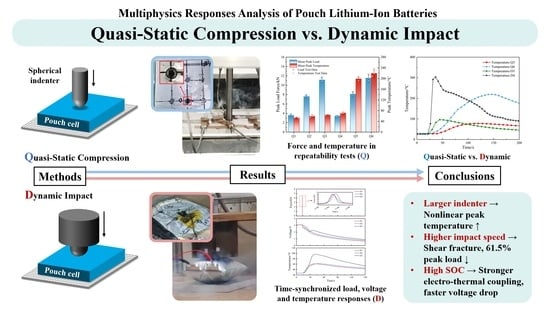
Open AccessArticle Experimental Investigation of Multiphysics Responses of Pouch Lithium-Ion Batteries Under Quasi-Static Compression and Dynamic Impact 1 School of Mechanical and Electrical Engineering, Fujian Agriculture and Forestry University, Fuzhou 350108, China 2 Xiamen Products Quality Supervision & Inspection Institute, Xiamen 361000, China 3 Key Laboratory of Safety Detection and Evaluation Technology of New Energy Batteries with High Specific Energy, State Administration for Market Regulation, Xiamen 361000, China * Author to whom correspondence should be addressed. Batteries 2026, 12(6), 211; https://doi.org/10.3390/batteries12060211 (registering DOI) Submission received: 27 April 2026 / Revised: 26 May 2026 / Accepted: 2 June 2026 / Published: 8 June 2026 Lithium-ion batteries are prone to internal short-circuits and subsequent thermal runaway under compression and impact loads during electric vehicle crashes, posing a critical safety challenge for the industry. However, existing studies lack systematic comparative analysis between quasi-static and dynamic loading conditions. In this study, ternary pouch lithium-ion batteries were used as research objects. A test platform for the synchronous acquisition of mechanical load, electrical voltage and thermal temperature was established. Quasi-static compression and drop-weight impact tests were conducted to investigate the effects of indenter diameter, impact velocity and state of charge (SOC) on the multiphysics responses of batteries. The results show significant differences in failure modes between the two loading conditions: quasi-static loading causes progressive plastic deformation and stable short-circuit voltage decay, while dynamic loading is likely to induce brittle shear fracture and soft short-circuit voltage rebound. Dynamic loading reduces peak load by 61.5% and raises peak temperature by up to 46.7%, while also decreasing failure displacement and advancing time-to-peak. Additionally, a high SOC (50% and 100%) alters the heat-release pathway during thermal runaway, leading to deviations in surface temperature measurements. These findings provide critical experimental support for the crash safety design of power batteries and the formulation of thermal runaway prevention and control strategies. Keywords: pouch lithium-ion battery; quasi-static compression; dynamic impact; failure mode; thermal runaway Graphical Abstract 1. Introduction Lithium-ion batteries have become the dominant solution for the battery systems of new energy vehicles due to their excellent energy density, long cycle life, low self-discharge rate and mature industrial chain system [ 4]. However, battery safety remains a critical bottleneck restricting industry development. In vehicle crash events, lithium-ion batteries may suffer frontal, side, and rear compression and intrusion, potentially resulting in internal battery short-circuits, subsequent thermal runaway, and even catastrophic vehicle fires in extreme cases. Therefore, it is vital to investigate the factors influencing battery failure and the mechanical–electrical–thermal responses under different loading conditions, as this provides data support for optimizing battery pack structural safety. Regarding the characteristics of batteries under dynamic impacts, Huang et al. [ 10] conducted low-velocity impact tests on 18650 cylindrical batteries and showed that impact energy and state of charge are the key factors governing the mechanical response and internal short-circuit behavior of the cells. Wang et al. [ 11] conducted multiple drop impact tests on prismatic batteries, and the results indicated that impact mass and impact velocity are the key factors influencing the dynamic failure of lithium-ion batteries. Li [ 12] comprehensively analyzed the effects of loading direction, loading rate, SOC and indenter type on the battery’s mechanical response curves, open-circuit voltage and surface temperature variations, and clarified the intrinsic correlation mechanism between mechanical loads and internal short-circuits in prismatic batteries. Liu et al. [ 13] conducted mechanical indentation tests and demonstrated the effects of SOC, internal short-circuit (ISC) resistance and electrode area on the electrochemical safety behavior of batteries. Zhou et al. [ 14] performed dynamic experiments to investigate the mechano-electro coupled failure mechanisms of pouch lithium-ion batteries, clarifying that the dominant failure mechanism under dynamic loading stems from the inertial effect of their multilayer structure rather than the strain rate effect of individual battery components. Kisters et al. [ 15] conducted local dynamic indentation tests on pouch batteries at various loading rates, and demonstrated the significant effect of strain rate on the mechanical response of the batteries. Deng et al. [ 16] conducted impact tests on high-capacity pouch batteries under various loading conditions, and demonstrated that the failure behavior of such batteries is jointly governed by the battery’s intrinsic dimensions, indenter geometry and SOC. Liu et al. [ 17] investigated the effects of dynamic loading on the mechano-electro-thermal coupled responses of new and aged pouch batteries, and the results indicated that batteries are more susceptible to early internal short-circuits under dynamic loading conditions, with a markedly accelerated voltage decay rate. In summary, in terms of quasi-static compression tests, existing studies have mostly focused on investigating the effects of compression modes, compression positions, indenter sizes and other factors on battery failure characteristics, and the compression deformation rate or voltage response is commonly used to determine the battery failure threshold. For dynamic impact tests, certain accumulations have been formed in experimental studies and systematic analyses of pouch batteries with different SOCs under various impact velocities and indenter sizes. However, a systematic comparative analysis of the differential multiphysics responses and failure mechanisms between quasi-static compression and dynamic impact remains lacking at present. In this work, a test platform for synchronous acquisition of mechanical load, electrical voltage and thermal temperature is established, and comprehensive quasi-static compression and drop-weight impact tests are conducted on ternary pouch lithium-ion batteries. Further, the reliability of the experimental data is verified through repeatability tests, and the effects of indenter diameter, impact velocity and SOCs on the coupled multiphysics responses of the batteries are systematically investigated. In addition, the influence of elevated SOC on the post-short-circuit electrochemical–thermal coupling effects is clarified, and the measurement deviation of surface temperature caused by the change in thermal runaway heat-release pathway is explained. Additionally, the distinct failure modes under quasi-static and dynamic loading conditions are comparatively analyzed, and the essential differences in mechanical, electrical and thermal responses between the two loading modes are discussed. 3. Results 3.1. Quasi-Static Compression Tests During quasi-static compression, luminous ignition was observed at the compressed region, accompanied by pronounced smoke emission. The stress concentration induced by the spherical indenter caused compressive stress in localized regions encompassing the aluminum-laminated film, current collectors, and separator, which exceeded critical thresholds, resulting in total structural failure. Upon separator rupture, ISC triggered by direct contact between the positive and negative electrodes generated Joule heating, which rapidly vaporized and decomposed the electrolyte, producing the observed smoke, as illustrated in Figure 5a. Figure 5. Test phenomena of group Q3: ( a) under testing; ( b) damage results. Figure 5. Test phenomena of group Q3: ( a) under testing; ( b) damage results. Figure 6. The surface temperature distribution of group Q3 at the time of peak temperature: ( a) spatial surface temperature distribution; ( b) temperature–distance from indentation center. Figure 6. The surface temperature distribution of group Q3 at the time of peak temperature: ( a) spatial surface temperature distribution; ( b) temperature–distance from indentation center. As illustrated in Figure 6, measurements from symmetrically located thermocouple points exhibit excellent consistency, which validates the reproducibility and reliability of the experimental data. The peak temperature was strictly localized at the indentation center, and the surface temperature decreased monotonically with increasing distance from the indentation center. This observation demonstrates that the thermal runaway remained confined exclusively to the damaged region, and no rapid thermal propagation occurred across the entire cell volume under the tested conditions. Given that the present study focuses primarily on the temperature rise characteristics and thermal runaway initiation mechanism at the indentation center, the spatial temperature distribution dataset obtained herein will be utilized for the validation and calibration of subsequent numerical simulation models. 3.1.1. Repeatability Verification To ensure experimental reliability, triplicate tests were conducted for each test condition to mitigate variations attributable to manufacturing tolerances in internal resistance, capacity, and other cell parameters. Taking Condition Q3 as an exemplar, pouch cells at 0% SOC were prepared with terminal voltages controlled within 3.15 ± 0.03 V (corresponding to a tolerance of ±1%). The repeatability results are presented in Figure 7. This test group exhibited excellent repeatability in both the force-displacement curves and the voltage and temperature profiles. As shown in Figure 7a, the three peak force values were 11.58 kN, 10.95 kN, and 10.97 kN, yielding an average relative error of 2.06%. The cell failure depth thresholds at failure were 4.43 mm, 4.34 mm, and 4.26 mm, with an average relative error of 1.33%. The peak temperatures for the three tests were 63.1 °C, 65.7 °C, and 64.5 °C, corresponding to an average relative error of 1.38%. The error analysis results for all quasi-static test groups are presented in Figure 8. These results confirm that the cells exhibited highly consistent mechanical, electrical, and thermal responses, validating the reliability of the experimental data for subsequent analysis. 3.1.2. Influence of Indenter Diameter To investigate the influence of indenter diameter on the compression response of pouch cells, comparative analyses were conducted using the results from test conditions Q1–Q3 and Q4–Q6. The results are presented in Figure 9. The results reveal significant correlations between indenter diameter and the mechanical, electrical, and thermal responses. The peak compression force increased substantially with indenter diameter: for conditions Q1–Q3, the values were 3.29 kN, 7.27 kN, and 10.97 kN; for conditions Q4–Q6, the corresponding values were 3.41 kN, 7.72 kN, and 11.52 kN. This enhancement arises because larger-diameter indenters engage greater contact areas, necessitating the overcoming of synergistic load-bearing resistance from multiple components, including the packaging layer, electrode stack, and separator, thereby resulting in elevated mechanical load peaks. Both the magnitude of voltage drop and the rate of voltage decay increased with indenter diameter. This behavior is attributed to the more severe damage inflicted on constituent materials within the compression zone as indenter diameter increases, which produces correspondingly larger short-circuit contact areas between the positive and negative electrodes, manifesting as more abrupt voltage drops and accelerated decay characteristics. The temperature rise rate and peak temperature also increased with indenter diameter. For group Q1–Q3, the peak temperatures were 56.4 °C, 59.1 °C, and 65.7 °C sequentially. This elevation is attributed to the larger internal short-circuit area associated with larger-diameter indenters, generating increased heating. Notably, no thermal runaway was observed under any of these three conditions. In contrast, group Q4–Q6 exhibited peak temperatures of 70.4 °C, 192.2 °C, and 219.6 °C, with thermal runaway triggered in conditions Q5 and Q6. In summary, the indenter diameter modulates the contact stress distribution and damage area, thereby quantitatively regulating the mechanical abuse response of pouch cells and determining the nonlinear coupled mechano-electrochemical-thermal behavior. 3.1.3. Influence of SOC To investigate the influence of elevated SOC on the compression failure behavior of pouch cells, comparative analyses were conducted using the results from conditions Q1–Q6, as summarized in Table 3. The data in Table 3 demonstrate that both the temperature rise rate and maximum temperature increased significantly with SOC. No thermal runaway was observed in test groups Q1–Q4. In Q4, the indenter with 6 mm diameter produced localized penetration without establishing an effective internal short-circuit pathway; consequently, no immediate voltage drop was detected, though the voltage decayed to 0 V after 24 h of observation. Under conditions Q5 and Q6, the cell voltage decayed rapidly approximately 50 s following battery structure failure, accompanied by sharp temperature elevation and subsequent thermal runaway. The peak temperatures reached 192.2 °C and 219.6 °C, respectively. The primary mechanism driving thermal runaway involves the combination of large short-circuit area and the synergistic amplification of Joule heating and parasitic reaction heat at elevated SOC states. This coupling substantially enhances electrochemical reaction kinetics within the cell, causing heat accumulation rates to substantially exceed heat dissipation capacity, ultimately triggering thermal runaway. Conversely, SOC exhibited limited influence on the peak load and failure displacement under quasi-static compression. Comparative analysis across indenter conditions revealed that 20% SOC produced only marginal increases in peak force (3.4–4.9%) and failure displacement (1.1–3.6%). This modest enhancement primarily stems from the volume expansion of litigated graphite in the negative electrode during charging, which induces slight overall cell-swelling and generates internal pre-stress. During initial compression stages, this pre-stress partially counteracts the external mechanical load, thereby marginally improving the structural load-bearing capacity, a finding consistent with the results reported in Reference [ 25]. The internal failure morphology further corroborates these observations, as illustrated in Figure 10Figure 11. Batteries at 20% SOC exhibited luminous ignition, rapid electrolyte volatilization, and fire initiation within the compressed region upon failure. Post-test examination revealed outer aluminum-laminated film melting and shrinkage with localized carbonization and ablation. Disassembly demonstrated severe structural damage to the cell main body, with the central region exhibiting perforation and carbonized charring characteristics. In summary, an elevated SOC exerts relatively limited influence on the macroscopic mechanical properties of cells, yet substantially intensifies the post-short-circuit electrochemical–thermal coupling effects. These effects manifest as accelerated voltage decay rates and more pronounced temperature elevation, with the amplification becoming increasingly prominent at larger indenter diameters, thereby significantly elevating the probability of thermal runaway initiation. 3.2. Drop-Weight Impact Tests 3.2.1. Repeatability Verification The error analysis was conducted using methodologies identical to those employed for the quasi-static test groups, with the results presented in Figure 12. The analysis confirms that the cells exhibited satisfactory consistency in mechanical response, electrical behavior, and thermal characteristics under dynamic loading conditions. 3.2.2. Influence of Indenter Diameter To investigate the influence of indenter diameter on the failure behavior of pouch cells under dynamic impact conditions, comparative analyses were performed using the results from test groups D1–D3. The mechanical–electrical–thermal response data are presented in Figure 13, and the corresponding surface damage morphologies are illustrated in Figure 14. The results reveal that the evolution trends of load, voltage, and temperature under dynamic impact differ substantially from those observed under quasi-static compression. As shown in Figure 13Figure 14, the substantial impact energy under dynamic loading resulted in complete penetration of the cell by the 6 mm diameter indenter in group D1, where significant stress concentration effects accelerated the localized rupture of the separator and electrode structures. The peak force reached 4.41 kN, marginally exceeding the peak force of the other two groups. In groups D2 and D3, the 9 mm and 12.7 mm diameter spherical indenters did not achieve full penetration; internal material damage was dominated by bulk plastic deformation and interlayer slip, with peak forces of 4.13 kN and 4.22 kN, respectively, showing substantial consistency. Unlike the significant force–diameter correlation observed in groups Q1–Q3, the loading forces in groups D1–D3 remained essentially comparable. Figure 13. Test results of groups D1~D3 under dynamic impact with different indenter diameters. Figure 13. Test results of groups D1~D3 under dynamic impact with different indenter diameters. Figure 14. Damage morphologies of battery cells in groups D1~D3 under different indenter diameters: ( a) φ6 mm indenter; ( b) φ9 mm indenter; ( c) φ12.7 mm indenter. Figure 14. Damage morphologies of battery cells in groups D1~D3 under different indenter diameters: ( a) φ6 mm indenter; ( b) φ9 mm indenter; ( c) φ12.7 mm indenter. Figure 14 reveals that the smaller indenters in groups D1 and D2 induced localized penetration-type internal short-circuits, triggering early hard short-circuits characterized by severe and irreversible voltage drops with no rebound. However, the complete penetration damage created heat-dissipation pathways, and the limited instantaneous heat generation and accumulation from the short-circuit resulted in relatively low peak temperatures. Conversely, larger indenters induced non-penetrating elastic–plastic deformation in the aluminum-laminated film and positive/negative electrodes. Upon indenter rebound, elastic recovery of the electrode sheets and separator caused partial separation of the previously shorted contact interfaces, resulting in soft short-circuit behavior characterized by gradual voltage decay and partial voltage rebound. Although the voltage decay rate was more gradual compared to small indenters, the substantially larger short-circuit contact area generated increased Joule heating, ultimately producing elevated temperature rise rates and peak temperatures. Quantitative comparison results further validate this mechanistic difference: when comparing the largest and smallest indenter diameters, the peak temperature rises by 9.3 °C (a 16.4% increase) between quasi-static groups Q3 and Q1, and by 35.3 °C (a 57.7% increase) between dynamic groups D3 and D1. This demonstrates that dynamic loading exhibits a pronounced amplifying effect on the temperature rise induced by increasing indenter diameter. In summary, unlike the strong correlation between force–electrical–thermal characteristics and indenter diameter observed in quasi-static conditions, dynamic impact scenarios exhibit significant associations between indenter diameter and damage morphology as well as voltage drop reversibility, influenced by variations in stress concentration and damage mode. The experimental measurements indicate that among the investigated parameters, only temperature rise and peak temperature demonstrate a significant positive correlation with indenter diameter, whereas peak force and voltage decay profiles remain essentially consistent. 3.2.3. Effect of Impact Velocity on Cell Failure Characteristics To investigate the influence of impact velocity on the failure behavior of pouch cells, test groups D3, D7, and D8 were selected for comparative analysis. The experimental results are presented in Figure 15, and the corresponding cell damage morphologies are illustrated in Figure 16. Figure 16. Damage morphologies of battery cells in groups D1, D7, and D8 under different impact velocities: ( a) 1 m/s in D3; ( b) 3 m/s in D3; ( c) 5 m/s in D3. Figure 16. Damage morphologies of battery cells in groups D1, D7, and D8 under different impact velocities: ( a) 1 m/s in D3; ( b) 3 m/s in D3; ( c) 5 m/s in D3. This process simultaneously restricts current conduction and Joule heat generation while suppressing exothermic parasitic reactions at the electrode–electrolyte interface, ultimately resulting in voltage decay rates and peak temperatures that do not exhibit systematic variation with impact velocity. These findings demonstrate that impact velocity fundamentally alters the internal material damage mode, thereby transforming the transient characteristics of short-circuit behavior and the heat accumulation process. This has significant implications for assessing battery safety performance under high-dynamic-loading conditions. 3.2.4. Effect of State of Charge on Cell Failure Characteristics As shown in Figure 17a, SOC exerts a decisive influence on the voltage decay rate. In groups D3 and D4, cells at 0% and 20% SOC exhibited distinctly gradual voltage drops. In group D5, the cell at 50% SOC demonstrated relatively rapid voltage decay, though complete failure was marginally delayed. In group D6, the cell at 100% SOC experienced precipitous voltage collapse to 0 V within 10 s post-impact, exhibiting instantaneous internal short-circuit behavior. These observations indicate that elevated SOC enhances internal electrochemical activity, thereby accelerating the impact-induced ISC progression. Figure 17. Variations in voltage and temperature with time during drop−weight impact tests at different SOC: ( a) voltage response; ( b) temperature response. Figure 17. Variations in voltage and temperature with time during drop−weight impact tests at different SOC: ( a) voltage response; ( b) temperature response. Concurrently, the severity of the damaged cell response increased substantially with SOC. Upon indenter impact, localized stress concentration rapidly perforated the separator, and direct contact between positive and negative electrodes triggered instantaneous internal short-circuits accompanied by spark generation. The rapid conversion of electrochemical energy into Joule heating provided the initial thermal energy for runaway initiation. As the ISC propagated, substantial electrolyte volatilization and gas generation produced significant internal pressure elevation, resulting in pronounced cell bulging and deformation. In tests D3 and D4, where the SOC was relatively low, internal pressure was primarily released through rupture of the aluminum-laminated film at the impacted site, confining the thermal runaway zone. Conversely, in tests D5 and D6, an elevated SOC produced high-temperature gas and electrolyte jetting from lateral pressure-relief vents, accompanied by open flame, as illustrated in Figure 18. The failure morphologies further corroborate this analysis, as presented in Figure 19. The indenter-contact region exhibited severe crushing, while the overall cell displayed extensive bulging and laminate structural collapse. Lateral rupture of the aluminum-laminated film with large-area carbonization and ablation reflected lateral electrolyte jetting and combustion during thermal runaway. Exposed electrodes and active materials were visible in the impact zone, indicating that under high-SOC conditions, mechanically induced ISCs can rapidly evolve into thermally dominated structural failure modes. Figure 18. Test process of 100% SOC battery cells in group D6: ( a) internal short-circuit initiation; ( b) cell bulging; ( c) thermal runaway with flame ejection. Figure 18. Test process of 100% SOC battery cells in group D6: ( a) internal short-circuit initiation; ( b) cell bulging; ( c) thermal runaway with flame ejection. Figure 19. Damaged morphologies of 100% SOC battery cells in group D6: ( a) localized crushing; ( b) packaging structure instability; ( c) side rupture and ablation. Figure 19. Damaged morphologies of 100% SOC battery cells in group D6: ( a) localized crushing; ( b) packaging structure instability; ( c) side rupture and ablation. However, in the present experiments, thermocouples were positioned on the upper cell surface near the impact center. The lateral venting jetting and combustion processes substantially altered the heat-release pathway, significantly reducing heat accumulation in the upper-surface region. It should also be noted that gas evolution causes the pouch cell to bulge, which separates the thermocouples from the underlying jelly roll and introduces significant thermal resistance. As a result, the thermocouples measure the temperature of the pouch film, heated by the escaping hot gases, which may underestimate the actual peak temperature inside the electrode assembly. Consequently, the recorded temperature peaks were relatively low. In contrast, cells at 20% SOC exhibited only bulging without lateral rupture, concentrating heat release primarily in the upper-impact region and thereby producing higher measured temperature peaks. This phenomenon resulted in the non-monotonic relationship between temperature peak and SOC observed in Figure 17b. Therefore, a comprehensive assessment of thermal safety under mechanical abuse requires the integrated consideration of both internal heat generation intensity and external pressure-relief pathways; surface temperature measurements cannot fully capture the true severity of thermal runaway. 4. Discussion To elucidate the differential effects of quasi-static compression and dynamic impact on the failure characteristics of pouch cells, comparative analyses were conducted using results from test conditions Q3, D3, Q6 and D4. With the SOC controlled, groups with the largest indenter diameter were chosen to obtain a higher loading force and more significant temperature rise, which facilitates a clearer comparison of failure behaviors between loading modes. The comparative results are presented in Figure 20Table 4. Synthesizing the aforementioned experimental results, the loading rate governs distinct failure mode transitions, resulting in markedly different voltage decay and temperature evolution characteristics under quasi-static compression versus dynamic impact. The principal distinctions are as follows: (1) Mechanical Response Differences: Continuity versus Transience in Load-Bearing Under quasi-static compression, the multilayer structure of the cell participates sequentially in load-bearing, producing force–displacement curves with characteristic elastoplastic behavior and pronounced continuity. The peak load reached 10.97 kN and 11.52 kN, with corresponding failure displacements of 4.10 mm and 4.15 mm, respectively. Large-diameter indenters must overcome the synergistic load-bearing resistance of the aluminum-laminated film, electrode stack, and separator, with failure manifested as progressive plastic deformation and interlayer slip. Figure 20. Voltage–temperature comparison of tests Q3, Q6, D3, and D4: ( a) voltage response; ( b) temperature response. Figure 20. Voltage–temperature comparison of tests Q3, Q6, D3, and D4: ( a) voltage response; ( b) temperature response. Table 4. Comparative results of quasi-static and dynamic test groups. Table 4. Comparative results of quasi-static and dynamic test groups. Test Group SOC/% Failure Displacement /mm Failure Displacement to Total Thickness Ratio/% Peak Load Force /kN Peak Temperature /°C Q3 0 4.10 55.8 10.967 65.7 Q6 20 4.15 56.5 11.517 219.6 D3 0 2.93 39.9 4.22 96.4 D4 20 2.96 40.3 4.31 304.1 Under dynamic impact, the load is applied extremely rapidly, causing internal materials to undergo localized shear fracture more readily under high-strain-rate conditions. The peak load is substantially reduced to only 4.22 kN and 4.31 kN, with a corresponding failure displacement of 2.93 mm and 2.96 mm, respectively. This represents a nearly 16% reduction in the failure displacement to total thickness ratio and a 61.5% reduction in peak load compared to the quasi-static counterpart. This disparity arises from the strain-rate sensitivity of the separator and active coating materials, which exhibit ductility under slow loading but brittleness under high-velocity impact. These results clearly demonstrate that the critical failure displacement decreases significantly with increasing loading rate. (2) Electrical Response Differences: Distinct Short-Circuit Conduction Characteristics Under quasi-static compression, internal short-circuits typically form progressively with structural degradation, establishing stable and sustained short-circuit pathways upon separator rupture. As observed in groups Q3 and Q6, the voltage exhibits continuous decay. Under dynamic impact, soft short-circuit behavior led to voltage responses characterized by multiple successive rebounds followed by gradual decay, as exemplified by group D3. This indicates that the damage morphology under high-velocity impact cannot sustain stable low-resistance conduction pathways, rendering voltage decay more difficult to predict. (3) Thermal Response Differences: Failure Mode and Heat Accumulation Capacity Under quasi-static compression, the sustained nature of short-circuit conduction allows Joule heating and parasitic reaction heat to accumulate gradually in localized regions without significant venting. This results in slow temperature elevation: in group Q6, although the peak temperature reached 219.6 °C due to the superimposed parasitic reaction heat from the thermal runaway, the peak occurred at 146 s with a gentle heating rate, concentrating heat release in the compression zone. Conversely, under dynamic impact, rapid structural destruction provides more direct pathways for heat release. In group D4, the heating rate was precipitous upon thermal runaway initiation, with the peak temperature reaching 302 °C within 15 s of voltage collapse, corresponding to a 38.5% higher peak temperature and a 131 s earlier time-to-peak compared to group Q6. The comparison between D3 and Q3 further corroborates this conclusion, with peak temperature rising by 46.7%, and the time-to-peak advanced by 84 s. The peak temperature difference is no more than 10% for small indenters of 6 mm and 9 mm, yet the peak temperature occurs earlier, by about 100 to 150 s. Quasi-static tests present a distinctly slower temperature rise, demonstrating substantial hysteresis in energy accumulation. Based on these observations, the design of lithium-ion batteries and their protective structures should explicitly consider the loading rate effect to avoid dynamic impact conditions that trigger rapid and violent thermal runaway. These comparative results demonstrate that assessments of battery safety under mechanical abuse must explicitly distinguish loading conditions and establish strain-rate-dependent multiphysics coupled with failure criteria. Test results show that even cells at a low SOC of 20% experienced thermal runaway under large-indenter high-velocity impact conditions. Therefore, battery pack design should incorporate strain-rate-sensitive energy-absorbing structures to attenuate high-velocity impact loads and transition the deformation process toward quasi-static behavior, while minimizing the maximum deformation of individual cells to further mitigate thermal runaway risks. 5. Conclusions This study systematically investigated the coupled mechano-electro-thermal response characteristics of pouch lithium-ion batteries under varying indenter diameters, impact velocities, and SOCs through quasi-static compression and dynamic drop-weight impact testing. The findings demonstrate that indenter geometry and impact velocity govern the contact stress distribution and damage zone scale, significantly influencing voltage decay rates and temperature elevation levels in a positively correlated manner. The principal conclusions are as follows: (1) There are essential distinctions in multiphysics responses between quasi-static compression and dynamic impact: Mechanically, quasi-static compression exhibits continuous load-bearing characteristics with progressive plastic deformation failure modes, whereas dynamic impact demonstrates transient load-bearing that tends to induces brittle shear fracture in internal materials. Electrically, quasi-static compression establishes stable and sustained short-circuit pathways with continuous voltage decay, while dynamic impact produces soft short-circuit conditions (when penetration is incomplete) causing multiple voltage rebounds. Thermally, quasi-static compression enables gradual heat accumulation, while dynamic impact produces a precipitous temperature rise with substantial temporal disparity in energy accumulation. (2) A linear increase in indenter diameter promotes the corresponding expansion of short-circuit area, thereby elevating peak temperature; however, this relationship exhibits nonlinear characteristics, mediated by the distinct damage modes of penetration-type hard short-circuits and deformation-induced soft short-circuits. Under non-thermal runaway conditions with consistent indenter increments, the temperature elevation amplitude in dynamic impact scenarios reached 57.7%, significantly exceeding the 16.4% observed in quasi-static conditions. (3) Dynamic impact velocity represents the dominant factor governing internal material damage mode transitions and temperature evolution. With increasing impact velocity, the damage mode is likely to transition from plastic deformation under slow loading to high-strain-rate shear fracture. As a result, dynamic loading significantly reduces failure displacement by 16% and peak load by 61.5%. Meanwhile, the peak temperature is substantially increased (38.5–46.7% higher than quasi-static conditions), and the time-to-peak is significantly advanced. (4) An elevated SOC exerts relatively limited influence on macroscopic mechanical properties but substantially intensifies post-short-circuit electrochemical–thermal coupling effects, accelerating voltage decay rates and increasing temperature elevation amplitudes. High-SOC conditions transform thermal runaway heat-release pathways from localized venting at the compression site to comprehensive lateral venting, introducing measurement inaccuracies in surface temperature monitoring. Limitations: The present study is constrained by sample availability, precluding surface temperature measurement and data correction under high-SOC conditions. Additionally, experimental limitations prevented the implementation of high-SOC thermal runaway tests under quasi-static conditions, resulting in an asymmetric experimental matrix. Synthesis: The failure behavior of pouch lithium-ion batteries under compression and impact conditions exhibits pronounced multiphysics coupling characteristics, with voltage and temperature responses being jointly influenced by indenter geometry, loading rate, and SOC. The systematic experimental results obtained herein provide critical empirical foundations and theoretical support for the impact-resistant structural protection design of power battery packs, vehicle collision safety assessments, and the formulation of thermal runaway early-warning strategies. Future research will first perform parametric tests across a continuous range of loading rates spanning quasi-static compression to high-velocity impact, and use the experimental datasets to calibrate and validate a high-fidelity coupled multiphysics finite element model. This integrated experimental–numerical approach will be used to elucidate the quantitative relationship between loading rate, critical failure displacement and thermal runaway initiation thresholds. On this basis, the established methodological framework to additional battery chemistries and alternative packaging configurations, integrating microstructural characterization techniques and finite element analysis to elucidate internal material damage evolution mechanisms and multiphysics coupling response patterns under impact loading. Author Contributions Conceptualization, L.Y.; methodology, L.Y.; validation, L.Y., S.X., Y.Z. and J.F.; formal analysis, L.Y.; investigation, L.Y., S.X., Y.Z. and J.F.; resources, J.L.; data curation, L.Y. and S.X.; writing—original draft preparation, L.Y.; writing—review and editing, L.Y., S.X. and J.X.; visualization, L.Y. and S.X.; supervision, L.Y.; project administration, L.Y.; funding acquisition, L.Y. All authors have read and agreed to the published version of the manuscript. Funding This research was funded by Natural Science Foundation of Fujian Province, grant number 2022J01612. Data Availability Statement The original contributions presented in the study are included in the article, further inquiries can be directed to the corresponding author. Acknowledgments The tests were conducted at Key Laboratory of Safety Detection and Evaluation Technology of New Energy Batteries with High Specific Energy, in Xiamen Products Quality Supervision & Inspection Institute. The authors gratefully acknowledge the technical support provided by the institute’s team. Conflicts of Interest The authors declare no conflicts of interest. References Figure 1. Pouch lithium-ion cell sample. Figure 1. Pouch lithium-ion cell sample. Figure 3. Dynamic impact test setup. Figure 3. Dynamic impact test setup. Figure 4. Combined measurement using high-speed camera and DIC. ( a) High-speed camera images. ( b) Single-point calibration measurement. Figure 4. Combined measurement using high-speed camera and DIC. ( a) High-speed camera images. ( b) Single-point calibration measurement. Figure 7. Repeatability test results of group Q3. ( a) Load response. ( b) Voltage-temperature. Figure 7. Repeatability test results of group Q3. ( a) Load response. ( b) Voltage-temperature. Figure 8. Comparison of mean peak load and mean peak temperature in Q1–Q6 test groups. Figure 8. Comparison of mean peak load and mean peak temperature in Q1–Q6 test groups. Figure 9. ( a) Force–electrical–thermal response results of test groups Q1 to Q3. ( b) Force–electrical–thermal response results of test groups Q4 to Q6. Figure 9. ( a) Force–electrical–thermal response results of test groups Q1 to Q3. ( b) Force–electrical–thermal response results of test groups Q4 to Q6. Figure 10. Damage locations after quasi-static compression with different indenters: ( a) 9 mm diameter indenter in test Q1; ( b) 12.7 mm diameter indenter in test Q3. Figure 10. Damage locations after quasi-static compression with different indenters: ( a) 9 mm diameter indenter in test Q1; ( b) 12.7 mm diameter indenter in test Q3. Figure 11. Surface and internal damage morphologies of the cells after compression with different indenters: ( a) surface morphology of test Q5; ( b) surface morphology of test Q6; ( c) internal morphology of test Q6. Figure 11. Surface and internal damage morphologies of the cells after compression with different indenters: ( a) surface morphology of test Q5; ( b) surface morphology of test Q6; ( c) internal morphology of test Q6. Figure 12. Comparison of mean peak load and mean peak temperature in D1–D8 test groups. Figure 12. Comparison of mean peak load and mean peak temperature in D1–D8 test groups. Figure 15. Test results of groups D3, D7, and D8 under different impact velocities. Figure 15. Test results of groups D3, D7, and D8 under different impact velocities. Table 1. Quasi-static compression test parameter settings. Table 1. Quasi-static compression test parameter settings. Test Group Indenter Diameter/mm SOC/% Q1 6.0 0 Q2 9.0 0 Q3 12.7 0 Q4 6.0 20 Q5 9.0 20 Q6 12.7 20 Table 2. Dynamic impact test parameter settings. Table 2. Dynamic impact test parameter settings. Test Group Impact Speed/(m·s −1) Indenter Diameter/mm SOC/% D1 1.0 6.0 0 D2 1.0 9.0 0 D3 1.0 12.7 0 D4 1.0 12.7 20 D5 1.0 12.7 50 D6 1.0 12.7 100 D7 3.0 12.7 0 D8 5.0 12.7 0 Table 3. Comparison of failure displacement, peak load force, and peak temperature of test groups Q1 to Q6. Table 3. Comparison of failure displacement, peak load force, and peak temperature of test groups Q1 to Q6. Test Group Indenter Diameter/mm SOC/% Failure Displacement /mm Peak Load Force /kN Peak Temperature /°C Q1 6.0 0 2.64 3.296 56.4 Q4 20 2.74 3.414 70.4 Q2 9.0 0 3.56 7.273 59.1 Q5 20 3.60 7.722 192.2 Q3 12.7 0 4.10 10.967 65.7 Q6 20 4.15 11.517 219.6 Disclaimer/Publisher’s Note: The statements, opinions and data contained in all publications are solely those of the individual author(s) and contributor(s) and not of MDPI and/or the editor(s). MDPI and/or the editor(s) disclaim responsibility for any injury to people or property resulting from any ideas, methods, instructions or products referred to in the content. © 2026 by the authors. Licensee MDPI, Basel, Switzerland. This article is an open access article distributed under the terms and conditions of the Creative Commons Attribution (CC BY) license. Ying, L.; Xiao, S.; Zhang, Y.; Xu, J.; Fan, J.; Lin, J. Experimental Investigation of Multiphysics Responses of Pouch Lithium-Ion Batteries Under Quasi-Static Compression and Dynamic Impact. Batteries 2026, 12, 211. https://doi.org/10.3390/batteries12060211 Ying L, Xiao S, Zhang Y, Xu J, Fan J, Lin J. Experimental Investigation of Multiphysics Responses of Pouch Lithium-Ion Batteries Under Quasi-Static Compression and Dynamic Impact. Batteries. 2026; 12(6):211. https://doi.org/10.3390/batteries12060211 Ying, Long, Shanglong Xiao, Yulong Zhang, Jianquan Xu, Jieliang Fan, and Jiashen Lin. 2026. "Experimental Investigation of Multiphysics Responses of Pouch Lithium-Ion Batteries Under Quasi-Static Compression and Dynamic Impact" Batteries 12, no. 6: 211. https://doi.org/10.3390/batteries12060211 Ying, L., Xiao, S., Zhang, Y., Xu, J., Fan, J., & Lin, J. (2026). Experimental Investigation of Multiphysics Responses of Pouch Lithium-Ion Batteries Under Quasi-Static Compression and Dynamic Impact. Batteries, 12(6), 211. https://doi.org/10.3390/batteries12060211
Experimental Investigation of Multiphysics Responses of Pouch Lithium-Ion Batteries Under Quasi-Static Compression and Dynamic Impact