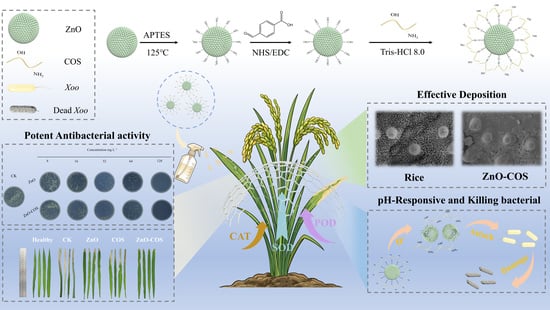
Developing zinc oxide-based nano-bactericides as alternatives to conventional chemical bactericides for controlling rice bacterial diseases has become a major research focus. In this study, ZnO nanoparticles were initially surface-modified and subsequently covalently conjugated with chitooligosaccharide (COS) via imine bonds to get a pH-responsive zinc oxide–chitooligosaccharide (ZnO–COS) delivery system. A series of physicochemical characterizations, including FTIR, UV-vis, XRD, and TGA, confirmed the successful synthesis of ZnO–COS NPs. Building on this foundation, the pH-responsive release behavior, foliar deposition performance, antibacterial activity, and biosafety of the nanoparticles were systematically investigated. The prepared ZnO–COS NPs exhibited pronounced acid-triggered Zn 2+ release, together with enhanced wettability, spreadability, and retention on rice leaf surfaces, owing to COS incorporation. In both in vitro and in vivo assays against Xanthomonas oryzae pv. oryzae ( Xoo), ZnO–COS NPs demonstrated effective antibacterial activity associated with bacterial cell damage and the activation of antioxidant defense responses in plants. Consequently, ZnO–COS NPs achieved a preventive efficacy of 56.0% against rice bacterial blight, surpassing those of ZnO (33.3%) and COS (14.3%). Furthermore, safety assessment confirmed the good biocompatibility of ZnO–COS NPs towards rice seed germination and seedling growth. In summary, the synthesised ZnO–COS NPs integrated pH-responsive release, improved foliar deposition, and enhanced antioxidant capacity of rice, offering a promising strategy for mitigating bacterial diseases in rice. 1. Introduction Rice bacterial blight caused by Xanthomonas oryzae pv. oryzae ( Xoo) is a destructive bacterial disease of rice and can occur at multiple developmental stages [ 1, 2, 3]. The pathogen mainly infects leaf tissues, markedly reducing photosynthetic capacity, with yield losses of 20–50%, posing a serious threat to rice production and food security [ 4, 5, 6]. The current field management of this disease relies on traditional chemical fungicides such as agricultural streptomycin and thiodiazole copper [ 7, 8]. However, long-term and intensive application has increased pathogen resistance to these components, accompanied by environmental contamination and other associated risks [ 9, 10, 11]. Therefore, the development of highly effective and environmentally compatible antibacterial agents is essential for the green management of the rice plant diseases. In recent years, the rapid development of nanomaterials has provided new technological approaches for the effective control of rice plant diseases. Among various nanomaterials, metal oxides, including zinc oxide (ZnO), titanium oxide (TiO 2), and copper oxide (CuO), have demonstrated promising applications in plant disease management, owing to their intrinsic antibacterial properties and favourable biocompatibility [ 12, 13, 14]. ZnO nanoparticles (NPs) have gained significant interest owing to their facile synthesis, cost effectiveness, environmental friendliness and readily modifiable surfaces. ZnO NPs can act as functional carriers for the loading and delivery of active molecules and as antibacterial agents owing to their intrinsic antibacterial activity. The antibacterial effects may be attributed to multiple mechanisms, which include the generation of reactive oxygen species (ROS), the release of Zn 2+ through partial dissolution, and direct interactions with bacterial cell envelopes [ 15, 16, 17]. Motelica et al. reported that ZnO NPs loaded with essential oil such as cinnamon essential oil demonstrated synergistic antibacterial activity against a broad spectrum of bacterial pathogens, owing to the combined effects of the essential oil components and released Zn 2+ [ 18]. Wang et al. reported that ZnO quantum dots effectively inhibited bacterial fruit blotch via the synergistic effects of reactive oxygen species generation and Zn 2+ release [ 16]. Despite their promising attributes, the practical application of ZnO NPs in the agriculture sector is hindered by their poor foliar affinity, characterised by insufficient wetting, spreading and adhesion on hydrophobic leaf surfaces. This drawback results in poor deposition, rapid loss caused by rain and low agrochemical utilisation efficiency. Despite the extensive exploration of ZnO NPs and COS in agriculture, the development of multifunctional systems that integrate microenvironment-responsive release with improved foliar deposition remains limited. Given that pathogen infection is frequently associated with localized acidification, we hypothesized that the grafting of COS onto ZnO NPs would enable acid-triggered Zn 2+ release while simultaneously enhancing wettability, retention, and rain fastness on rice leaves, ultimately improving preventive efficiency against rice bacterial blight. To validate this hypothesis, a functionalized ZnO–COS NPs was developed through aldehyde functionalization of ZnO NPs and subsequent covalent conjugation with COS. The resulting nanoparticles were first characterized for their physicochemical properties, after which their pH-responsive release behavior and foliar deposition-related performance were systematically evaluated. Their antibacterial efficacy was then comprehensively assessed through both in vitro and in vivo experiments, and the underlying potential antibacterial mechanism was preliminary investigated. In addition, their biosafety toward rice was examined. These findings offer a rational strategy for developing efficient and potentially environmentally friendly approaches for managing rice bacterial blight. 2.1. Materials Zinc acetate (99%), magnesium acetate tetrahydrate (99%), sodium hydroxide (NaOH, 96%), (3-Aminopropyl) triethoxysilane (APTES, 98%), 4-formylbenzoic acid (98%), 3-(3-dimethylaminopropyl)-1-ethylcarbodiimide hydrochloride (EDC, 97%+), N-hydroxysuccinimide (NHS, 98%), ethanol, n-hexane (97%) and anhydrous N, N-dimethylformamide (DMF) were obtained from Aladdin Biochemical Technology Co., Ltd. (Shanghai, China). Chitooligosaccharide (COS, purity 90%) was purchased from SHIGAODE Plant Nutrition Technology Co., Ltd. (Binzhou, China). The superoxide dismutase (SOD), peroxidase (POD), and catalase (CAT) activities were tested according to the instructions of the defence enzyme assay kit (Suzhou Keming Biotechnology Co., Ltd., Suzhou, China). 2.2. Production of ZnO–COS NPs In 2025, a pH-responsive delivery system zinc oxide–chitooligosaccharide (ZnO–COS) was successfully developed by surface-functionalising ZnO and covalently conjugating them with COS via imine bonds. 2.2.1. Preparation of ZnO NPs ZnO synthesis was performed using a reported co-precipitation method [ 16]. In this procedure, 734 mg of zinc acetate and 86 mg of magnesium acetate tetrahydrate were completely dissolved in 60 mL of pre-heated ethanol at 80 °C under vigorous magnetic stirring. Separately, 200 mg of sodium hydroxide was uniformly dispersed in 30 mL of ethanol via ultrasonic treatment. Both solutions were independently cooled in an ice bath for 30 min. NaOH dispersion was added to the zinc/magnesium acetate solution, and the mixture was vigorously stirred at 25 °C for 12 h. To obtain the ZnO, 250 mL of n-hexane (as a precipitant/anti-solvent) was added to the reaction mixture. Subsequently, the ZnO was collected via centrifugation, cleaned thoroughly using ethanol and then vacuum-dried. 2.2.2. Preparation of ZnO–NH 2 NPs The prepared ZnO was initially dispersed in 15 mL of DMF. To this dispersion, 400 μL of (3-aminopropyl) triethoxysilane (APTES) was introduced, and the mixture was heated at 125 °C for 30 min [ 26]. Upon cooling to room temperature, the product was purified via centrifugation at 12,000 rpm and repeatedly washed with anhydrous DMF three times. 2.2.3. Preparation of ZnO–CHO NPs A total of 180 mg of EDC and 155 mg of NHS were completely dissolved in 15 mL of DMF containing 100 mg of 4-formylbenzoic acid. After stirring for 0.5 h, the 4-formylbenzoic acid was fully activated. The ZnO–NH 2 was then added to the activated 4-formylbenzoic acid solution, and the mixed solution was stirred at 25 °C for 24 h [ 27]. The –CHO-functionalised ZnO was isolated via high-speed centrifugation at 12,000 rpm and washed three times with anhydrous DMF. 2.2.4. Preparation of ZnO–COS NPs The process began with the dissolution of 400 mg of COS in 20 mL of Tris buffer solution (pH 8.0). Separately, the synthesised ZnO–CHO was added to 20 mL of anhydrous DMF. Then, the two solutions were combined and allowed to react in the dark for 24 h under constant stirring at an ambient temperature. Subsequently, the mixture was centrifuged at 12,000 rpm and washed three times with Tris buffer (pH 7.0) to clear any redundant components. ZnO–COS was prepared as a suspension at 200 mg L −1 for subsequent experiments. The suspension was stored at 0 °C or 25 °C prior to use and remained stable before testing, with no evident precipitation or aggregation observed. 2.3. Characterisation The morphology of the nanoparticles was investigated using a high-resolution transmission electron microscope (Tecnai G2 F30 S-TWIN, FEI, Hillsboro, OR, USA). Fourier transform infrared (FTIR) spectroscopy (Cary 670, Agilent, Santa Clara, CA, USA) was employed to obtain spectra over the 400–4000 cm −1 range by the KBr tablet method. An ultraviolet–visible (UV–vis) spectrophotometer (GENESYS 180, Thermo Scientific, Waltham, MA, USA) was used to record the UV–vis absorption spectra in the range of 200–500 nm. Under the condition of the excitation wavelength of 347 nm, Fluorescence emission spectra were collected using a fluorescence spectrometer (F-7000, Hitachi, Tokyo, Japan). The Zeta potentials of the NPs were measured using a Malvern laser particle size analyser (ZS90, Malvern Instruments, Worcestershire, UK), tested at pH = 7 and a concentration of 200 mg L −1. The crystalline phases were identified using an X-ray diffractometer (D8 Advance, Bruker, Karlsruhe, Germany) at a rate of 10°/min in range of 5–80°. Thermogravimetric analysis (TGA) was conducted using a thermogravimetric analyser (TGA2, METTLER TOLEDO, Zurich, Switzerland) at a heating rate of 10 °C/min under a nitrogen atmosphere, spanning a temperature range of 30–800 °C. X-ray photoelectron spectroscopy (XPS) was performed using an XPS energy spectrum analyser (ESCALAB 250Xi, Thermo Scientific, Waltham, MA, USA). 2.4. Controlled Release Kinetics The release kinetics of Zn 2+ from ZnO–COS NPs were evaluated using a dialysis method. ZnO–COS NPs suspension (2 mL; 5 mg mL −1) was dispersed in a dialysis bag ( Mw = 3500 Da) and then immersed in 28 mL of Tris buffer solution at pH levels of 5, 6 and 7. These buffer solutions with different pH values were prepared by adjusting a 10 mM L −1 Tris aqueous solution using 1 M L −1 HCl. In an incubator shaker, the system was continuously shaken at a constant speed (180 rpm). At predetermined time intervals, 1 mL of the external buffer solution of the dialysis bag was collected for Zn 2+ quantification via ICP-MS (Elan DRC-e, PerkinElmer, USA), and the same volume of new Tris buffer was replenished to keep a constant total volume. All experiments were conducted in triplicate. The cumulative release data were modelled using zero-order, first-order, Higuchi and Ritger–Peppas kinetic equations. 2.5. Wettability and Adhesion Ability The contact angles of deionised water, COS, ZnO and ZnO–COS NPs suspensions (200 mg L −1) on rice leaves were tested using an optical contact angle metre (SL200KB, Shanghai Soren Information Technology Co., Ltd., Shanghai, China). To evaluate the attachment performance of ZnO–COS NPs on rice leaf surfaces [ 28], fresh leaf samples were first prepared. Each leaf was cut into 1 cm × 2 cm segments, and the surface area of each segment was recorded as S. Aqueous solutions of COS, ZnO and ZnO–COS were prepared, and all treatments were kept in the same concentration. Then, rice leaves were immersed in each solution. After removal, they were held above the liquid until droplet runoff ceased. All treatments were conducted in triplicate. The mass of the solution before leaf immersion was recorded as m a. The remaining mass after immersion was recorded as m b. The retention amount (R) was calculated using Equation (1). R = ( m a − m b ) / S (1) The rain-wash resistance of ZnO–COS NPs on rice leaves was evaluated. A prepared suspension of ZnO–COS NPs was evenly sprayed onto rice leaves. The leaves were mounted onto glass slides after the droplets on the leaves had dried, and the slides were tilted at a 45° angle. Next, subjecting to a continuous flow of deionised water to simulate natural rainfall [ 29]. The treated leaves were dried, followed by immersion in glutaraldehyde and incubation at 4 °C overnight. Then, the fixed samples were washed with phosphate-buffered solution (PBS), followed by dehydration through a graded ethanol series. All samples were subjected to critical point drying. Subsequently, the dried specimens were sputter-coated with gold and imaged using a Zeiss-Supra55 scanning electron microscope (Carl Zeiss, Oberkochen, Germany). 2.6.1. In Vitro Antibacterial Test To determine the antibacterial activity of the NPs against Xoo, colony counting was employed. An overnight culture was first established by inoculating a single Xoo colony into 10 mL of NB medium and incubating it at 28 °C under shaking (150 rpm min −1). The bacterial suspension was adjusted to a desired concentration of 0.7 optical density at 600 nm and subjected to a 10 6-fold serial dilution. The suspension (50 μL) was spread onto NA plates that were amended with the test product at concentrations of 128, 64, 32, 16 and 8 mg L −1. After incubation at 28 °C for 3 days, colony numbers were recorded, and the inhibition rate was calculated to evaluate antibacterial activity. Briefly, the tested concentrations were log 10 -transformed, and the corresponding inhibition rates were converted into probit values to establish the regression equation. The EC 50 was calculated as the concentration corresponding to 50% inhibition on the fitted regression line [ 30]; the values in parentheses indicate the 95% confidence limits for the EC 50 estimates. 2.6.2. In Viv Antibacterial Test To evaluate preventive efficiency, rice leaves were uniformly sprayed with nanoparticles. After a certain period, inoculation with Xoo was performed, and the final disease lesion area was calculated. The detailed experimental procedure is described as follows: suspensions of ZnO, COS and ZnO–COS (200 mg L −1) were prepared using deionised water as the control. These materials were evenly sprayed onto the rice leaves during the tillering stage. Each treatment consisted of three pots, each containing 10 rice plants. After 24 h of treatment, sterilised scissors were dipped into the cultured Xoo bacterial suspension (OD 600 = 0.8), and a wound was created approximately 2 cm from the tip of the uppermost leaves of the rice plant. After processing each set, the scissors were re-sterilised. All treatments were cultivated at 28 °C (90% humidity) for 14 days. Subsequently, the area of diseased spots was measured, and the disease index and preventive efficiency were calculated using Equation (2). Based on the severity level of symptoms and the prescribed formula, the corresponding disease index was determined for each group, the grading standards are detailed in Table S2, with C representing the negative group and T the treatment group [ 31, 32]: Disease index ( C or T ) = ∑ ( Number of leaves at each grade ୍ଠ corresponding grade ) Total number of leaves ୍ଠ superlative grade (2) The preventive efficiency ( I) against Xoo was calculated using Equation (3). I = C − T C ୍ଠ 100 % (3) 2.7. Morphological Analysis of Xoo The morphological alterations of Xoo were observed using a previously reported method [ 33]. Bacteria from different treatments were pelleted via centrifugation. The resulting supernatant was removed, and the pellets were fixed in 2.5% glutaraldehyde overnight at 4 °C. After being rinsed three times with PBS and dehydrated through a graded ethanol series, the samples were subjected to critical point drying. The dried specimens were then sputter-coated with gold and the images were recorded via scanning electron microscopy (SEM; Gemini SEM 300; Carl Zeiss, Oberkochen, Germany). 2.8. Enzyme Assays Rice leaf samples were collected at 24, 72 and 120 h after spraying with deionised water, ZnO, COS and ZnO–COS NPs suspensions (200 mg L −1). The collected leaves were washed, and the activities of antioxidant enzymes, specifically SOD, POD and CAT, were determined. Enzyme activity was assessed in accordance with the manufacturer’s protocol. Leaf tissue (0.1 g) was promptly frozen with liquid nitrogen and completely ground. After adding 1 mL of extraction buffer, the mixture was centrifuged at 8000 rpm for 10 min at 4 °C. The supernatant obtained following centrifugation was preserved on ice for later enzyme activity measurement. To determine the activities of SOD, POD and CAT, absorbance measurements were conducted at 560 nm, 470 nm and 240 nm, respectively, utilizing an enzyme calibration system (SYNERGY2, BioTek Instruments, Inc., Winooski, VT, USA). All the samples were repeated three times. 2.9. Crop Safety Assay Initially, the rice seeds were sanitised by soaking them in a 2% sodium hypochlorite solution for 10 min, after which they were rinsed three times with deionised water. Subsequently, they were soaked in the prepared suspensions of ZnO, COS and ZnO–COS NPs at concentrations of 400, 200, 100 and 50 mg L −1 for 12 h. For each treatment, 20 disinfected seeds were randomly selected and placed in Petri dishes lined with filter paper, to which 10 mL of the corresponding nanomaterial suspension was added. All treatments were conducted in triplicate. Then, the seeds were incubated in a growth chamber set at 28 °C ± 2 °C (80% humidity) under controlled light conditions. The germination rate was recorded on Day 5, and the root and shoot lengths of the seedlings were measured after 7 days [ 34]. 2.10. Statistical Analysis Statistical analyses were conducted using the data processing system software (9.01), and graphs were generated using Origin 2024. The results were expressed as mean ± standard deviation. Statistical analysis was performed via one-way analysis of variance, followed by least significant difference multiple comparison testing. The differences were considered significant at p < 0.05. Duncan’s multiple range test was used to assess significant differences, with different lowercase letters indicating significance at p < 0.05. All experiments were conducted in triplicate. 3.1. Preparation and Characterisation of ZnO–COS The process of ZnO–COS NPs preparation is depicted in Figure 1A. ZnO NPs were prepared using a liquid-phase precipitation technique. The obtained ZnO was modified with APTES to introduce surface –NH 2 groups, affording amino-functionalised ZnO. 4-Formylbenzoic acid was conjugated to the –NH 2 groups on the ZnO surface via an amidation reaction, producing –CHO-functionalised ZnO. Finally, COS was grafted onto the –CHO-functionalised ZnO via imine bond formation. HRTEM images show that ZnO NPs exhibit an average diameter of approximately 4.5 nm ( Figure S1A), with a nearly spherical morphology and uniform dispersion ( Figure 1B), consistent with reported studies [ 27, 35]. No significant changes appear in the shape and size of ZnO–CHO ( Figure 1C), with a size of approximately 4.6 nm ( Figure S1B). Figure 1D shows the presence of spherical ZnO particles, whereas an outer layer of the material surrounds the particles, demonstrating that COS is successfully incorporated onto the ZnO surface [ 36]. Consequently, the size of ZnO–COS slightly increases than that of ZnO ( Figure S1C). The characteristics of NPs were analysed via FTIR spectroscopy ( Figure 2A). The specific peak of ZnO at 466 cm −1 is attributed to the Zn–O bond. ZnO–NH 2 exhibits a characteristic peak at 1055 cm −1, which is attributed to the stretching vibration of the Si–O–Si bond, whereas the peak at 1002 cm −1 represents the vibration of the Si–O–Zn bond [ 37]. The peak located at 2923 cm −1 represents the vibration of the C–H bond. The vibrational modes of –NH 2 are responsible for the distinct peaks at 1573 and 3258 cm −1, indicating the successful coupling of APTES with ZnO [ 35]. After the reaction with 4-formylbenzoic acid, a distinct new characteristic peak was appeared at 1674 cm −1, owing to the vibration of the C=O bond in the exposed –CHO group [ 27, 35]. In the COS spectrum, the characteristic peak at 1585 cm −1 is attributed to N–H vibrations, confirming the presence of –NH 2 in COS. Compared with ZnO–CHO, the characteristic peak at 1674 cm −1 disappears in ZnO–COS and is replaced by a peak at 1650 cm −1, representing the C=N bond [ 38], confirming the covalent bond formation between ZnO–CHO and COS. Figure 2B presents the UV spectra of ZnO, ZnO–NH 2, ZnO–CHO, ZnO–COS and COS. In the synthesis process, ZnO exhibits a characteristic ultraviolet absorption peak around 350 nm [ 17, 39]. After successful APTES coupling, the absorption peak blue shifts and forms a characteristic peak at 340 nm. This shift might have resulted from the APTES-induced passivation of the ZnO surface, leading to reduced defects. ZnO–CHO exhibits a new characteristic peak at 260 nm because of the benzene ring in 4-formylbenzoic acid [ 35]. Concurrently, the original absorption peak at 340 nm exhibits a red shift, likely attributed to the influence of the benzene ring. At 300 nm, COS displays a characteristic absorption peak, which can be attributed to the n → π* transition of the C=O group in residual acetyl moieties [ 40]. After reaction with ZnO–CHO, this absorption peak disappears, while the peak at 350 nm shows significant attenuation. The peak at 260 nm remains unchanged, confirming the successful reaction between COS and ZnO–CHO [ 17]. Combined with the particle size, the observed wavelength shifts are more likely caused by stepwise surface modification than by particle size variation, since the size differences among the nanoparticles were small. Figure 2C presents the fluorescence spectra of the samples. COS exhibits an absorption peak at 420 nm when excited at 347 nm, whereas ZnO and ZnO–NH 2 show an absorption peak at 538 nm. The absorption peak of ZnO–CHO exhibits a slight blue shift, likely owing to the introduction of 4-formylbenzoic acid [ 41]. In the spectrum of ZnO–COS, the fluorescence intensity of the absorption peak at 420 nm is significantly reduced, while there is almost no absorption peak observed at 538 nm. This indicates that the surface states and local electronic environment of ZnO were altered following modification [ 27]. Zeta potential analysis was conducted on the samples, with the results presented in Figure 2D. The positive potentials of ZnO and ZnO–NH 2 are +31.7 and +31.2 mV, respectively. The Zeta potential of ZnO–CHO (−9.9 mV) is attributed to residual carboxyl groups from 4-formylbenzoic acid or silanol group [ 42, 43]. After grafting COS with a positive potential, the potential of ZnO–COS increased to +11.3 mV. This increase is attributed to the reaction between certain amino groups of COS and the aldehyde groups present on ZnO–CHO. Consequently, the number of free positively charged amino groups decreased, leading to a lower potential compared to that of free COS [ 44, 45, 46]. The potential changes after each modification correspond to the changes in UV spectra. 3.2. XPS Analysis XPS analysis results of ZnO–CHO and ZnO–COS confirm the presence of Zn, O, C and N ( Figure 3A). Figure 3B shows the two peaks of Zn in ZnO–CHO and ZnO–COS. Compared with ZnO–CHO, the peaks in ZnO–COS exhibit slight shifts, with the ZnO 2p 1/2 and 2p 3/2 peak positions increasing by 0.02 and 0.19 eV, respectively [ 15]. This can be attributed to the presence of COS. The O 1s XPS spectra of ZnO–COS ( Figure 3C) show an additional peak at 534.93 eV, characteristic of O–H. The presence of a hydroxyl group (–OH) in COS, coupled with the absence of an O–H peak in ZnO–CHO, confirms the successful incorporation of COS [ 52]. The N 1s spectra of ZnO–CHO ( Figure 3D) show peaks at 400.21 and 399.54 eV, corresponding to N–H and C–N, respectively. ZnO–COS shows the corresponding peaks at 400.87 and 399.61 eV. Concurrently, a new peak appears at 398.56 eV, characteristic of C=N, confirming that COS is successfully covalently bonded to ZnO–COS. The new O–H bonds further corroborate this finding. 3.3. Controlled Release Behaviour Figure 4A shows the release behaviour of ZnO–COS evaluated under different pH conditions. To evaluate the biological relevance of the release assay, pH 6 and pH 5 were selected to simulate the weakly acidic and more strongly acidified microenvironments that may develop at Xoo infection sites due to plant-pathogen interactions and tissue damage [ 53, 54, 55]. After 100 h, the cumulative Zn 2+ release reaches 93.98% (pH 5), 53.82% (pH 6) and 11.16% (pH 7). It demonstrates a pronounced acid-induced release behaviour. The high release rate in acidic media can be attributed to the acid-labile cleavage of the C=N bond, which promotes the dissociation of NPs and Zn 2+ diffusion [ 7, 56]. We employed four distinct release kinetic models to analyse the release behaviour, including the zero-order model (constant release rate), the first-order model (concentration-dependent release), the Higuchi model (diffusion-controlled release from a matrix), and the Ritger–Peppas model (an empirical model for identifying the release mechanism), as illustrated in Figure 4B–E. The kinetic parameters and regression coefficients (R 2) for each model are summarized in Table S1. Notably, the Ritger–Peppas model demonstrates the highest regression coefficients (R 2), all exceeding 0.962, indicating the best fit to the experimental release curves. The diffusion exponents derived from the Ritger-Peppas kinetic model were all less than 0.43, suggesting that the release of Zn 2+ is governed by Fickian diffusion. It indicates that the release of Zn 2+ is primarily controlled by a concentration gradient, where the internal Zn 2+ at high concentrations diffuses through pores towards the low-concentration external environment [ 57]. Initially, the elevated internal concentration of Zn 2+ facilitated its outward diffusion. However, as the release progressed, the diminishing concentration gradient resulted in a reduced release rate. This effect may be further enhanced by the presence of COS, which can restrict direct contact between ZnO and the acidic medium, thereby facilitating a slower and more sustained release behavior [ 21]. Meanwhile, the cleavage of acid-labile C=N bonds promoted the dissociation of nanoparticles and the diffusion of Zn 2+ [ 35]. 3.4. Wetting Properties In the experiment, deionised water, ZnO, COS and ZnO–COS were used to measure the contact angle of each solution on rice leaves for 120 s ( Figure 5A,B). The contact angle of deionised water remains essentially unchanged, whereas that of ZnO decreases from 109.42° to 105.79°, indicating that ZnO exhibits poor wettability. In comparison, ZnO–COS exhibits a larger contact angle from 101.82° at the initial time point to 74.78° after 120 s. The contact angle of the COS solution on rice leaves decreases from 84.60° to 56.15° within 120 s. The alteration in ZnO–COS wettability can be attributed to the presence of the –OH and –NH 2 groups within COS. These hydrophilic functional groups form hydrogen bonds with the –OH groups on the rice leaf surface, significantly reducing the contact angle [ 22, 58]. The deposition behaviour of pesticide droplets on target crop foliage directly determines the utilisation efficiency of the active ingredient and the resulting biological control efficacy [ 33]. The evaluated retention amounts of ZnO, COS and ZnO–COS on rice leaves ( Figure 5C) are 11.68, 20.10 and 16.4 mg cm −2, respectively. COS shows the highest retention, whereas ZnO–COS exhibits markedly higher retention than ZnO, suggesting that COS functionalisation improves the foliar retention of ZnO. 3.5. In Vitro Investigation of Antibacterial Activity Figure 6A illustrates the antibacterial activity of ZnO and ZnO–COS against the strain Xanthomonas oryzae pv. Oryzae ( Xoo), which exhibits a positive correlation with dosage. Table 1 presents the half maximal effective concentration (EC 50) value of ZnO and ZnO–COS are 10.56 and 10.94 mg L −1 respectively, that exhibited remarkable inhibitory effects against Xoo. Notably, no clear synergistic effect was observed after COS was introduced into the ZnO–COS NPs. This may be attributed to the relatively low effective concentration of COS, which was substantially below the levels reported in the literature to produce measurable biological effects [ 59, 60, 61]. SEM results further reveal morphological alterations in Xoo cells after NPs treatment [ 62]. Untreated cells display a typical short rod-like morphology with intact structure and smooth surfaces ( Figure 6B), whereas cells treated with ZnO or ZnO–COS show pronounced surface indentations and wrinkling ( Figure 6C,D). Thus, ZnO and ZnO–COS can directly disrupt bacterial cell integrity, consistent with their inhibitory effects on Xoo growth [ 56, 62, 63]. 3.6. In Vivo Investigation of Antibacterial Activity To evaluate the antibacterial efficacy of ZnO, COS and ZnO–COS NPs against Xoo under in vivo conditions, artificial infection was conducted using a leaf-clipping method [ 31]. Before pathogen inoculation, each experimental group of rice plants was sprayed with a 200 mg L −1 suspension of the corresponding NPs. After 14 days, disease lesions appear in each group ( Figure 7A). The preventive efficiency of each group is presented in Figure 7B. ZnO–COS exhibited the highest preventive efficacy at 56.0%, which is greater than that of ZnO at 33.3% and COS at 14.3%. We speculate that this enhancement in control efficacy may be attributed to the introduction of COS, which improved the adhesion performance of nanoparticles on rice leaves [ 29, 32, 64]. This hypothesis is supported by our experimental results, which indicate that ZnO–COS exhibits excellent wettability and retention on the rice leaf surfaces. Such an enhanced retention might facilitate the persistence of ZnO on the leaf surface, improving its preventive efficiency. Based on a better preventive activity of ZnO–COS against rice bacterial blight infection, we propose that ZnO–COS may simultaneously activate defense responses upon entering rice plants. Figure 7C–E illustrates the changes in the enzyme activities of SOD, POD, and CAT in rice treated with 200 mg L −1 of ZnO and ZnO–COS. The water-treated group served as a control (CK). ZnO–COS treatment exhibits the maximum POD and CAT activities after 3 days of application, whereas the SOD activity is the maximum after 5 days. Compared with the CK group, the SOD activity increases by 2.9-, 2.6- and 3.4-fold on Days 1, 3 and 5, respectively. On Day 3, POD and CAT activities in the ZnO–COS-treated group are 2.2- and 1.8-fold higher than those in the CK group, respectively, and exceed those in the ZnO- and COS-treated groups. These results indicate that ZnO–COS effectively activates the antioxidant defense system in rice. Consequently, these physiological changes may enhance the plant’s tolerance or resistance to bacterial infections [ 65, 66, 67, 68]. 3.7. Effects of ZnO-COS on Rice Seed Germination and Early Seedling Growth The germination and growth patterns of rice seeds exposed to varying concentrations of ZnO, COS and ZnO–COS are presented in Figure 8A,B. Most treatments exhibit a negligible effect on the germination rate, except for seeds treated with a high concentration (400 mg L −1) of ZnO, with marked inhibition ( Figure 8C). Figure 8D,E show that the root and shoot lengths increase with increasing concentrations in all treatment groups, except for ZnO alone, which might be caused by high Zn 2+ or oxidative stress [ 69]. Compared with the control group, significant growth is promoted across multiple treatments. Notably, ZnO–COS exhibited no significant phytotoxicity to rice seed germination, even at a concentration of 400 mg L −1, indicating good biosafety at relatively high levels. This effect may be attributed to the incorporation of COS, which could alleviate Zn 2+-induced oxidative stress while simultaneously promoting plant growth [ 56, 65, 70]. Collectively, these findings suggest that ZnO–COS showed good preliminary biocompatibility toward rice seed germination and seedling growth under the tested conditions. 4. Conclusions In this work, a multifunctional ZnO–COS nanoplatform was successfully constructed by covalently grafting chitooligosaccharide onto ZnO nanoparticles through acid-responsive imine linkages. The resulting nanoparticles exhibited pronounced acid-responsive Zn 2+ release. The introduction of COS improved the wettability, retention and rain fastness of the formulation on rice leaves. While both ZnO and ZnO–COS demonstrated comparable in vitro antibacterial activity against Xoo. In pot experiment, ZnO–COS exhibited significantly greater efficacy in controlling rice bacterial blight under the tested conditions. This enhanced performance was potentially associated with the enhanced foliar retention of ZnO–COS and its stronger induction of antioxidant defence enzymes in rice. Furthermore, ZnO–COS did not exhibit any significant adverse effects on rice seed germination or early seedling growth under the tested conditions. Overall, this study highlights a feasible strategy for integrating microenvironment-responsive release with enhanced foliar delivery in a single nanomaterial platform, thereby improving disease management efficacy while maintaining favorable crop compatibility. Future studies should further elucidate the relative contributions of foliar retention enhancement and plant immune activation to disease suppression, investigate additional defense-related signaling pathways, and comprehensively evaluate environmental safety toward non-target organisms under field conditions. Supplementary Materials The following supporting information can be downloaded at https://www.mdpi.com/article/10.3390/agriculture16121272/s1. Figure S1: Size distribution of (A) ZnO, (B) ZnO-CHO, and (C) ZnO-COS; Table S1: The Zn 2+ release data of ZnO-COS nanoparticles at different pH were fitted to the correlation coefficients of four mathematical models; Table S2: The following are the grading standards for the artificial inoculation survey of rice bacterial blight. Figure 1. ( A) Flowchart of ZnO–COS NPs preparation. ( B) HRTEM of ZnO. ( C) ZnO–CHO. ( D) ZnO–COS. Figure 1. ( A) Flowchart of ZnO–COS NPs preparation. ( B) HRTEM of ZnO. ( C) ZnO–CHO. ( D) ZnO–COS. Figure 2. ( A) FTIR spectra, ( B) UV–vis absorbance spectra, ( C) fluorescence spectra, ( D) Zeta potential. ( E) XRD patterns and ( F) TGA curves. Figure 2. ( A) FTIR spectra, ( B) UV–vis absorbance spectra, ( C) fluorescence spectra, ( D) Zeta potential. ( E) XRD patterns and ( F) TGA curves. Figure 3. ( A) XPS spectra and ( B– D) high-resolution XPS Zn 2p, O 1s and N 1s spectra of ZnO–CHO and ZnO–COS NPs. Figure 3. ( A) XPS spectra and ( B– D) high-resolution XPS Zn 2p, O 1s and N 1s spectra of ZnO–CHO and ZnO–COS NPs. Figure 4. ( A) Controlled release behaviours of Zn 2+ from ZnO–COS at different pH values and fitting of the release data to four kinetic models: ( B) zero-order, ( C) first-order, ( D) Higuchi and ( E) Ritger–Peppas. Figure 4. ( A) Controlled release behaviours of Zn 2+ from ZnO–COS at different pH values and fitting of the release data to four kinetic models: ( B) zero-order, ( C) first-order, ( D) Higuchi and ( E) Ritger–Peppas. Figure 5. ( A) Contact angle variation and ( B) images of deionised water, ZnO, COS and ZnO–COS nanoparticle suspensions at 200 mg L −1 on rice leaf surfaces. ( C) Retention of ZnO, COS and ZnO–COS NPs suspensions on rice leaves, *, **, and *** indicate p < 0.05, p < 0.01, and p < 0.001. ( D) Distribution of ZnO–COS NPs on rice leaves before and after simulated rainfall. It is noteworthy that Control represents untreated rice leaves. Figure 5. ( A) Contact angle variation and ( B) images of deionised water, ZnO, COS and ZnO–COS nanoparticle suspensions at 200 mg L −1 on rice leaf surfaces. ( C) Retention of ZnO, COS and ZnO–COS NPs suspensions on rice leaves, *, **, and *** indicate p < 0.05, p < 0.01, and p < 0.001. ( D) Distribution of ZnO–COS NPs on rice leaves before and after simulated rainfall. It is noteworthy that Control represents untreated rice leaves. Figure 6. ( A) Inhibitory effect of ZnO and ZnO–COS on Xoo. ( B) SEM analysis of Xoo under the blank solvent control (CK) treatment, ( C) ZnO (32 mg L −1) and ( D) ZnO–COS (32 mg L −1). Figure 6. ( A) Inhibitory effect of ZnO and ZnO–COS on Xoo. ( B) SEM analysis of Xoo under the blank solvent control (CK) treatment, ( C) ZnO (32 mg L −1) and ( D) ZnO–COS (32 mg L −1). Figure 7. ( A, B) Comparative evaluation of the in vivo antibacterial activity and efficacy of ZnO, COS and ZnO–COS. Changes in ( C) SOD, ( D) POD and ( E) CAT activities in rice leaves after CK, ZnO, COS and ZnO–COS treatments. Different letters in graphs denote statistically significant differences, determined by one-way ANOVA followed by the Duncan’s test post hoc test analysis ( p < 0.05). Figure 7. ( A, B) Comparative evaluation of the in vivo antibacterial activity and efficacy of ZnO, COS and ZnO–COS. Changes in ( C) SOD, ( D) POD and ( E) CAT activities in rice leaves after CK, ZnO, COS and ZnO–COS treatments. Different letters in graphs denote statistically significant differences, determined by one-way ANOVA followed by the Duncan’s test post hoc test analysis ( p < 0.05). Figure 8. ( A, B) Germination and growth of rice seedlings under control conditions (CK) and treatment with the indicated materials at concentrations of 50, 100, 200 and 400 mg L −1. ( C) Germination rate, ( D) root length and ( E) stem length of rice seedlings under the indicated treatments. Different letters in graphs denote statistically significant differences, determined by one-way ANOVA followed by the Duncan’s test post hoc test analysis ( p < 0.05). Figure 8. ( A, B) Germination and growth of rice seedlings under control conditions (CK) and treatment with the indicated materials at concentrations of 50, 100, 200 and 400 mg L −1. ( C) Germination rate, ( D) root length and ( E) stem length of rice seedlings under the indicated treatments. Different letters in graphs denote statistically significant differences, determined by one-way ANOVA followed by the Duncan’s test post hoc test analysis ( p < 0.05). Table 1. Antibacterial activities of ZnO and ZnO–COS against Xoo. Table 1. Antibacterial activities of ZnO and ZnO–COS against Xoo. Crop Disease Pathogenic Bacterium Treatment EC 50 (mg L −1) Regression Equation Rice bacterial blight Xanthomonas oryzae pv. Oryzae ( Xoo) ZnO 10.56 (5.37–20.78) y = 4.831x + 0.056 ZnO-COS 10.94 (5.64–21.22) y = 4.902x − 0.088
Fabrication of Zinc Oxide–Chitooligosaccharide-Based pH-Responsive Nanoparticles for Rice Bacterial Blight Management