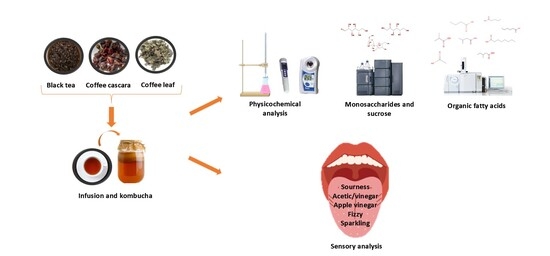
Foods, Vol. 15, Pages 2074: Changes in Short- and Medium-Chain Fatty Acids and Sugars During Kombucha Fermentation of Tea and Coffee Byproducts and Their Relation to Sourness Foods doi: 10.3390/foods15122074 Authors: Amanda Luísa Sales Marco Aurelio Dal Sasso Débora de Almeida Azevedo Alessandro Maia Verônica Calado Marco Antônio Lemos Miguel Adriana Farah Kombucha is traditionally produced by fermenting Camellia sinensis tea and sugar in a consortium of microorganisms called SCOBY (Symbiotic Culture Of Bacteria and Yeasts). Short- and medium-chain fatty acids and other organic acids in K are mainly produced by acetic acid bacteria, which contribute to the typical K taste. Coffee is one of the most widely consumed beverages in the world and one of the most traded commodities globally. Harvesting during coffee production generates tons of byproducts generally considered of low value, including cascara (CC), composed of dried pulp and skin, and leaves (CL). To date, few studies have investigated the production of short- and medium-chain fatty acids and monosaccharide’s profile during traditional kombucha fermentation, and their composition in kombuchas prepared from substrates other than C. sinensis is even scarcer. This study followed the changes in sugars and the production of short- and medium-chain fatty acids during K fermentation of black tea (BT), CC, and CL and associated their concentrations with physicochemical parameters (total soluble solids (TSS), pH, and titratable acidity (TA)) and the perceived acidity of the beverages evaluated by a trained panel and untrained consumers. BT K, a SCOBY, and 10% sucrose were added to infusions of arabica CC, CL, or BT. The mixture was fermented for 0, 3, 6, and 9 days. Organic acids were analyzed by GC-MS; sucrose and monosaccharides were analyzed by HPLC-RID. The Rate All That Apply (RATA) test was used for sensory analysis. Results were treated by ANOVA–Fisher and Pearson correlation tests with significance at p < 0.05. Glucose, fructose, arabinose, xylose, cellobiose and glycerol were identified in the infusions. On average, sucrose concentration decreased by 28% up to day 9, considering all K samples, accompanied by TSS decrease. Eight organic acids were semi-quantified, with acetic being the major acid in all beverages (8.4 to 1971 mg L−1) and isovaleric being the lead minor acid (0.7 to 17.7 mg L−1). Additional acids identified were: butanoic, 2-methylpropanoic, pentanoic, 3-methylpentanoic, hexanoic, and octanoic acids. TA values and sourness perceived by consumer assessors increased generally, even though in CC Ks, the acid concentration decreased by day 9. TA, sourness, and sparkling and fizzy mouthfeel correlated positively in all Ks. In general, although the total acid concentration was mainly higher on days 3 or 6, CO2 formation, among other organic acids, probably increased TA and sourness on day 9. Although it is generally accepted that pH and organic acid concentrations are directly associated with sour taste, it is not possible to accurately predict and modify sour taste intensity in kombucha based only on these parameters, given that other factors, such as the production of CO2, the existence of buffer systems, and the presence of sugars and other soluble solids, will probably affect the perceived acidity and sourness.
Foods, Vol. 15, Pages 2074: Changes in Short- and Medium-Chain Fatty Acids and Sugars During Kombucha Fermentation of Tea and Coffee Byproducts and Their Relation to Sourness